Least Weasel
Mustela nivalis
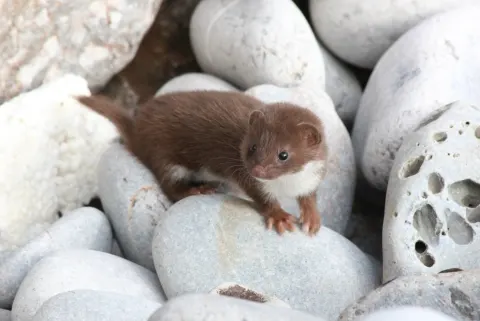
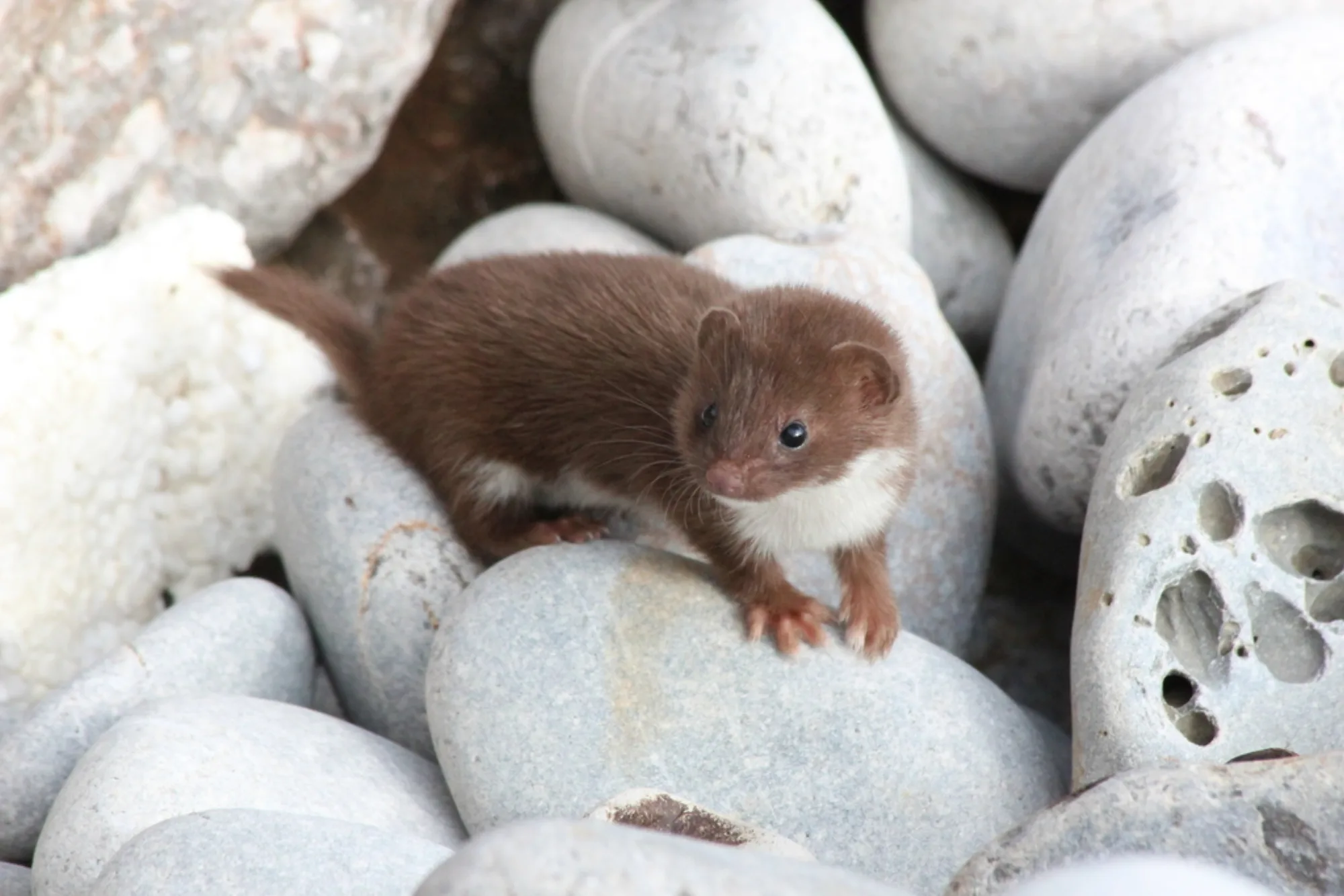
Small enough to pursue rodents into their tunnels, the Least Weasel has a long, slender body, short legs and a short tail. Its upper body and sides are usually brown, while its underparts are white, with a generally straight boundary between the colours. The tail is brown too, sometimes with a darker tip, but never a black one. In northern areas and at high elevations, the coat turns white for winter.
Native across Eurasia, North America and North Africa, it has also been introduced to islands including New Zealand, Malta and Crete. It lives in fields, open woodland, scrubby and rocky places, as well as parks and gardens, at elevations up to about 3,000 m. Rather than digging a den, it uses an abandoned burrow, where it sleeps, stores food and raises its young. Male territories can overlap several female ranges, and males use scent to mark them. The weasel hunts mostly mouse-like rodents, including mice and gerbils, and also takes rabbits, often young ones. It forages under cover to avoid foxes and birds of prey, sometimes chasing its quarry down tunnels or driving it into the open. Breeding takes place in spring and summer, with one litter of about six kits raised by the female alone. The family separates after 9 to 12 weeks. Foxes, stoats, owls, buzzards and some snakes prey on least weasels, while competition with stoats for rodents can also shape where they live and hunt. When rodent numbers are low, birds make up more of the diet and females may fail to breed.
Written from the English Wikipedia article Least weasel (CC BY-SA 4.0).
- Records
- 10,574
- Countries
- 13
No atlas park has a record of the Least Weasel in or around it yet.
These are open occurrence records, so they show where people looked for and recorded the Least Weasel as much as where it lives. Cells are up to 25 km across, and every location is generalised to its cell.
Generalised encounter areas, not exact locations. Each shape is a grid cell coloured by how likely the species is there.
- Very likelyFrance25 km zone · high confidence · 4105 records · updated 80 days ago
- Very likelySwitzerland25 km zone · medium confidence · 3729 records · updated 80 days ago
- Very likelyNorway25 km zone · medium confidence · 1131 records · updated 80 days ago
- Very likelyUnited Kingdom25 km zone · medium confidence · 563 records · updated 80 days ago
- Very likelyFinland25 km zone · high confidence · 431 records · updated 80 days ago
- Very likelyBelgium25 km zone · medium confidence · 352 records · updated 80 days ago
- Very likelyLiechtenstein25 km zone · medium confidence · 98 records · updated 80 days ago
- Very likelyEstonia25 km zone · medium confidence · 75 records · updated 80 days ago
- Very likelyAustria25 km zone · medium confidence · 31 records · updated 80 days ago
- Very likelyLuxembourg25 km zone · medium confidence · 30 records · updated 80 days ago
Conservation status not assessed here yet, so every location is generalised to its grid cell.