Black-footed Ferret
Mustela nigripes
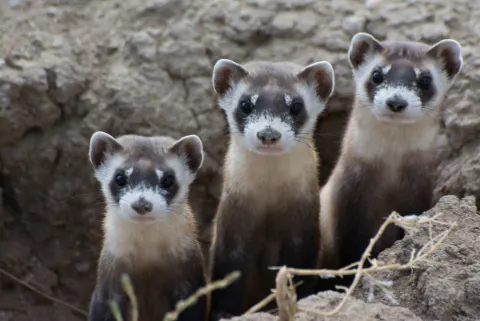
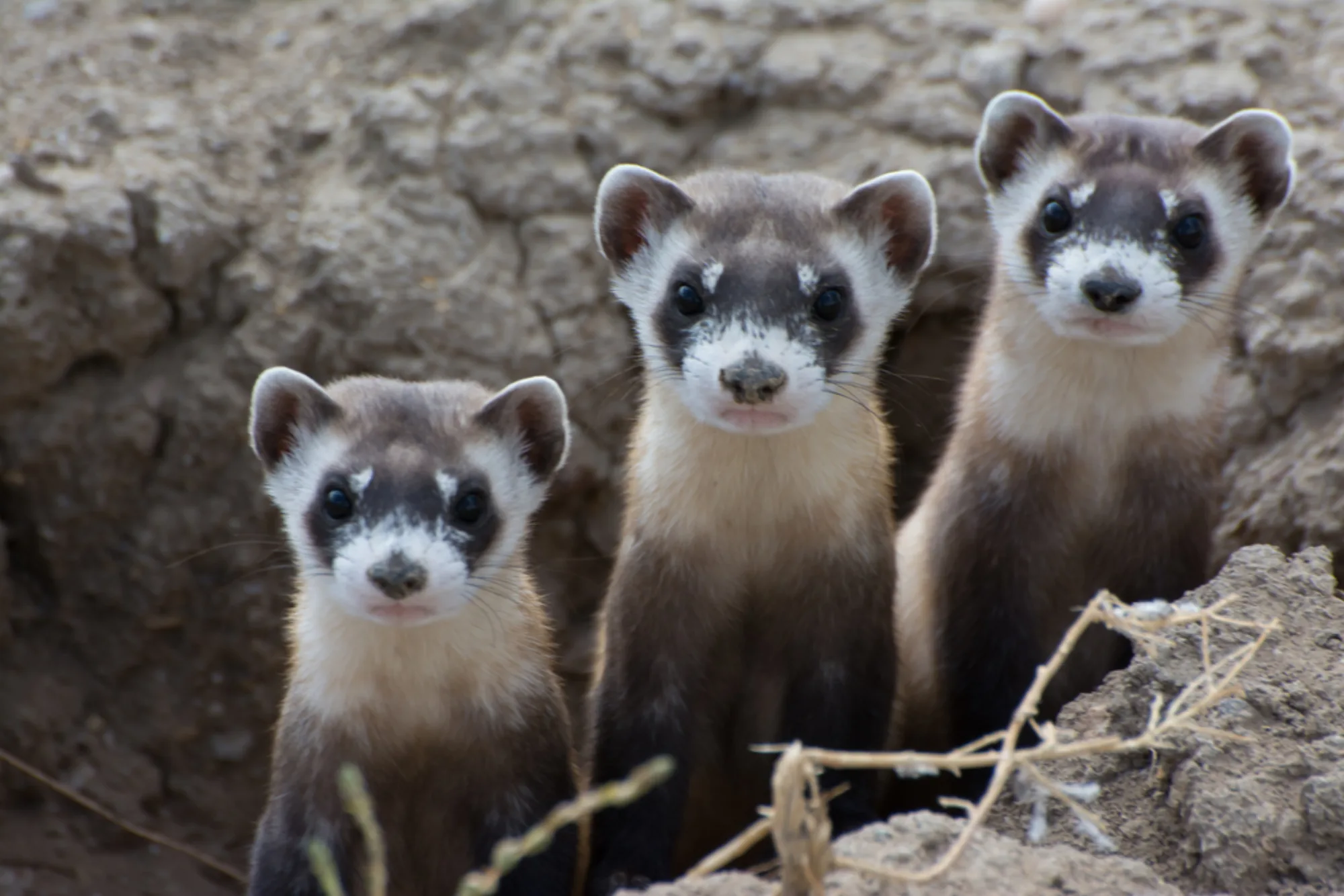
With a pale buff body, dark legs and a black mask across its eyes, the Black-footed Ferret is a distinctive prairie hunter. This slender member of the mustelid family is roughly the size of a mink, with short legs, a long neck and a black-tipped tail. Native to central North America, it has been reintroduced at sites in the western United States, Canada and Mexico. Its historical habitats ranged from shortgrass and mixed-grass prairie to shrub steppe, sagebrush steppe and mountain grassland. Prairie dog burrows provide shelter from predators and the weather, as well as places to raise young.
Mostly solitary and nocturnal, the ferret enters prairie dog burrows to hunt its sleeping prey. Above ground, it is busiest between dusk and midnight, then from 4 am until mid-morning; activity is greatest in late summer and early autumn, when young ferrets become independent. Prairie dogs make up as much as 90% of its diet, supplemented by small rodents and rabbits or hares. In May and June, females give birth to one to five kits in prairie dog burrows. The young first emerge above ground in July and stay under their mother's care for several months.
Loss of prairie dog habitat through agriculture, livestock use and development threatens the ferret's food supply and shelter. Poisoning used to control prairie dogs can also kill ferrets indirectly. Sylvatic plague can infect ferrets directly and wipe out the prairie dog colonies on which they feed. Captive breeding and reintroductions have helped restore wild populations, but as of 2026 only about 300 individuals live in the wild.
Written from the English Wikipedia article Black-footed ferret (CC BY-SA 4.0).
- Records
- 8
- Countries
- 2
- Atlas places
- 1
These are open occurrence records, so they show where people looked for and recorded the Black-footed Ferret as much as where it lives. Cells are up to 25 km across, and every location is generalised to its cell.
Generalised encounter areas, not exact locations. Each shape is a grid cell coloured by how likely the species is there.
- Very likelyCanada25 km zone · medium confidence · 6 records · updated 80 days ago
- LikelyUnited States25 km zone · medium confidence · 2 records · updated 80 days ago
Conservation status not assessed here yet, so every location is generalised to its grid cell.