European Mink
Mustela lutreola
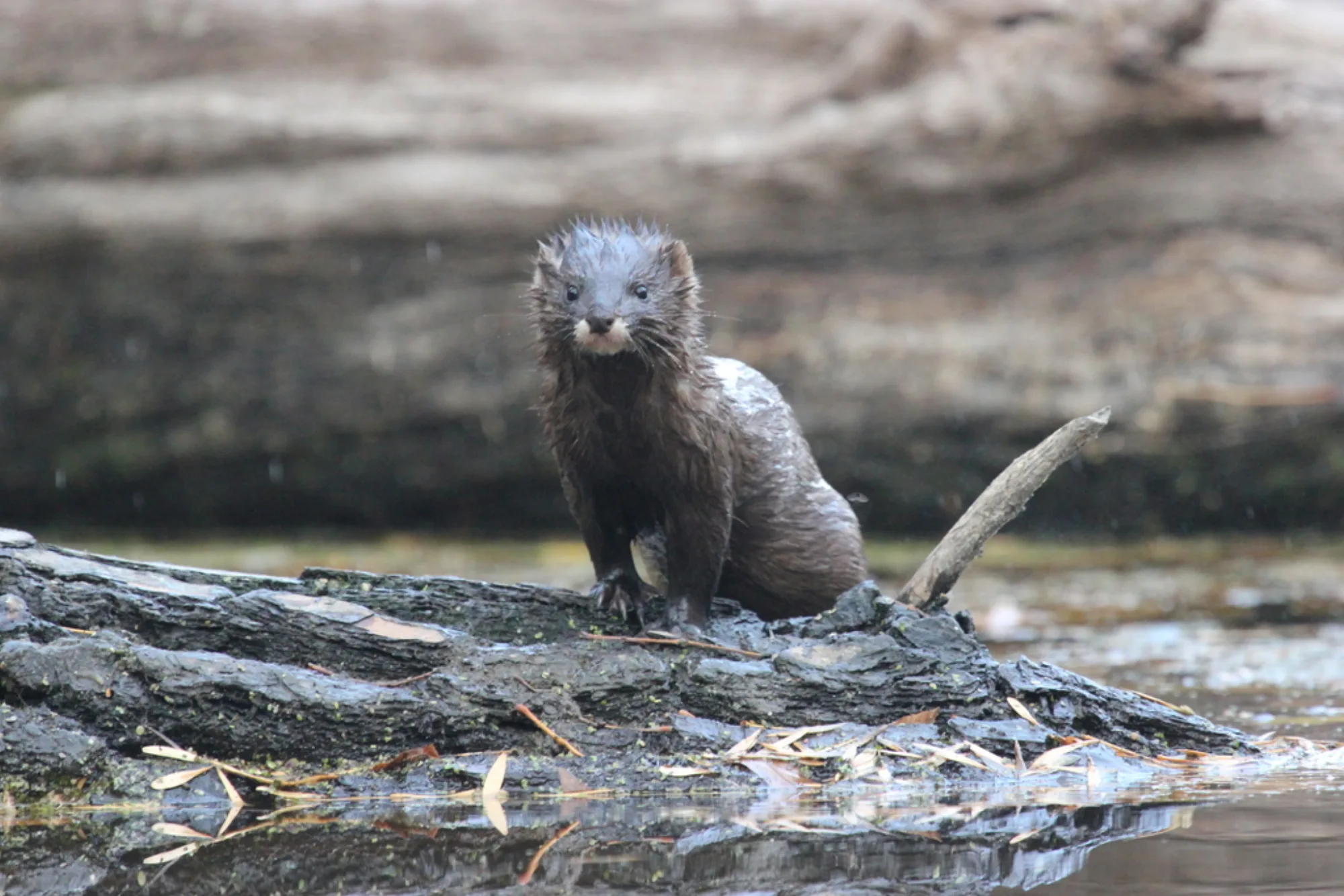
Along the banks of Europe's waterways, the European Mink moves on short legs beneath a long, compact body. Its broad head has short ears, and its short tail is less than half the length of its body. The coat ranges from reddish brown to almost blackish brown, with slightly darker legs and tail. White on both lips and the chin helps distinguish it from the American mink, which almost never has white on its upper lip. A skilful swimmer and diver, it can run along stream beds and remain underwater for one to two minutes.
This semiaquatic mammal favours forest streams that are unlikely to freeze in winter. One isolated population lives in western France and northern Spain, while the main range lies in Eastern Europe and includes the Danube Delta. It keeps a permanent burrow close to the water and also uses temporary shelters. In very cold weather it may stay in its burrow for long periods. Voles are its main food, with frogs, crustaceans and water insects close behind; in floodlands, fish are also important. When food is plentiful, it stores some for later. Litters average three to seven kits, which are born blind and later accompany their mother on hunts.
Mink numbers have fallen across much of the former range. Drainage of small rivers and damage to river ecosystems have been linked to declines, while competition and disease associated with introduced American mink may also play a part. A shortage of crayfish and interbreeding with the European polecat are among the other possible causes.
Written from the English Wikipedia article European mink (CC BY-SA 4.0).
- Records
- 374
- Countries
- 6
No atlas park has a record of the European Mink in or around it yet.
These are open occurrence records, so they show where people looked for and recorded the European Mink as much as where it lives. Cells are up to 25 km across, and every location is generalised to its cell.
Generalised encounter areas, not exact locations. Each shape is a grid cell coloured by how likely the species is there.
- Very likelySpain25 km zone · medium confidence · 230 records · updated 80 days ago
- Very likelyUkraine25 km zone · medium confidence · 82 records · updated 80 days ago
- LikelyFrance25 km zone · medium confidence · 47 records · updated 80 days ago
- LikelyGermany25 km zone · medium confidence · 15 records · updated 80 days ago
- PossibleUnited Kingdom25 km zone · low confidence · 0 records · updated 80 days ago
- UncommonRomania25 km zone · low confidence · 0 records · updated 80 days ago
Conservation status not assessed here yet, so every location is generalised to its grid cell.