Ferret
Mustela furo
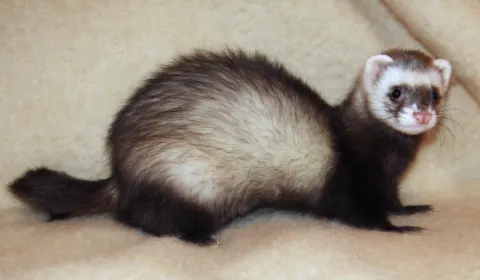
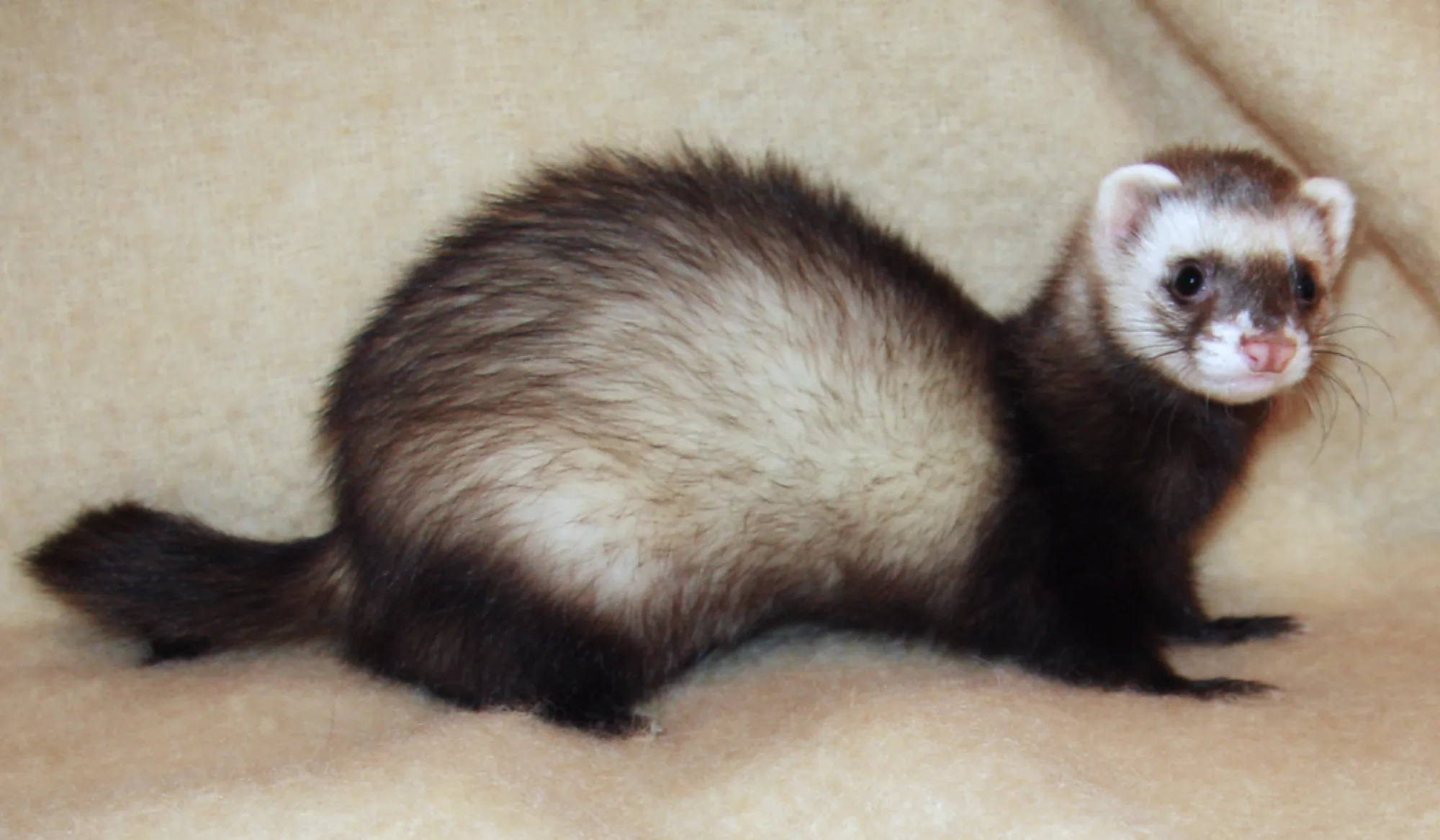
Long and slender, the Ferret (Mustela furo) is a small domesticated member of the mustelid family, most likely descended from the wild European polecat. Its average length, including the tail, is about 50 cm, and it weighs between 0.7 and 2.0 kg. Males are considerably larger than females, and their coats range from white to brown or black, sometimes combining these colours. Many have a dark mask and sable colouring, while albinos have white fur and pink eyes.
Ferrets are kept as pets, particularly in North America, and have also been bred to hunt rabbits. Feral colonies have established themselves in the Shetland Islands and remote parts of New Zealand, in areas without competition from similarly sized predators. Ferrets like to burrow and prefer to sleep somewhere enclosed. They sleep for 14 to 18 hours each day, with their busiest periods around dawn and dusk. Most live happily in social groups, although they are territorial. An excited ferret may invite play with sideways hops and leaps, sometimes accompanied by a soft clucking sound. Ferrets eat meat and need to feed frequently; some are given prey such as mice and rabbits. Females may have two or three litters a year, usually with three to seven young in each, and the young become independent at three months.
Common health problems include cancer of the adrenal glands, pancreas or lymphatic system, along with viral diseases such as canine distemper and influenza. Ferrets can also swallow objects that obstruct the bowel, while some coat patterns associated with white markings are linked to partial or total deafness.
Written from the English Wikipedia article Ferret (CC BY-SA 4.0).
- Records
- 179
- Countries
- 5
No atlas park has a record of the Ferret in or around it yet.
These are open occurrence records, so they show where people looked for and recorded the Ferret as much as where it lives. Cells are up to 25 km across, and every location is generalised to its cell.
Generalised encounter areas, not exact locations. Each shape is a grid cell coloured by how likely the species is there.
- Very likelyUnited Kingdom25 km zone · medium confidence · 123 records · updated 80 days ago
- Very likelyPortugal25 km zone · medium confidence · 45 records · updated 80 days ago
- LikelyNew Zealand25 km zone · medium confidence · 11 records · updated 80 days ago
- UncommonIsle of Man25 km zone · low confidence · 0 records · updated 80 days ago
Conservation status not assessed here yet, so every location is generalised to its grid cell.