Steppe Polecat
Mustela eversmanii
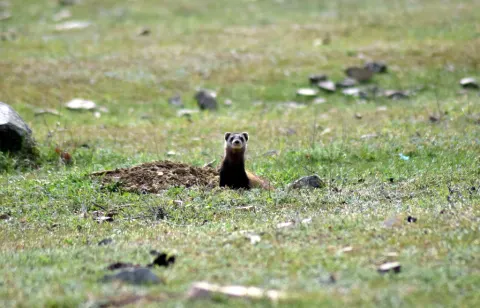
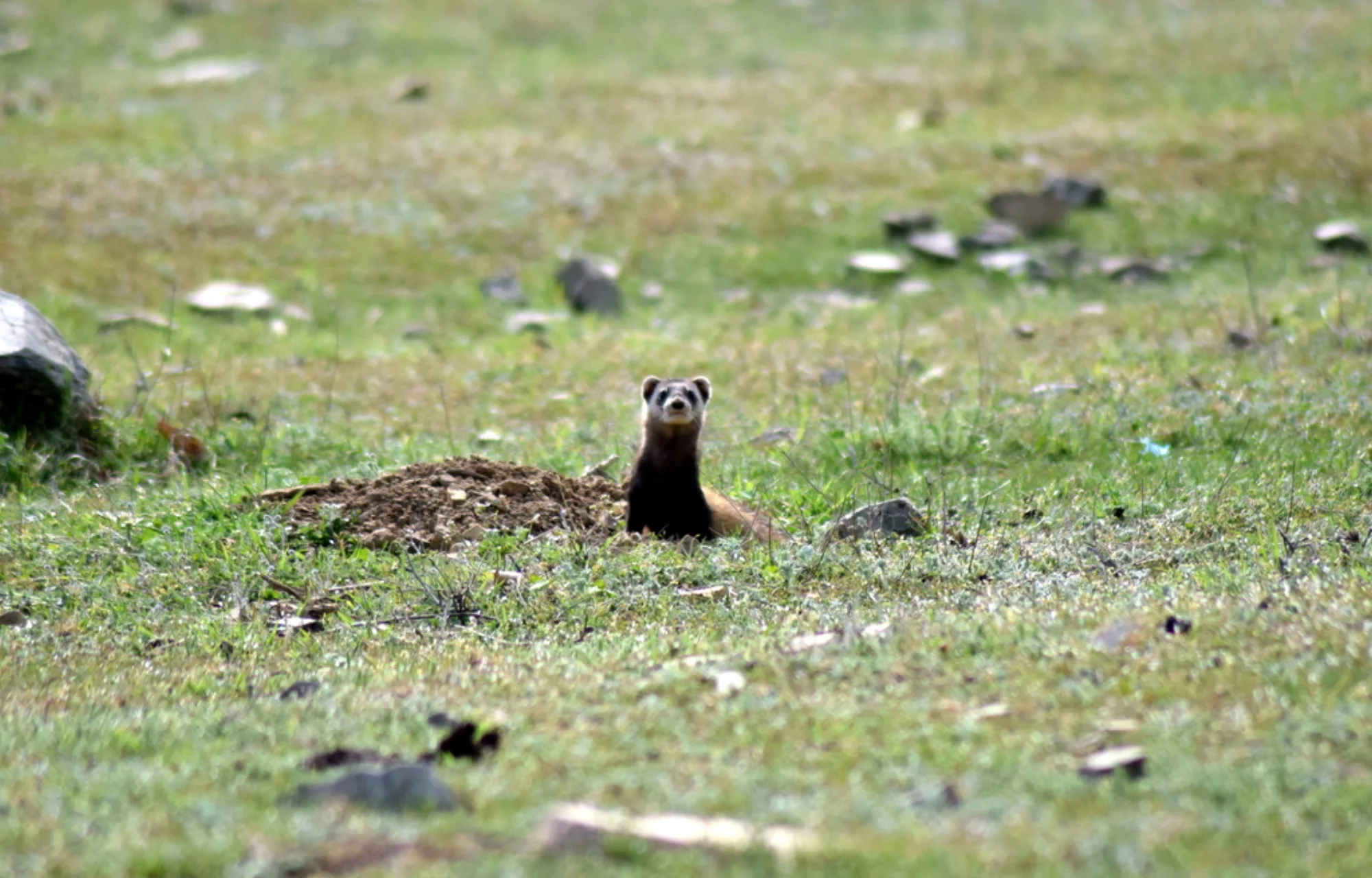
Pale yellow fur, dark legs and a dark mask across the face give the Steppe Polecat a distinctive appearance. This mustelid has a long-looking body and a short tail, with a dark brown tip. Its winter coat is soft and light, while the shorter summer coat has a stronger reddish or ochre tone. A white band crosses the head behind the mask, although some animals have an entirely white head.
Its range stretches from Central and Eastern Europe across parts of Central and East Asia, reaching Mongolia and northern and western China. It has also been recorded at 5,050 m in Nepal's Annapurna Conservation Area. The polecat moves through steppe landscapes and often uses the burrows of other animals for shelter, widening them when necessary. It usually stays in one area only until its prey becomes scarce, though females with nursing litters are more settled. In winter it becomes more active, travelling 12 to 18 km a day, and may move towards ravine slopes or settlements during heavy snowfall.
Ground squirrels form the mainstay of its diet year-round: it hunts them on the surface in warm weather and digs them out in autumn. Other prey includes pikas, hamsters and marmots that are young or injured, and it may feed chiefly on water voles where ground squirrels are absent. Females generally have litters of three to six kits, which stay in the family burrow for 2.0 to 2.5 months. Changes to steppe landscapes, ploughing and chemical rodent control have been linked to declines, partly through a reduction in natural prey. The species is also caught for the fur trade, often in traps placed near occupied burrows.
Written from the English Wikipedia article Steppe polecat (CC BY-SA 4.0).
- Records
- 6
- Countries
- 4
No atlas park has a record of the Steppe Polecat in or around it yet.
These are open occurrence records, so they show where people looked for and recorded the Steppe Polecat as much as where it lives. Cells are up to 25 km across, and every location is generalised to its cell.
Generalised encounter areas, not exact locations. Each shape is a grid cell coloured by how likely the species is there.
- Very likelyUkraine25 km zone · medium confidence · 6 records · updated 80 days ago
- PossibleHungary25 km zone · low confidence · 0 records · updated 80 days ago
- PossibleUnited States25 km zone · low confidence · 0 records · updated 80 days ago
- UncommonRomania25 km zone · low confidence · 0 records · updated 80 days ago
Conservation status not assessed here yet, so every location is generalised to its grid cell.