Stoat
Mustela erminea
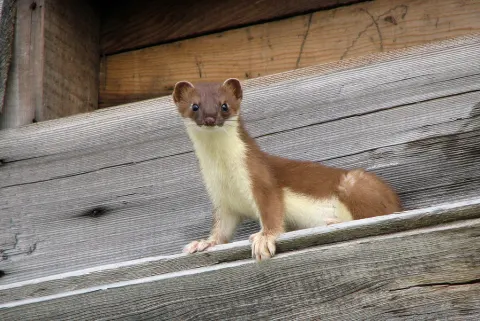
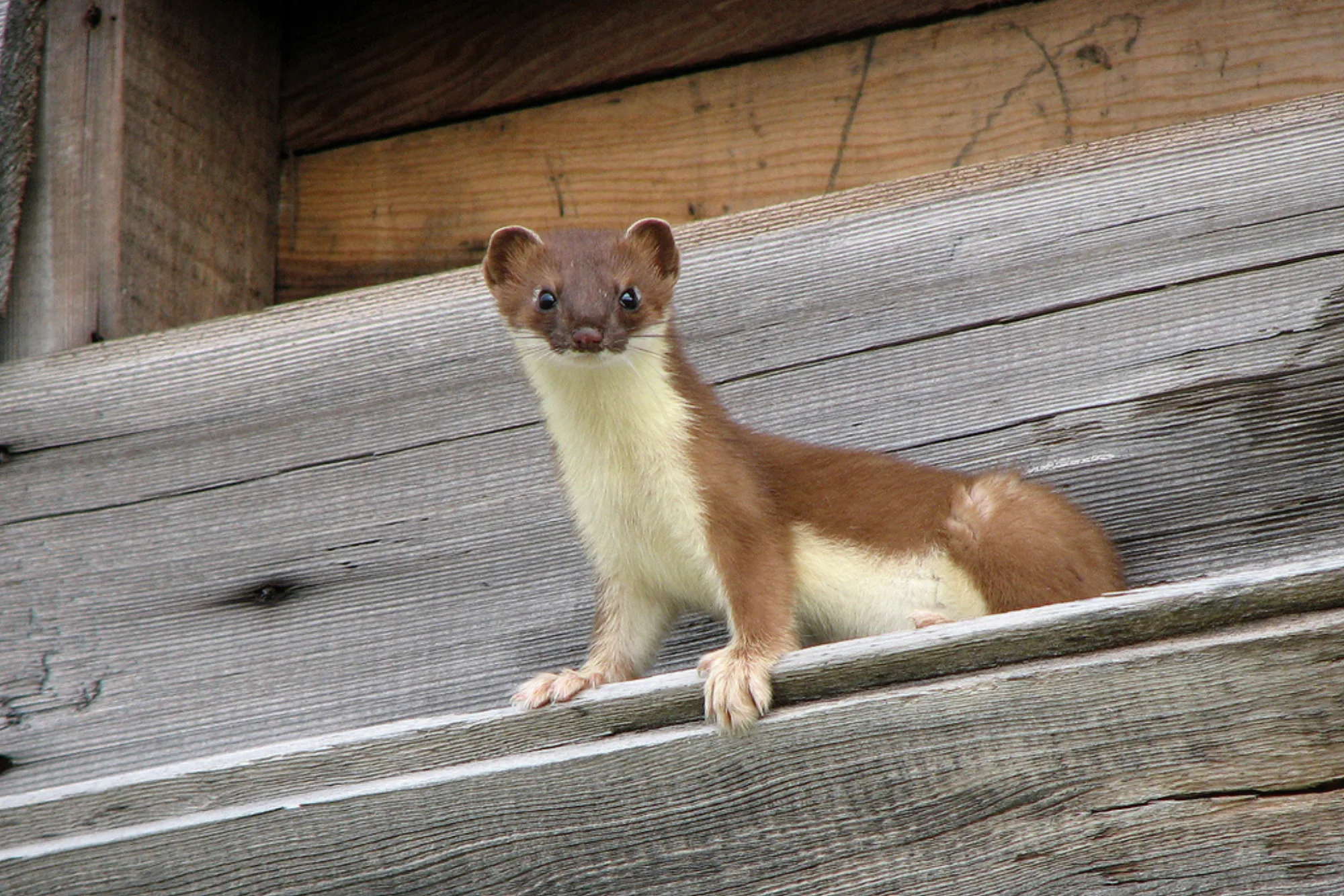
A long body, rounded ears and a black-tipped tail give the Stoat (Mustela erminea) a distinctive outline. In summer its head and back are sandy brown, with white fur underneath. In the northern part of its range, its winter coat turns white apart from the tail tip, while farther south it stays brown and becomes denser. Males are larger than females, with an average body length of 187 to 325 mm, compared with 170 to 270 mm for females.
Stoats range across Europe, Asia and northern North America, from sea level to 3,000 m. They use a variety of shelters, including rotting stumps, tree roots, rock piles and burrows taken from rodents they have killed. Each animal has several dens within its range, and males and females usually live separately but near one another. Stoats move quickly as they search burrows and crevices for food, and climb trees to reach birds' nests. Small rodents make up much of their diet, although they also take rabbits and other prey larger than themselves. When food is abundant, they may store surplus kills for later.
Young are born in spring after a lengthy delay in development, and their mother raises them without help from the male. The kits begin eating solid food after four weeks and open their eyes at five to six weeks. Stoats can fall prey to red foxes, sables and a range of birds, including owls and buzzards. Disease and parasites also affect them: tuberculosis has been recorded, and one parasitic worm can damage the bones around the nose and reduce fertility. Stoats are also captured for their pelts, with their winter fur particularly prized.
Written from the English Wikipedia article Stoat (CC BY-SA 4.0).
- Records
- 56,049
- Countries
- 12
No atlas park has a record of the Stoat in or around it yet.
These are open occurrence records, so they show where people looked for and recorded the Stoat as much as where it lives. Cells are up to 25 km across, and every location is generalised to its cell.
Generalised encounter areas, not exact locations. Each shape is a grid cell coloured by how likely the species is there.
- Very likelySwitzerland25 km zone · high confidence · 32365 records · updated 80 days ago
- Very likelyFrance25 km zone · medium confidence · 18424 records · updated 80 days ago
- Very likelyNorway25 km zone · medium confidence · 3136 records · updated 80 days ago
- Very likelyUnited Kingdom25 km zone · medium confidence · 844 records · updated 80 days ago
- Very likelyGermany25 km zone · medium confidence · 516 records · updated 80 days ago
- Very likelyItaly25 km zone · high confidence · 249 records · updated 80 days ago
- Very likelyFinland25 km zone · high confidence · 202 records · updated 80 days ago
- Very likelyAustria25 km zone · medium confidence · 104 records · updated 80 days ago
- Very likelyLuxembourg25 km zone · high confidence · 85 records · updated 80 days ago
- Very likelyBelgium25 km zone · medium confidence · 52 records · updated 80 days ago
Conservation status not assessed here yet, so every location is generalised to its grid cell.