Hazel Dormouse
Muscardinus avellanarius
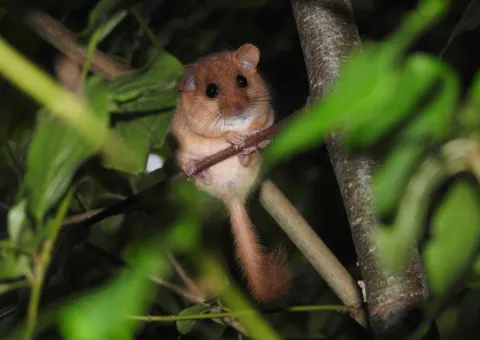
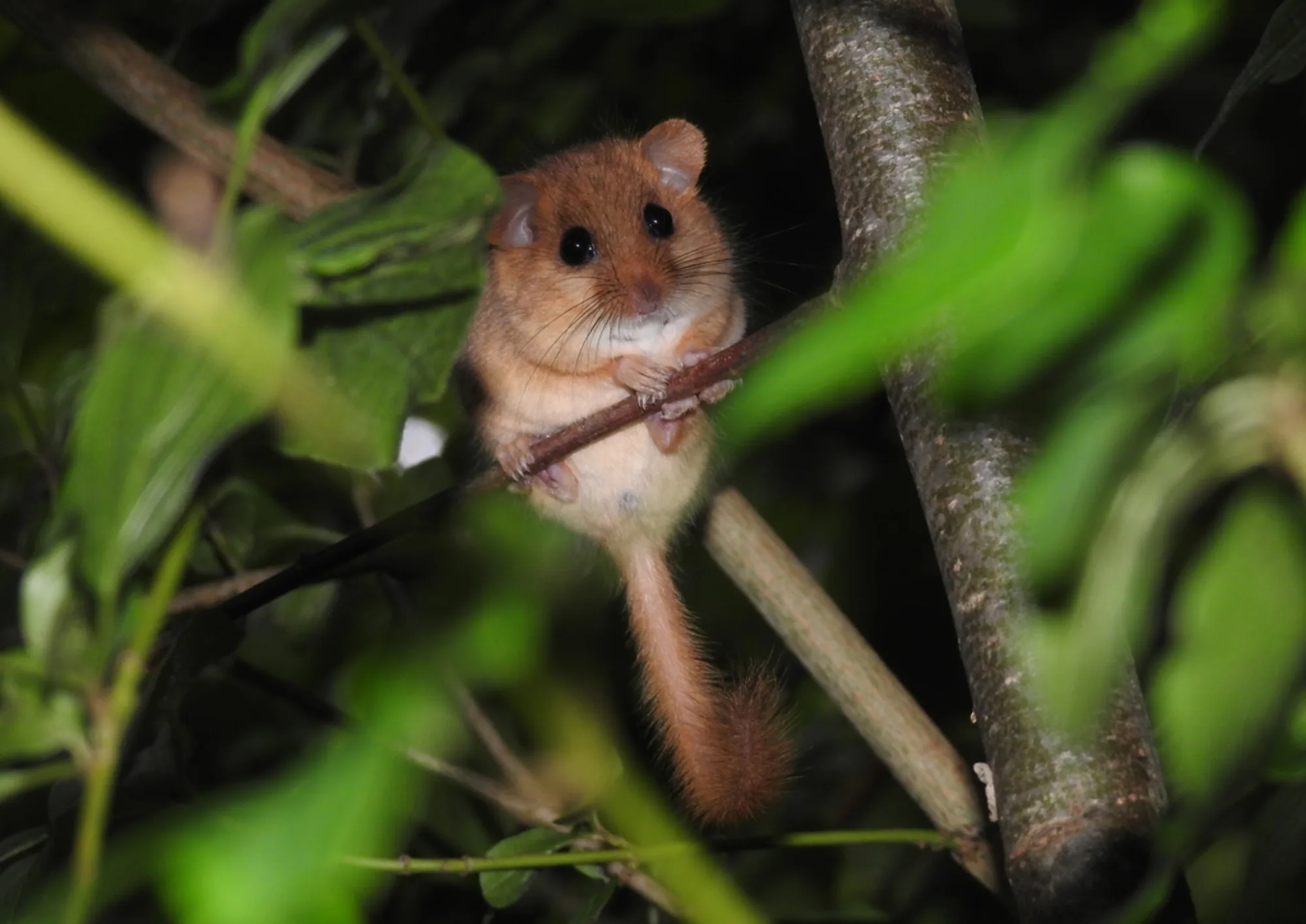
With large black eyes, small ears and a long, furry tail, the Hazel Dormouse is a small nocturnal mammal with reddish brown fur that can shade towards golden or yellow-orange brown, becoming lighter underneath. Its body measures 6 to 9 cm, while its furry tail adds another 5.7 to 7.5 cm. Found across northern Europe and Asia Minor, it lives mainly in woodland, especially deciduous woodland, as well as hedgerows and scrub. It was also discovered in County Kildare in Ireland in 2010, where it appears to be spreading.
At night, the dormouse spends much of its waking time searching for food among branches, often taking long detours to avoid coming down to the ground. It eats berries, nuts and other fruit, as well as buds, flowers and insects such as aphids and caterpillars. Hazelnuts help it gain weight before hibernation, when it sleeps in ground-level nests from October to April or May. These winter nests may lie beneath piles of leaves or logs, or among the bases of hazel stools and old coppiced trees. In spring it weaves nests in the undergrowth from honeysuckle bark, fresh leaves and grasses. Cold, wet weather and scarce food can send it into a curled-up sleep called torpor, which saves energy.
Woodland loss and changes in woodland management threaten the species, alongside a warming climate. Deforestation, hedge-trimming and competition from other animals can reduce or eliminate its food sources. Predators include foxes, weasels, owls and domestic cats, while badgers often disturb or dig up dormice during hibernation.
Written from the English Wikipedia article Hazel dormouse (CC BY-SA 4.0).
- Records
- 13,208
- Countries
- 11
No atlas park has a record of the Hazel Dormouse in or around it yet.
These are open occurrence records, so they show where people looked for and recorded the Hazel Dormouse as much as where it lives. Cells are up to 25 km across, and every location is generalised to its cell.
Generalised encounter areas, not exact locations. Each shape is a grid cell coloured by how likely the species is there.
- Very likelySwitzerland25 km zone · high confidence · 5945 records · updated 80 days ago
- Very likelyUnited Kingdom25 km zone · high confidence · 2511 records · updated 80 days ago
- Very likelyFrance25 km zone · high confidence · 2262 records · updated 80 days ago
- Very likelyLuxembourg25 km zone · high confidence · 1385 records · updated 80 days ago
- Very likelyDenmark25 km zone · high confidence · 517 records · updated 80 days ago
- Very likelyGermany25 km zone · high confidence · 360 records · updated 80 days ago
- Very likelyBelgium25 km zone · high confidence · 77 records · updated 80 days ago
- Very likelyIreland25 km zone · medium confidence · 56 records · updated 80 days ago
- Very likelyAustria25 km zone · medium confidence · 37 records · updated 80 days ago
- LikelyItaly25 km zone · medium confidence · 58 records · updated 80 days ago
Conservation status not assessed here yet, so every location is generalised to its grid cell.