Reeves' Muntjac
Muntiacus reevesi
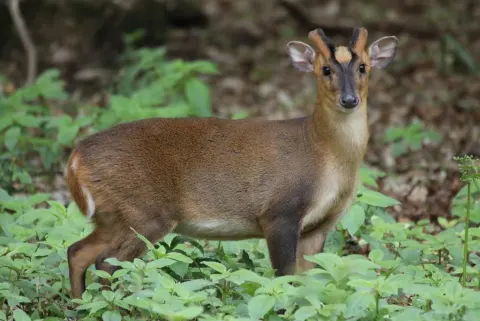
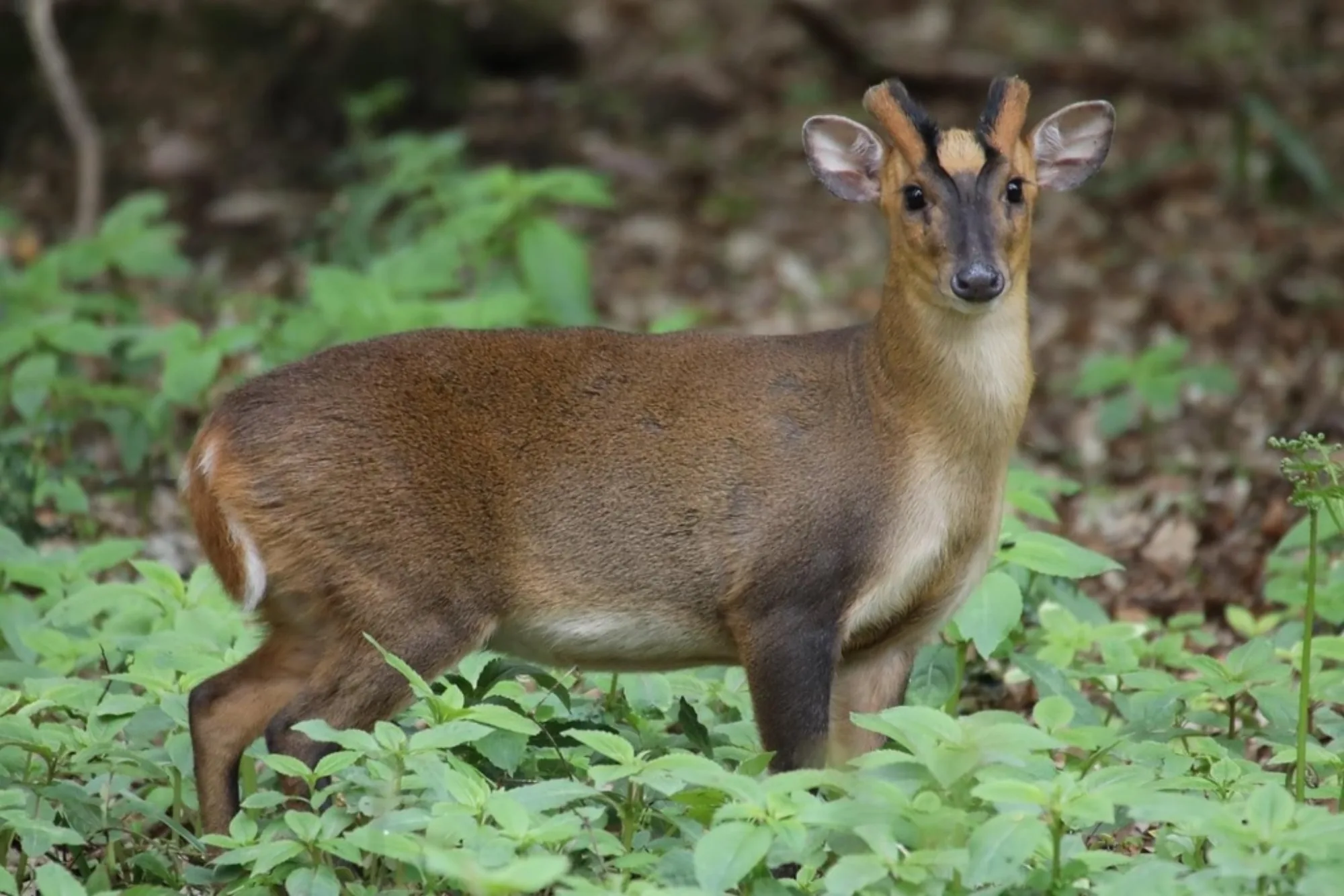
Small and reddish-brown, the Reeves' Muntjac has striped facial markings and a creamy-white belly, with paler fur extending to its neck, chin and the underside of its tail. An adult stands up to 0.5 m at the shoulder, measures 0.95 m in length and weighs 10 to 18 kg. Males have short antlers and long upper canine teeth, while females have bony lumps and black spots on their foreheads. The Taiwanese subspecies is darker than other subspecies. Its distinctive bark is often heard during mating or when the animal is provoked.
The species favours forest and shrubland, and is widespread across Taiwan and south-eastern China, ranging between Gansu and Yunnan. Introduced populations occur in Japan and several European countries, including Belgium, Ireland, the Netherlands and the United Kingdom. In England, colonies occur south of the Humber. Solitary and active at twilight, muntjacs defend small territories, with both sexes marking them using secretions from glands near their eyes. They eat herbs, blossoms, shoots, fungi, berries, grasses and nuts, and have also been reported eating tree bark. Eggs and carrion are taken opportunistically. Mating takes place throughout the year, and females become sexually mature within their first year. Gestation lasts 209 to 220 days.
In the Republic of Ireland, concern about the species becoming established led to a year-round hunting season. An eradication effort on Japan's Izu Ōshima followed damage to local ashitaba plantations, but the effort failed. Muntjac skin is occasionally used in products including musical instruments and packaging, and its meat is also valued for food.
Written from the English Wikipedia article Reeves's muntjac (CC BY-SA 4.0).
- Records
- 20,810
- Countries
- 7
No atlas park has a record of the Reeves' Muntjac in or around it yet.
These are open occurrence records, so they show where people looked for and recorded the Reeves' Muntjac as much as where it lives. Cells are up to 25 km across, and every location is generalised to its cell.
Generalised encounter areas, not exact locations. Each shape is a grid cell coloured by how likely the species is there.
- Very likelyUnited Kingdom25 km zone · high confidence · 16809 records · updated 80 days ago
- Very likelyChina25 km zone · high confidence · 3611 records · updated 80 days ago
- Very likelyJapan25 km zone · high confidence · 225 records · updated 80 days ago
- LikelyBelgium25 km zone · medium confidence · 42 records · updated 80 days ago
- PossibleTaiwan25 km zone · medium confidence · 113 records · updated 80 days ago
- PossibleDenmark25 km zone · medium confidence · 7 records · updated 80 days ago
- PossibleUnited States25 km zone · medium confidence · 3 records · updated 80 days ago
Conservation status not assessed here yet, so every location is generalised to its grid cell.