Fea's Muntjac
Muntiacus feae
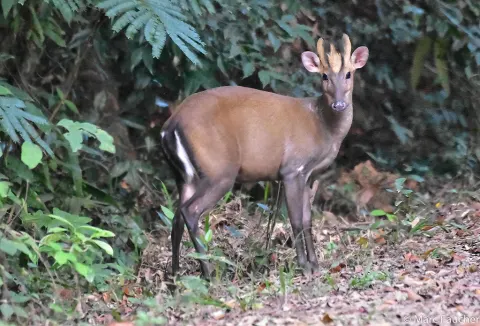
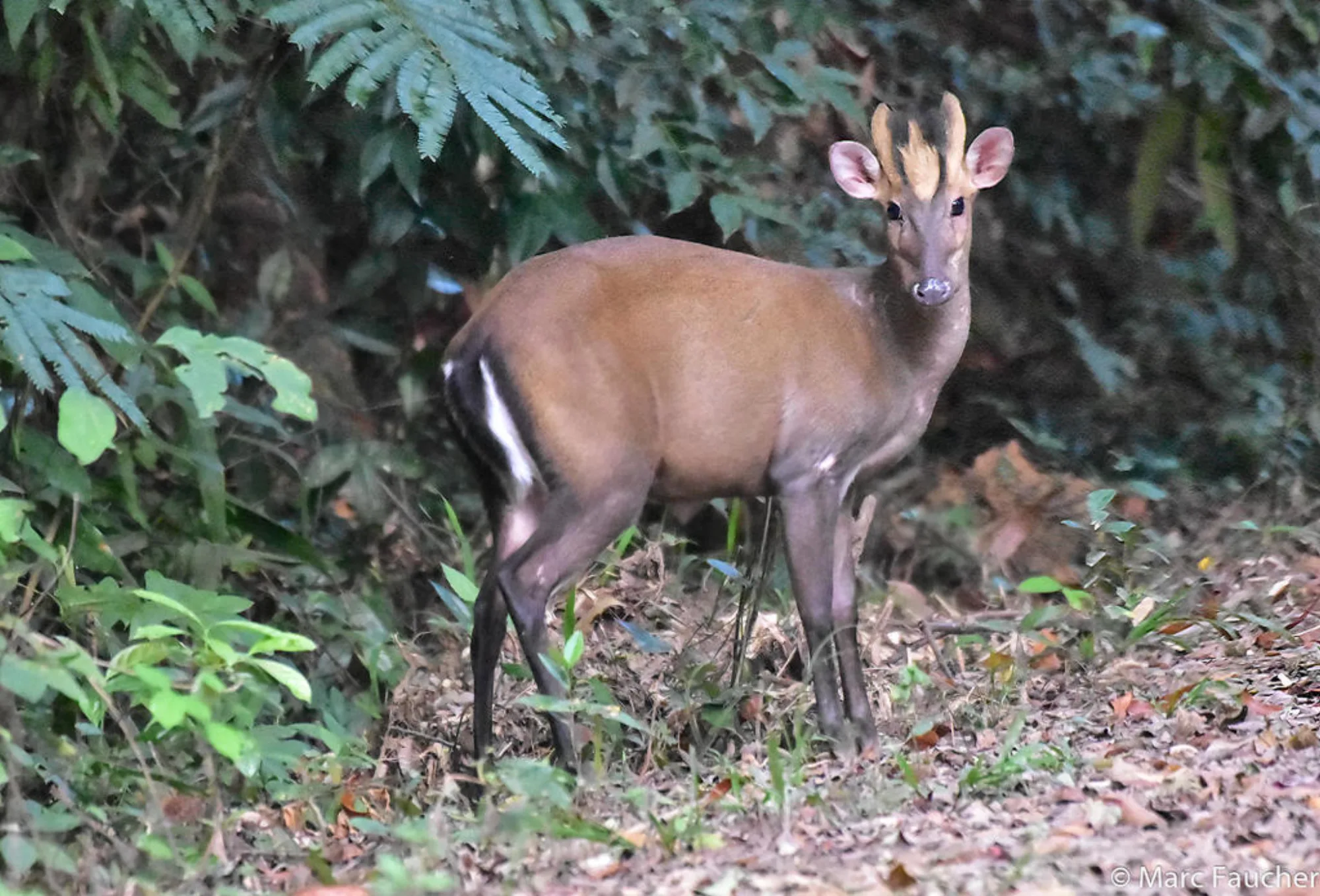
This small deer, often called the Tenasserim muntjac, weighs about 25kg and reaches a length of 88cm. You can identify the Fea's muntjac by its dark orange, brown, or gray coat, which contrasts with its black limbs and tail. Look for a distinctive triangular patch of light yellow on the forehead, with darker fur running from the snout to the glands beneath the eyes. Two black stripes also mark the area below its horns. While it resembles the red muntjac in size, its black tail helps a traveller tell them apart.
Native to the border regions of Thailand and Myanmar, these animals prefer the cover of evergreen forests. They appear to be more common in wet areas than in drier woodlands. Because they are shy and generally solitary, most of what we know about their distribution comes from sightings on camera traps. These deer are likely omnivorous, though they have been observed specifically eating leaves and fruit. They may possess a highly developed sense of smell, which likely helps them navigate their dense habitat.
Several factors make life difficult for this species. In Myanmar, they are hunted for food and face the loss of their homes as forests are cleared for rubber and palm oil plantations or logging. In Thailand, small captive groups suffer from high levels of inbreeding, and there are fewer than three breeding pairs in captivity. Some researchers also believe that unusual genetic traits in the Fea's muntjac might cause reproductive problems. While those living in high altitude Thai forests enjoy more stable habitats, the overall lack of data on their numbers remains a concern for their future.
Written from the English Wikipedia article Fea's muntjac (CC BY-SA 4.0).
- Records
- 3
- Countries
- 1
- Atlas places
- 0
These are open occurrence records, so they show where people looked for and recorded the Fea's Muntjac as much as where it lives. Cells are up to 25 km across, and every location is generalised to its cell.
Generalised encounter areas, not exact locations. Each shape is a grid cell coloured by how likely the species is there.
- Very likelyThailand25 km zone · medium confidence · 3 records · updated 4 days ago
Conservation status not assessed here yet, so every location is generalised to its grid cell.