Grey Mullet
Mugil cephalus
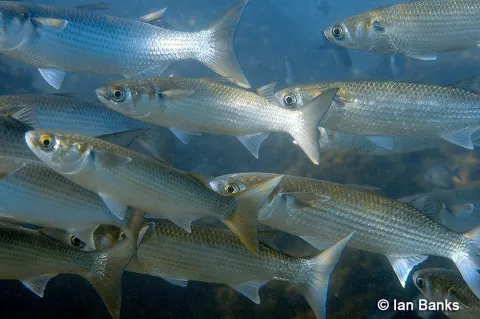
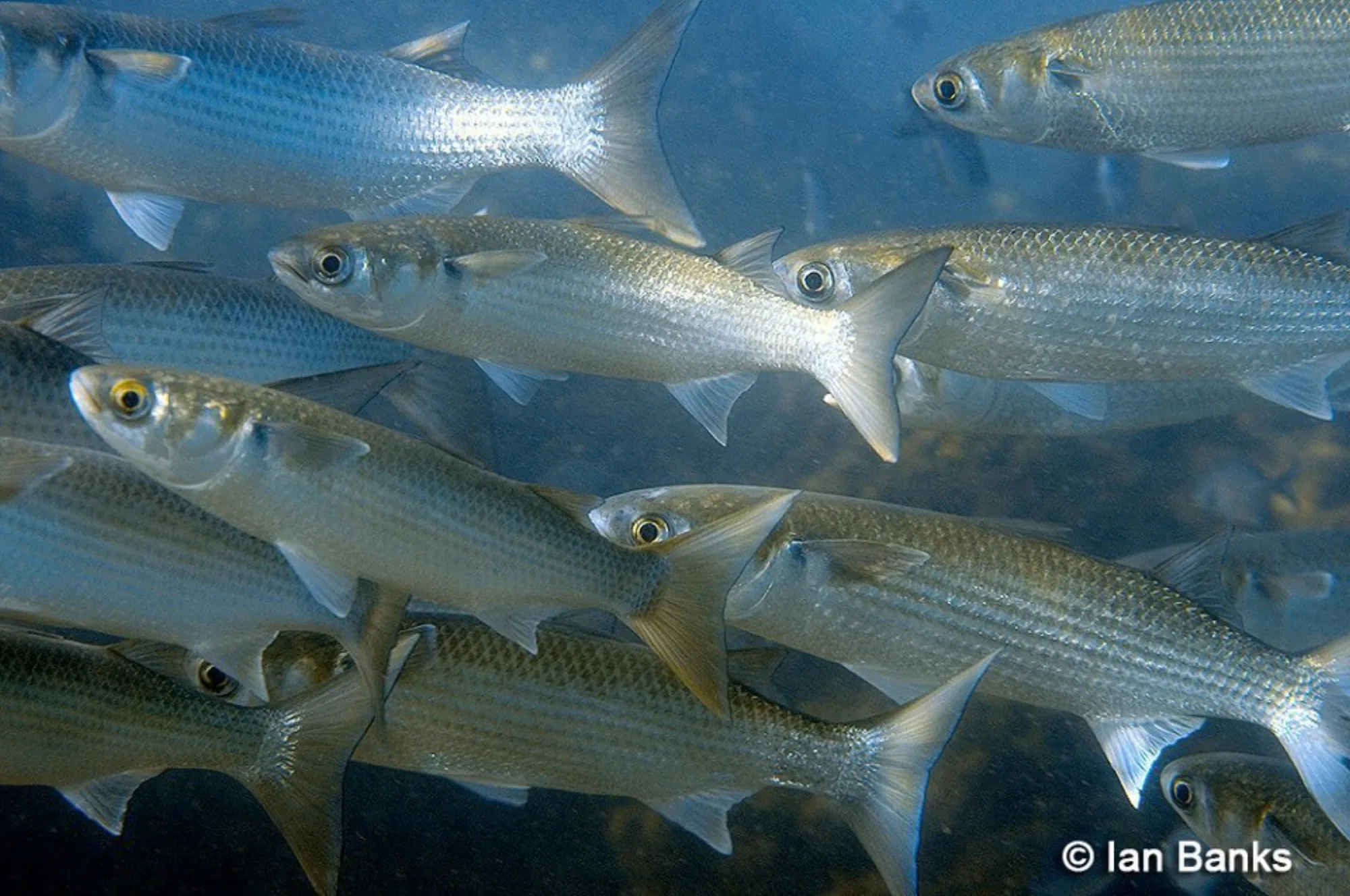
Silvery sides, an olive-green back and a pale belly give the Grey Mullet a distinctive appearance in coastal waters. Some have six or seven horizontal stripes along their sides, and their lips are thin. Usually measuring 30 to 75 centimetres, this food fish can reach 100 cm in length and weigh up to 8 kg. Also called the flathead grey mullet and striped mullet, it belongs to the mullet family.
The species lives in temperate, subtropical and tropical coastal waters worldwide, with its northern Atlantic range extending to Nova Scotia and the Bay of Biscay. It uses marine, brackish and fresh water, occurring in estuaries, the lower reaches of rivers, lagoons and lakes. In Australia, its range extends from Far North Queensland around the south to the Kimberley region of Western Australia, and includes the Bass Strait area of Tasmania. It can adjust to a wide range of salinity and has been recorded at depths from 0 to 120 metres.
Grey Mullet are mainly active by day and often gather in schools above sandy or muddy bottoms. They eat zooplankton, dead plant material, microalgae and detritus, while adults normally feed on algae in fresh water. Although they can travel far into estuaries, they return to the sea to spawn. The fish is caught and farmed for food around the world, and its roe is prepared as a speciality in several countries. In Arizona, dams and reduced water flow towards the Gulf of California have restricted its range, and its population is declining when the Colorado River fails to reach the gulf.
Written from the English Wikipedia article Flathead grey mullet (CC BY-SA 4.0).
- Records
- 111,332
- Countries
- 15
- Atlas places
- 6
These are open occurrence records, so they show where people looked for and recorded the Grey Mullet as much as where it lives. Cells are up to 25 km across, and every location is generalised to its cell.
Generalised encounter areas, not exact locations. Each shape is a grid cell coloured by how likely the species is there.
- Very likelyUnited States25 km zone · high confidence · 99684 records · updated 80 days ago
- Very likelyAustralia25 km zone · high confidence · 7573 records · updated 80 days ago
- Very likelyMozambique25 km zone · high confidence · 2177 records · updated 80 days ago
- Very likelySpain25 km zone · high confidence · 606 records · updated 80 days ago
- Very likelyFrance25 km zone · high confidence · 330 records · updated 80 days ago
- Very likelyMexico25 km zone · high confidence · 257 records · updated 80 days ago
- Very likelyTaiwan25 km zone · medium confidence · 250 records · updated 80 days ago
- Very likelyGreece25 km zone · high confidence · 129 records · updated 80 days ago
- Very likelySouth Africa25 km zone · medium confidence · 104 records · updated 80 days ago
- Very likelyJapan25 km zone · medium confidence · 68 records · updated 80 days ago
Conservation status not assessed here yet, so every location is generalised to its grid cell.