Grey Wagtail
Motacilla cinerea
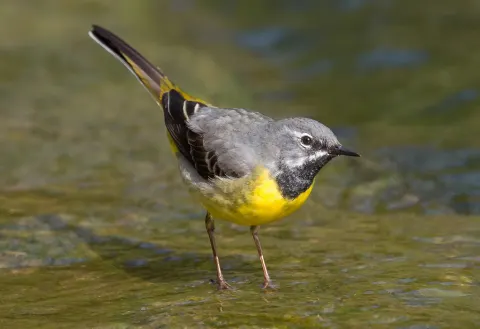
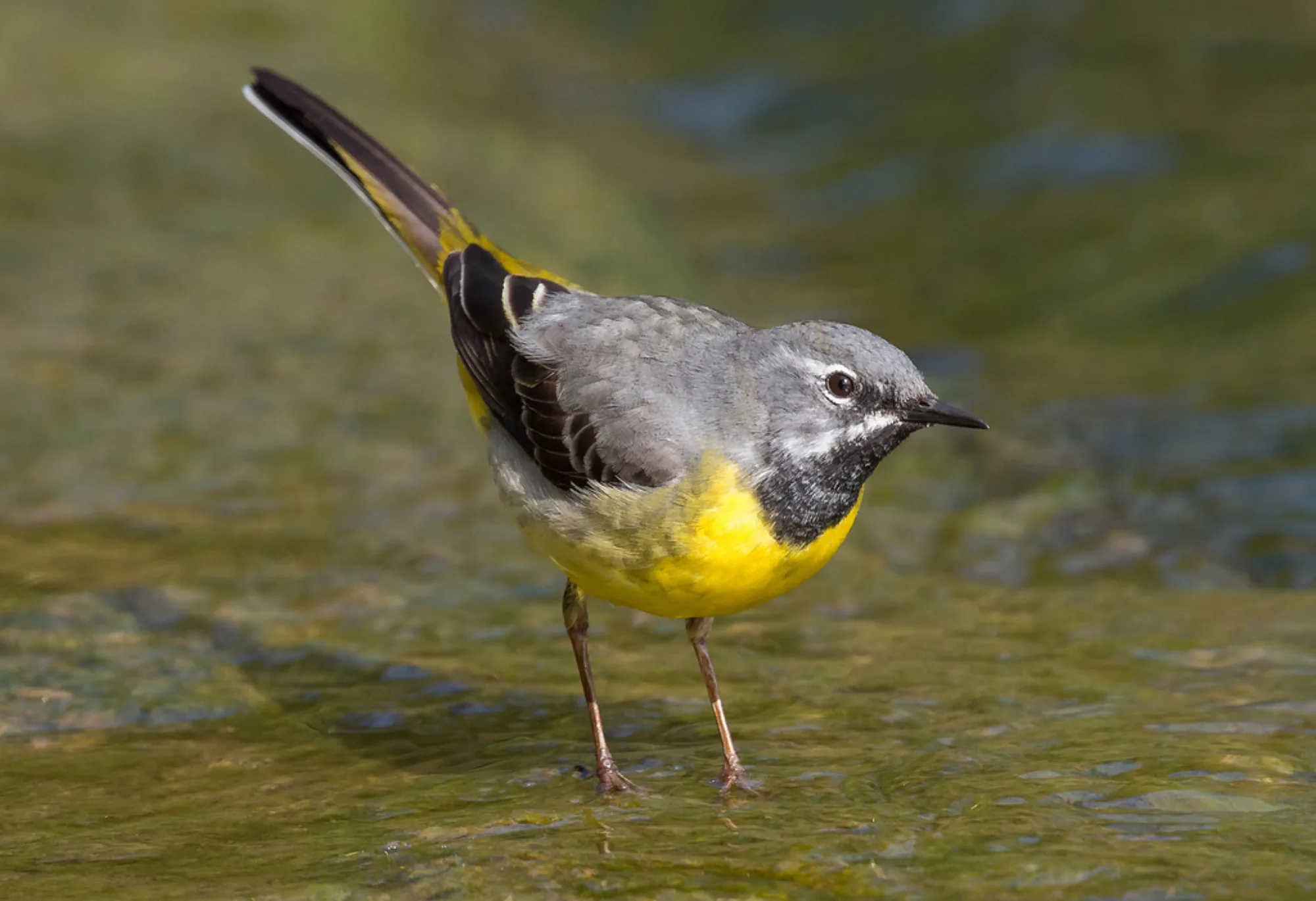
Look for the Grey Wagtail beside running water, where its slim shape, long, frequently wagged tail and flashes of yellow make it distinctive. Around 18 to 19 cm long, it has grey upperparts, whitish underparts and yellow around the throat and vent. A narrow white stripe above the eye and a broken eye ring add to its markings, while breeding males have a black throat edged with whitish stripes. Its flight is low and undulating, often accompanied by a sharp call.
The species ranges widely across Europe and Asia, with island populations in the Azores, Madeira and Canary Islands. Several populations breed across Eurosiberia and migrate to tropical parts of Asia and Africa, while birds breeding in northeastern Asia winter in Southeast Asia. During breeding it stays close to running water, but at other times it can also be found around lakes, coasts and other wet places. It searches for food alone or in pairs in meadows and shallow marshes, uses rocks in the water and often perches in trees. Its prey includes aquatic invertebrates such as flies, mayflies, beetles, crustaceans and molluscs. In winter, birds often forage along roadsides and roost in small groups; some return to the same winter site each year, sometimes a small urban garden.
From April to July, nests are placed near fast streams or rivers, among stones and roots in an embankment. In Europe, holes in human-made structures are also often used. A clutch contains 3 to 6 speckled eggs, and a pair may raise several broods. Eggs or chicks are sometimes taken by predators, the main cause of breeding failure, while kestrels may prey on the birds and common cuckoos sometimes lay their eggs in wagtail nests.
Written from the English Wikipedia article Grey wagtail (CC BY-SA 4.0).
- Records
- 491,448
- Countries
- 27
- Atlas places
- 5
These are open occurrence records, so they show where people looked for and recorded the Grey Wagtail as much as where it lives. Cells are up to 25 km across, and every location is generalised to its cell.
Generalised encounter areas, not exact locations. Each shape is a grid cell coloured by how likely the species is there.
- Very likelyTaiwan25 km zone · high confidence · 115077 records · updated 80 days ago
- Very likelyUnited Kingdom25 km zone · high confidence · 84453 records · updated 80 days ago
- Very likelyIndia25 km zone · high confidence · 61667 records · updated 80 days ago
- Very likelyBelgium25 km zone · high confidence · 49270 records · updated 80 days ago
- Very likelyNorway25 km zone · high confidence · 44145 records · updated 80 days ago
- Very likelySpain25 km zone · high confidence · 43524 records · updated 80 days ago
- Very likelyPortugal25 km zone · high confidence · 32163 records · updated 80 days ago
- Very likelyFrance25 km zone · high confidence · 19616 records · updated 80 days ago
- Very likelyHong Kong SAR China25 km zone · high confidence · 4012 records · updated 80 days ago
- Very likelyChina25 km zone · high confidence · 3667 records · updated 80 days ago
Conservation status not assessed here yet, so every location is generalised to its grid cell.