White Wagtail
Motacilla alba
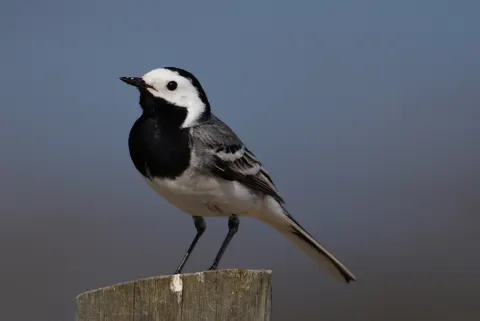
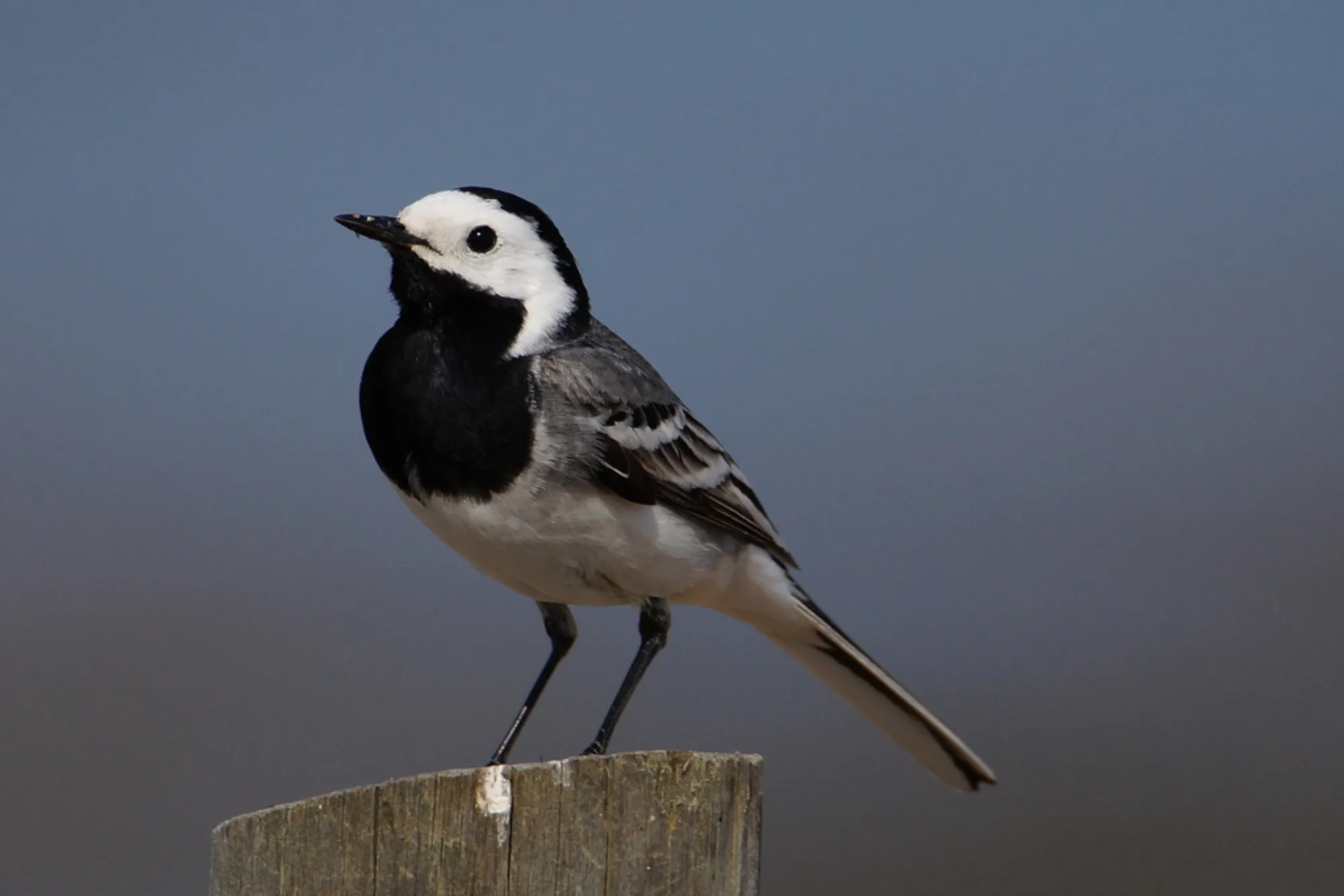
A slender bird with a long, almost constantly wagging tail, the White Wagtail measures 16.5 to 19 cm, with some East Asian forms reaching 21 cm. Its appearance varies across its range: the pied wagtail, common in Britain and Ireland, has a black back in males and a dark grey back in females and young birds. Listen for its sharp chissick call as it moves through open country, often close to water or buildings.
White Wagtails breed across much of Europe and Asia, in parts of North Africa and, more rarely, in western Alaska. They occupy many habitats but are absent from deserts, and favour bare ground where they can spot and chase prey. In towns and cities, they also feed on paved surfaces, including car parks. Birds stay year-round in milder areas, while many others migrate: those breeding in northern Europe spend the colder months near the Mediterranean or farther south in Africa's tropical and subtropical regions. Their food varies by location, but mainly consists of insects and other small invertebrates, including flies, beetles, spiders and worms.
Pairs defend breeding territories, and for most birds the season runs from April to August, starting later in the north. Both sexes build a nest, usually in a hole or crevice, including sites in riverbanks, walls, bridges and buildings. Both parents incubate the eggs and feed the chicks, which leave the nest after 12 to 15 days and receive food for another week. People catch White Wagtails for sport and collections, keep them as cagebirds and eat them, while climate change may be affecting the timing of their migration.
Written from the English Wikipedia article White wagtail (CC BY-SA 4.0).
- Records
- 1,417,686
- Countries
- 130
- Atlas places
- 12
- Chitwan National Park· Nepal
- Yala National Park· Sri Lanka
- Aberdare National Park· Kenya
- Annapurna Conservation Area· Nepal
- Arusha National Park· Tanzania
- Hell's Gate National Park· Kenya
- Koshi Tappu Wildlife Reserve· Nepal
- Lake Manyara National Park· Tanzania
- Lake Nakuru National Park· Kenya
- Nairobi National Park· Kenya
- Ngorongoro Conservation Area· Tanzania
- Udawalawe National Park· Sri Lanka
These are open occurrence records, so they show where people looked for and recorded the White Wagtail as much as where it lives. Cells are up to 25 km across, and every location is generalised to its cell.
Generalised encounter areas, not exact locations. Each shape is a grid cell coloured by how likely the species is there.
- Very likelyUnited Kingdom25 km zone · high confidence · 251597 records · updated 86 days ago
- Very likelyNorway25 km zone · high confidence · 246756 records · updated 86 days ago
- Very likelySpain25 km zone · high confidence · 176884 records · updated 86 days ago
- Very likelyPortugal25 km zone · high confidence · 103029 records · updated 86 days ago
- Very likelyTaiwan25 km zone · high confidence · 84112 records · updated 86 days ago
- Very likelyBelgium25 km zone · high confidence · 68250 records · updated 86 days ago
- Very likelyFrance25 km zone · high confidence · 47163 records · updated 86 days ago
- Very likelyFinland25 km zone · high confidence · 40556 records · updated 86 days ago
- Very likelyIsrael25 km zone · high confidence · 37950 records · updated 86 days ago
- Very likelyChina25 km zone · high confidence · 30146 records · updated 86 days ago
Conservation status not assessed here yet, so every location is generalised to its grid cell.