Siberian Musk Deer
Moschus moschiferus
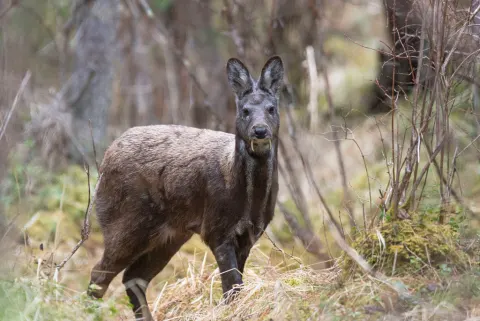
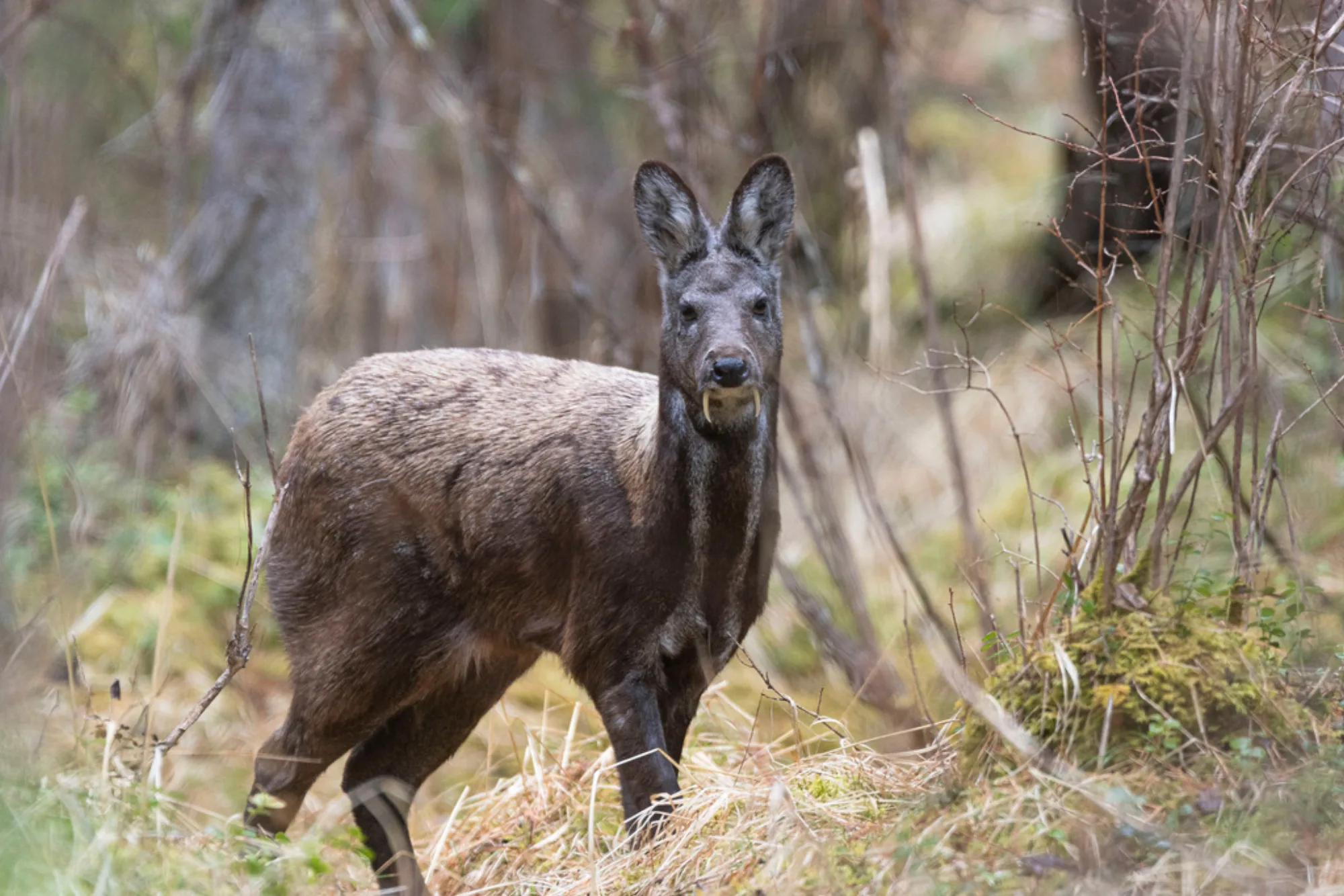
Small enough to slip through openings in rocky ground, the Siberian Musk Deer (Moschus moschiferus) has a kangaroo-like face and conspicuous tusks. Adults weigh 7 to 17 kg, and males grow tusks instead of antlers, using them in competition with other males and to attract females. Its small size also helps it run quickly from predators.
This deer lives in Northeast Asia's mountain forests, with its greatest prevalence in southern Siberia's taiga. It also occurs on the Korean Peninsula and in areas of Manchuria, Inner Mongolia and Mongolia. It favours elevations above 2,600 m and can be found on shrub-covered slopes in mountainous taiga, where food is abundant. Rocky crevices and crags offer places to hide from predators, including lynx, wolves and bears. Mostly active at night, it travels only short distances when it migrates. Musk deer mark territories with arrangements of fallen branches, tree trunks and plant stems, and also by leaving droppings.
Despite its tusks, the deer eats plants, feeding mainly on lichens, pine needles, leaves and tree bark. In winter, lichens make up 99% of its diet. Females are pregnant for over 6 months and usually give birth to 1 to 3 young between May and June. Hunting and poaching for musk glands have severely reduced the population, and the deer are seldom left alive when the gland is removed. Deforestation is another threat, particularly because the deer can live in only a few areas. Musk trading is controlled internationally, and the countries where the deer occurs are beginning efforts to restore its population.
Written from the English Wikipedia article Siberian musk deer (CC BY-SA 4.0).
- Records
- 0
- Countries
- 1
No atlas park has a record of the Siberian Musk Deer in or around it yet.
These are open occurrence records, so they show where people looked for and recorded the Siberian Musk Deer as much as where it lives. Cells are up to 25 km across, and every location is generalised to its cell.
Generalised encounter areas, not exact locations. Each shape is a grid cell coloured by how likely the species is there.
- Very likelyRussia25 km zone · low confidence · 0 records · updated 80 days ago
Conservation status not assessed here yet, so every location is generalised to its grid cell.