Northern Gannet
Morus bassanus
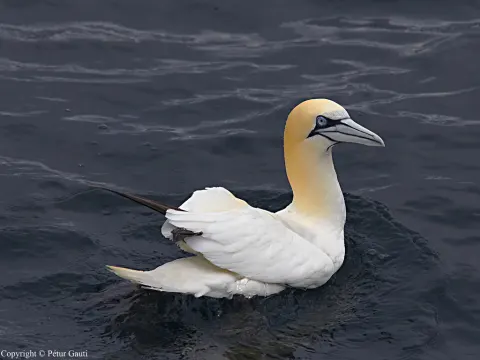
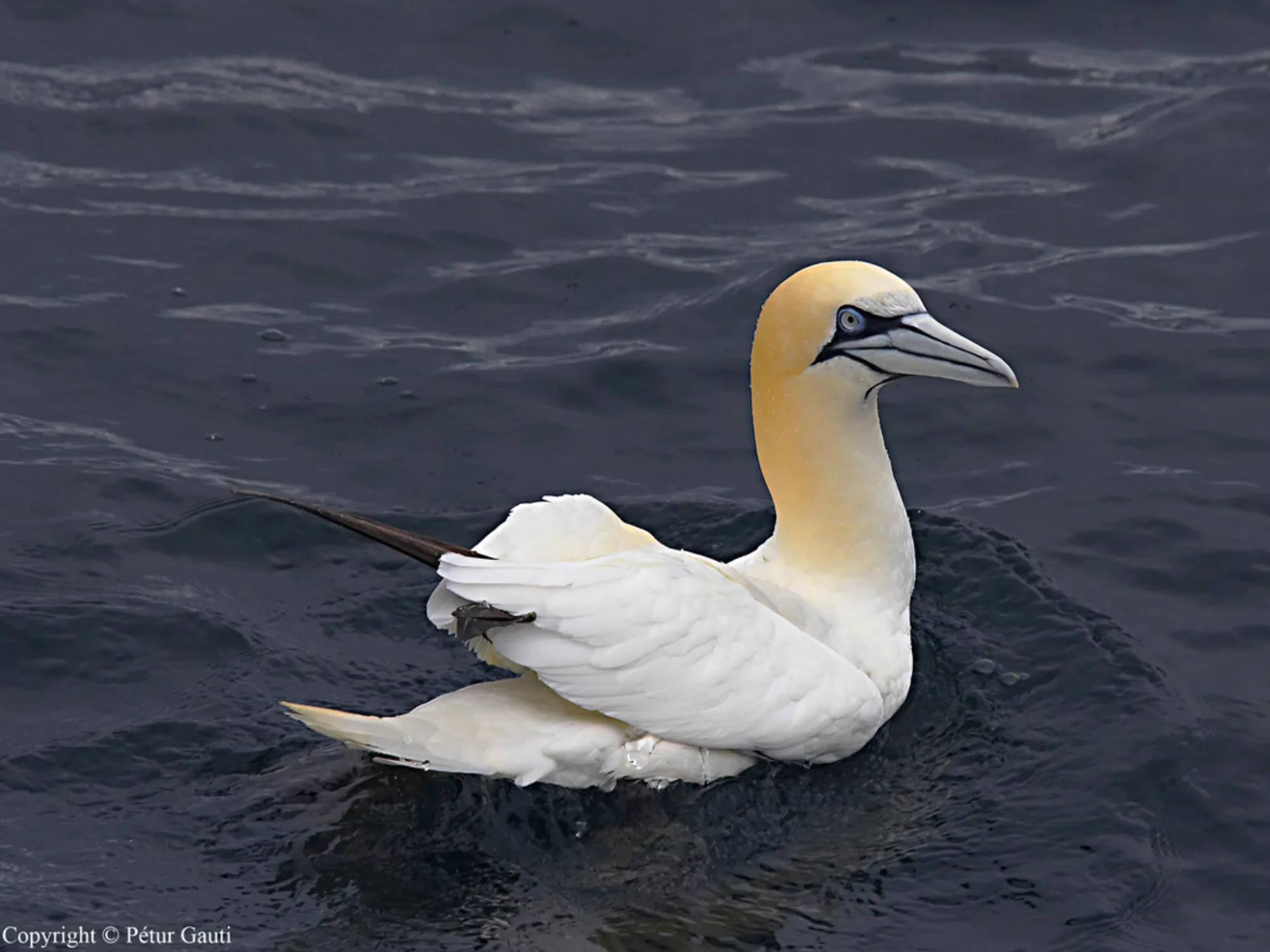
With long, slender wings and a pointed blue-grey bill, the Northern Gannet is the northern Atlantic's largest seabird. Adults are mostly white, with dark wing tips and a buff-yellow wash on the head and neck that becomes more pronounced in the breeding season. Young birds are mostly grey-brown and gradually turn whiter, reaching maturity after five years. In flight, their wingspan measures 170 to 180 cm.
Northern Gannets breed on both sides of the North Atlantic, usually in large colonies on ocean cliffs or small rocky islands. The British Isles host over two-thirds of the global breeding population, with colonies including Bass Rock in Scotland and Grassholm in Wales. The birds are noisy at their colonies, where a harsh call can announce an arrival or a challenge to another gannet. Close-packed nests incorporate plants, earth, seaweed and material gathered from the sea. A pair lays one egg, and the parents feed their chick until it leaves the nest. After breeding, adults disperse widely, with some travelling to the western Mediterranean or along Africa's Atlantic coast.
At sea, gannets search for food during the day and plunge into the water at high speed. Fish, including Atlantic mackerel and herring, are their main food, though they also take squid. Fishing boats and cetaceans can attract gannets looking for injured fish or scraps. Hunting continues in the Outer Hebrides and the Faroe Islands, while eagles prey on adults and gulls, ravens and other animals take eggs and chicks. In 2022, an H5N1 outbreak caused mass deaths at colonies across the North Atlantic, and its longer-term effects on the population remained uncertain.
Written from the English Wikipedia article Northern gannet (CC BY-SA 4.0).
- Records
- 683,186
- Countries
- 47
- Atlas places
- 1
These are open occurrence records, so they show where people looked for and recorded the Northern Gannet as much as where it lives. Cells are up to 25 km across, and every location is generalised to its cell.
Generalised encounter areas, not exact locations. Each shape is a grid cell coloured by how likely the species is there.
- Very likelyUnited States25 km zone · high confidence · 274833 records · updated 86 days ago
- Very likelyCanada25 km zone · high confidence · 168683 records · updated 86 days ago
- Very likelyUnited Kingdom25 km zone · high confidence · 78349 records · updated 86 days ago
- Very likelyNorway25 km zone · high confidence · 42760 records · updated 86 days ago
- Very likelyPortugal25 km zone · high confidence · 32318 records · updated 86 days ago
- Very likelyBelgium25 km zone · high confidence · 17534 records · updated 86 days ago
- Very likelySpain25 km zone · high confidence · 14513 records · updated 86 days ago
- Very likelyMorocco25 km zone · high confidence · 12628 records · updated 86 days ago
- Very likelyNetherlands25 km zone · high confidence · 8434 records · updated 86 days ago
- Very likelyFrance25 km zone · high confidence · 6891 records · updated 86 days ago
Conservation status not assessed here yet, so every location is generalised to its grid cell.