Striped Bass
Morone saxatilis
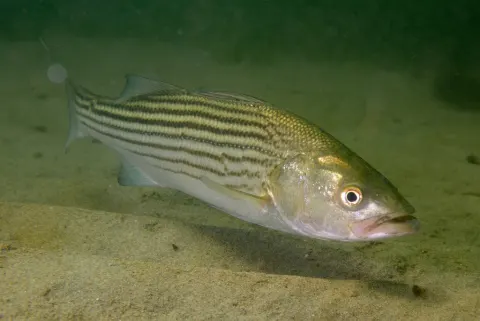
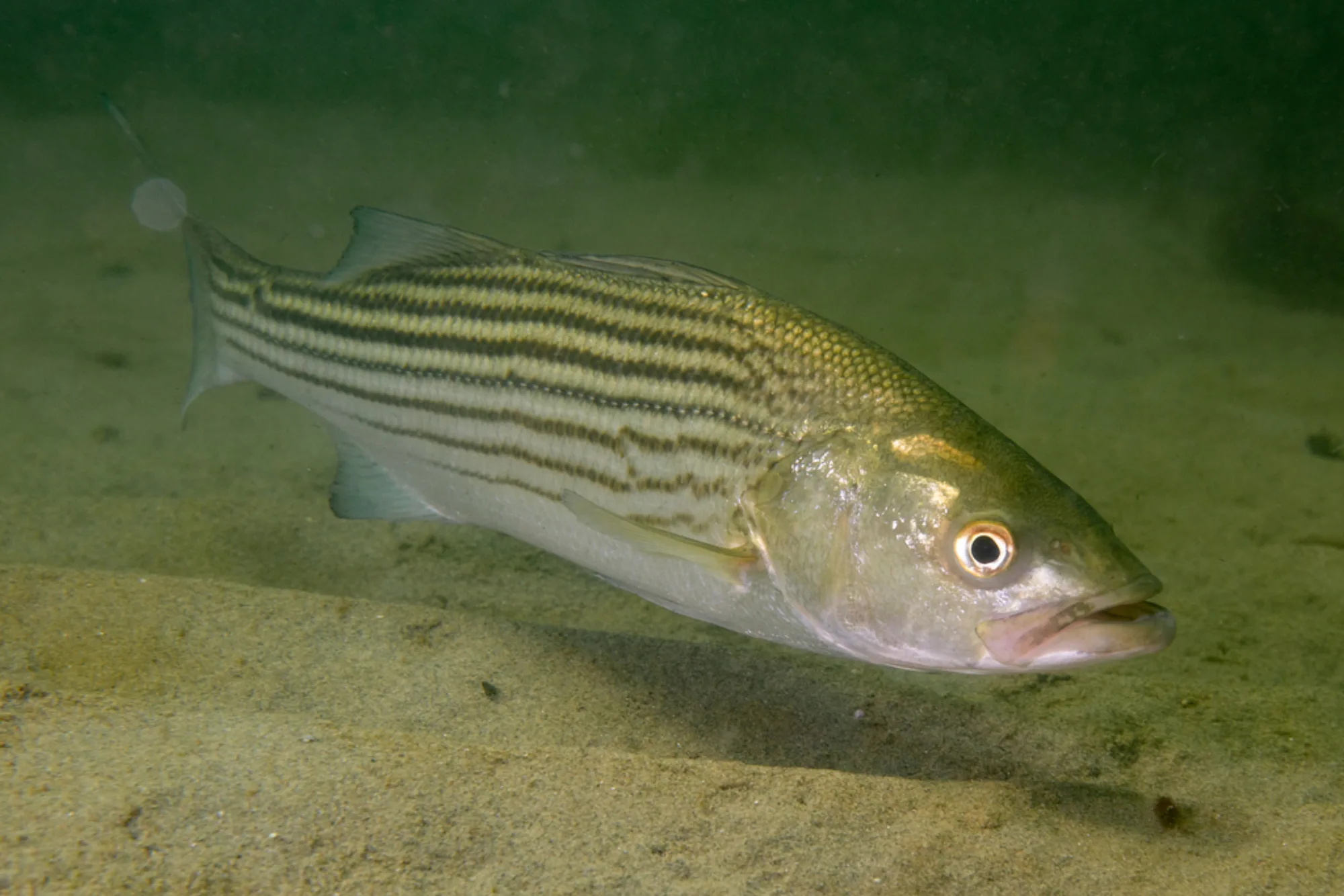
Dark stripes mark the Striped Bass's streamlined silver body, running lengthwise between the gills and tail. Its average length is 50 to 90 cm, although size varies with age and sex. Mature fish commonly weigh 9 to 18 kg, and their lifespan may reach 30 years.
Native to North America's Atlantic coastline, the species ranges from the St. Lawrence River south into the Gulf of Mexico, reaching Louisiana. It has also been introduced to the Pacific coast and to reservoirs across the United States, as well as waters in several other countries. Its habitats include wetlands, streams, ponds and lakes. They naturally spend their adult lives in salt water and migrate into fresh water to spawn, although some have adapted to freshwater habitats. In Nova Scotia, many overwinter in Grand Lake before moving into the Shubenacadie River in early April to breed. Landlocked fish may also migrate upstream from lakes during the spawning period, though natural reproduction has historically been difficult for them.
Their prey includes river herring, shad and blueback herring. A study found that pressure on these food sources could put the bass population at risk when prey did not return to the same spawning areas. Overfishing and dredging were implicated in the disappearance of the Saint Lawrence population, which was later successfully reintroduced. In the San Francisco Bay-Delta, high levels of dissolved solids have been found to reduce spawning success.
Written from the English Wikipedia article Striped bass (CC BY-SA 4.0).
- Records
- 39,062
- Countries
- 3
- Atlas places
- 2
These are open occurrence records, so they show where people looked for and recorded the Striped Bass as much as where it lives. Cells are up to 25 km across, and every location is generalised to its cell.
Generalised encounter areas, not exact locations. Each shape is a grid cell coloured by how likely the species is there.
- Very likelyCanada25 km zone · high confidence · 32593 records · updated 80 days ago
- Very likelyUnited States25 km zone · high confidence · 6411 records · updated 80 days ago
- Very likelyMexico25 km zone · medium confidence · 58 records · updated 80 days ago
Conservation status not assessed here yet, so every location is generalised to its grid cell.