White Bass
Morone chrysops
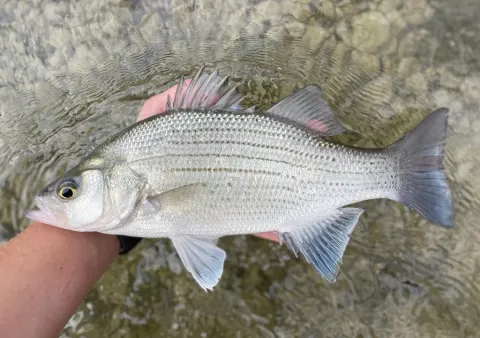
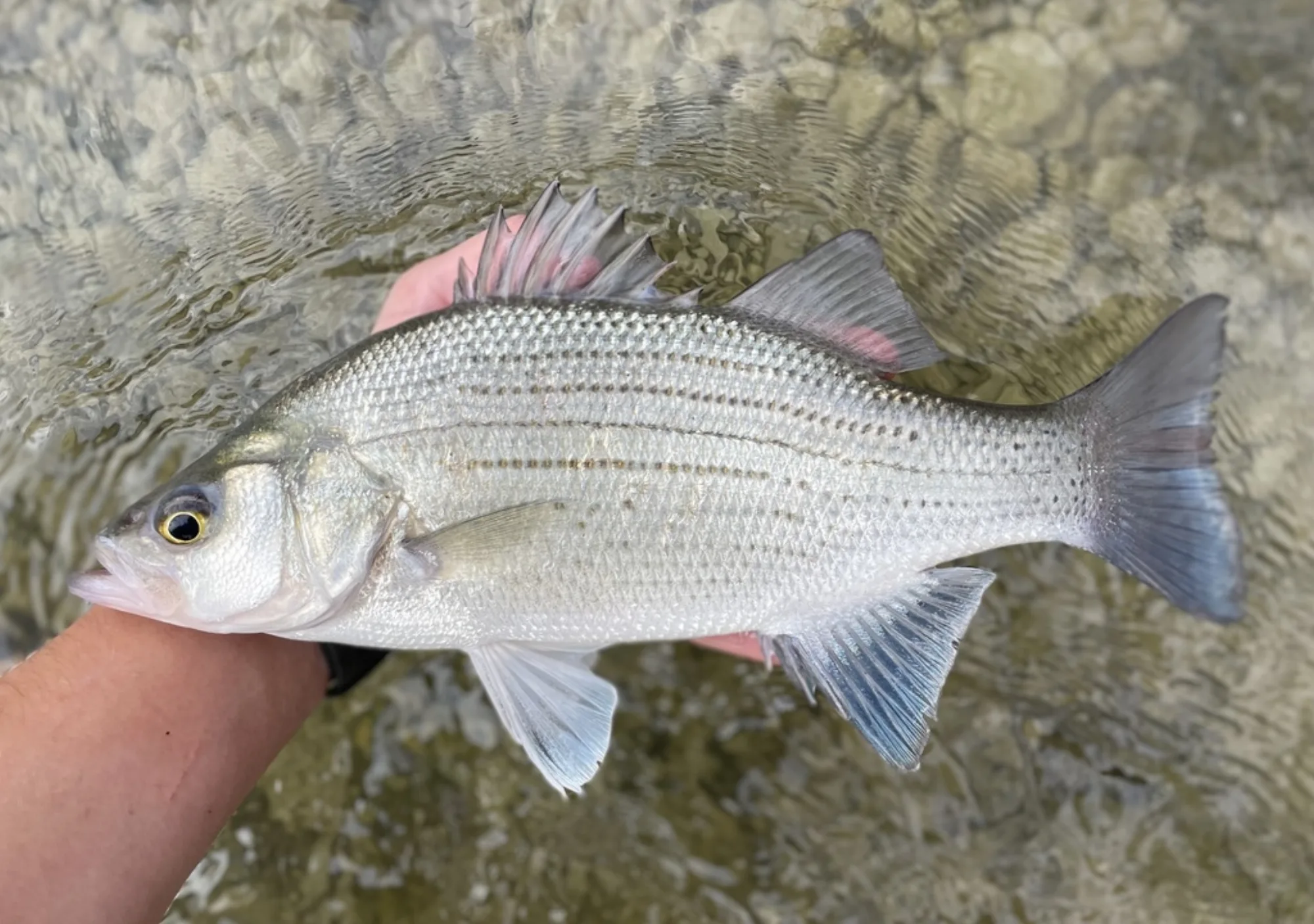
Silver-white to pale green, the White Bass is a freshwater fish with a dark back, white sides and belly, and narrow dark stripes along its flanks. Large, rough scales and two separate dorsal fins add to its distinctive appearance. Most grow between 25 and 30 cm long, although some reach 43 cm or more.
White Bass occur widely across North America, living in large rivers and reservoirs. They are especially widespread in the Midwest, with abundant populations in Pennsylvania, around Lake Erie and in Oklahoma. Its native range includes Lake Poinsett in South Dakota, the Detroit River, western Lake Erie and the Arkansas River. The fish has also been introduced to waters across the United States, particularly in the south, and to Manitoba, where it has become an important sport fish. In spring, look for it in shallow rivers, creeks and streams. White Bass can also gather in high densities in upstream sections of rivers.
These carnivores hunt by sight and eat small aquatic animals including copepods, daphnia and leptodora. Only the largest eat other fish, and the amount of fish in their diet generally falls as summer progresses. Spawning takes place from mid-March to late May, often in the moving water of a tributary stream, although windswept lake shores are also used. In clear, fairly shallow water, eggs stick to surfaces such as vegetation, rocks and sunken wood. The parents then move into deeper water, leaving the young without their care; the young remain in the shallows for a time before moving deeper. Upstream river habitat, where White Bass can be concentrated, is subject to degradation.
Written from the English Wikipedia article White bass (CC BY-SA 4.0).
- Records
- 7,015
- Countries
- 4
No atlas park has a record of the White Bass in or around it yet.
These are open occurrence records, so they show where people looked for and recorded the White Bass as much as where it lives. Cells are up to 25 km across, and every location is generalised to its cell.
Generalised encounter areas, not exact locations. Each shape is a grid cell coloured by how likely the species is there.
- Very likelyUnited States25 km zone · high confidence · 6738 records · updated 80 days ago
- Very likelyCanada25 km zone · high confidence · 241 records · updated 80 days ago
- Very likelyMauritania25 km zone · medium confidence · 36 records · updated 80 days ago
Conservation status not assessed here yet, so every location is generalised to its grid cell.