Green Tree Python
Morelia viridis
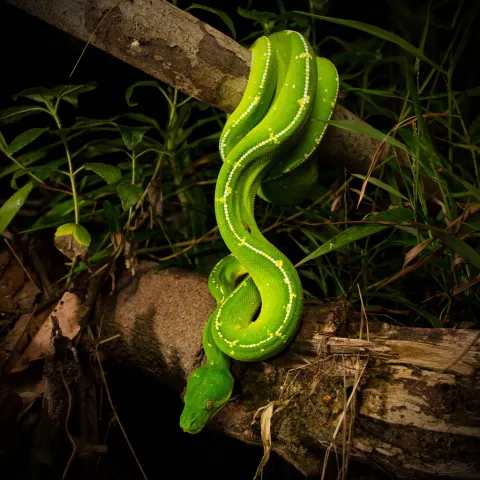
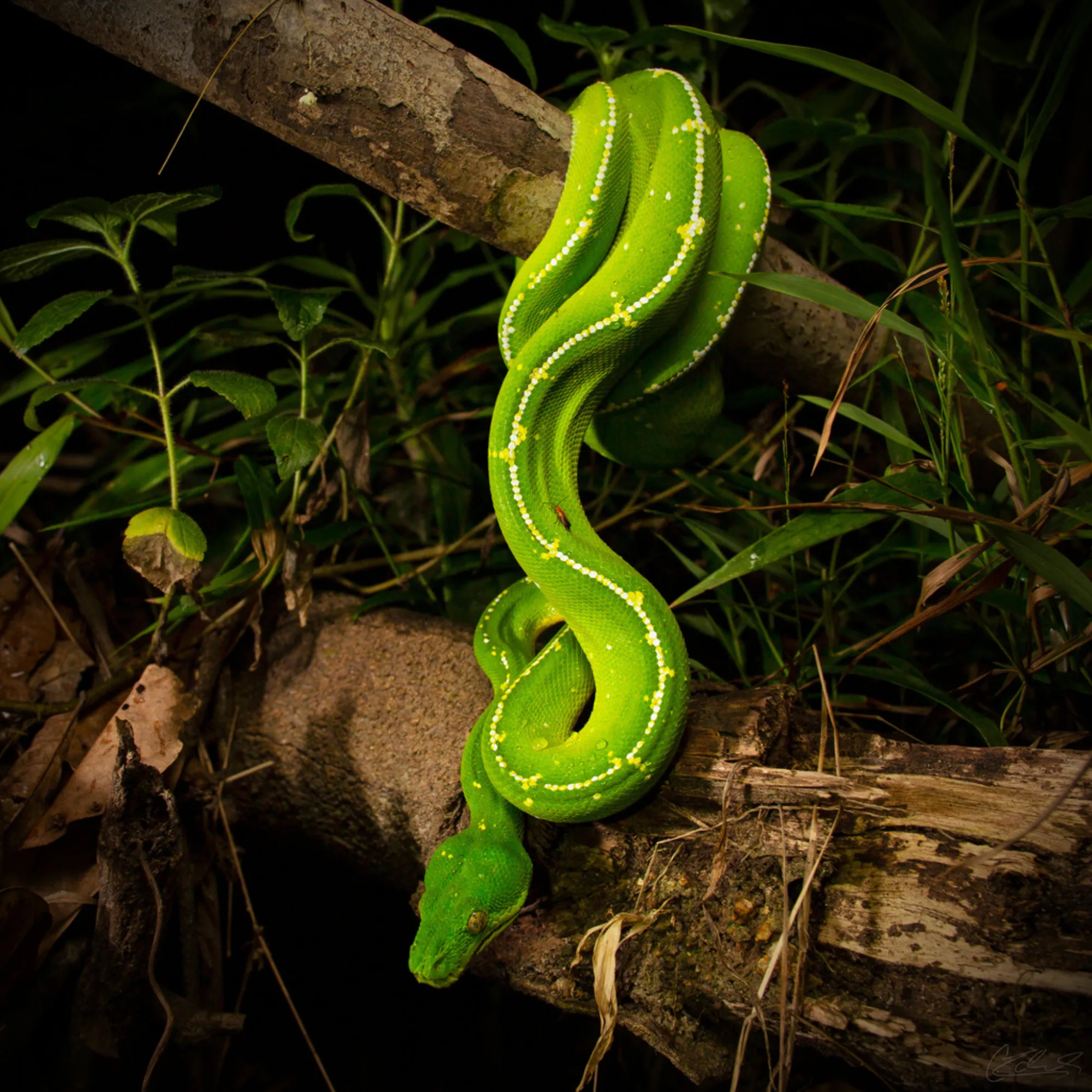
Bright green and usually draped over a branch, the Green Tree Python (Morelia viridis) is a slender snake with a large head set apart from its neck. It usually reaches 150 to 180 cm in total length, including the tail, though large females can reach 200 cm. Young snakes look quite different: hatchlings may be lemon-yellow with broken purple and brown markings, or golden or orange-red. At Iron Range National Park in Australia, yellow youngsters changed colour over 5 to 10 days when they were about a year old.
The species lives in New Guinea, eastern Indonesia and Australia's Cape York Peninsula, including nearby islands in parts of its range. It favours places in or near rainforest, spending most of its time in trees, shrubs and bushes, though it is occasionally seen on the ground. At rest, it often loops its body over a branch like a saddle, with its head in the middle of the coils. Its food consists mostly of small mammals, particularly rodents, but it also eats reptiles such as geckos and skinks, as well as insects. It can hold a branch with its tail, strike from an S-shaped position and constrict its prey. A clutch can contain up to 25 viable eggs; breeding has not been reported in the wild, but captive females protect and incubate their eggs.
Demand from reptile enthusiasts has encouraged illegal collection from the wild, harming native populations. Transport is dangerous for the snakes, and up to half are thought to die during smuggling. Illegal trade continues despite protection in Indonesia, with breeding farms found to have channelled wild-caught snakes out of the country. Collection has been especially heavy on Biak and neighbouring islands, where populations have declined.
Written from the English Wikipedia article Green tree python (CC BY-SA 4.0).
- Records
- 113
- Countries
- 2
No atlas park has a record of the Green Tree Python in or around it yet.
These are open occurrence records, so they show where people looked for and recorded the Green Tree Python as much as where it lives. Cells are up to 25 km across, and every location is generalised to its cell.
Generalised encounter areas, not exact locations. Each shape is a grid cell coloured by how likely the species is there.
- Very likelyAustralia25 km zone · high confidence · 107 records · updated 80 days ago
- LikelyPapua New Guinea25 km zone · medium confidence · 6 records · updated 80 days ago
Conservation status not assessed here yet, so every location is generalised to its grid cell.