Carpet Python
Morelia spilota
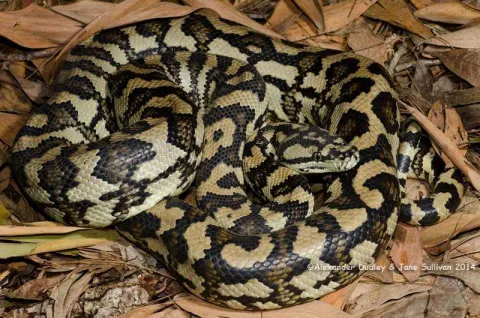
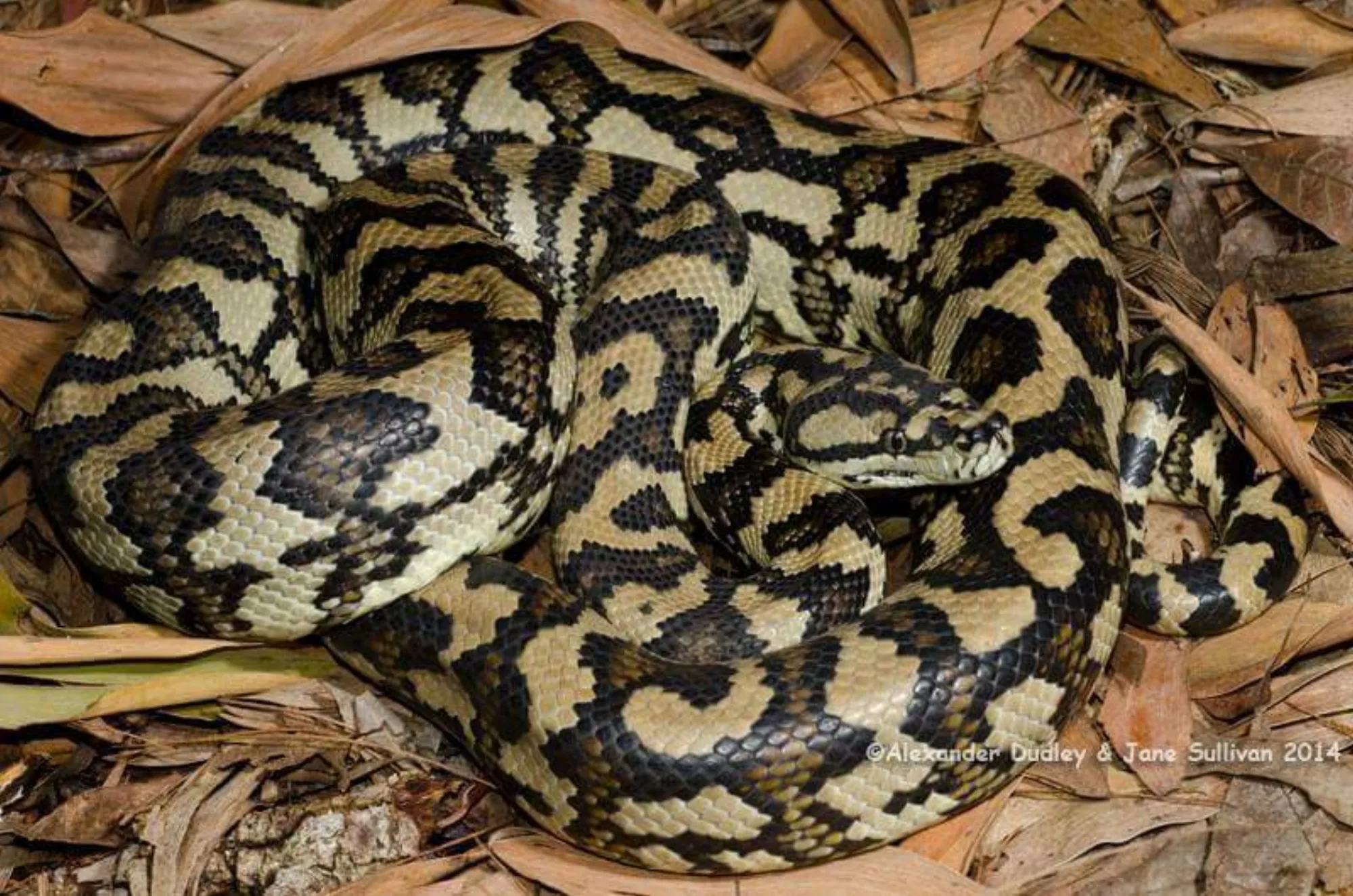
Across forests, woodlands and even treeless islands, the Carpet Python is a large snake with a triangular head and highly variable colouring. It can be olive to black, marked with white, cream or gold, and its pattern may form rough diamonds or intricate light and dark bands. Adults average roughly 2 m in length, though the species can reach 4 m and weigh up to 15 kg. Females are usually larger than males, and in some regions they can be up to four times as heavy.
The species occurs across much of mainland Australia, apart from the arid centre and western regions, and is widely distributed in the forests of Southwest Australia. Its range also includes New Guinea, the Bismarck Archipelago and the northern Solomon Islands. Habitats range from northeastern Queensland rainforests and river woodlands to temperate grasslands and arid islands off South Australia. It also lives in places that receive snowfall and is often found near homes, where it eats rats and other vermin. In Darwin, encounters in suburban areas are more likely during the dry season months of May to July.
Carpet pythons favour life in trees but also move on the ground, and often bask in open spaces. They are generally active by day and night, although one subspecies is primarily nocturnal. They kill by constriction and feed mainly on small mammals, birds and lizards. Females lay 10 to 50 eggs, then coil around them for protection and warmth until the young emerge. Habitat loss threatens the subspecies found in Western Australia.
Written from the English Wikipedia article Morelia spilota (CC BY-SA 4.0).
- Records
- 15,677
- Countries
- 2
- Atlas places
- 4
These are open occurrence records, so they show where people looked for and recorded the Carpet Python as much as where it lives. Cells are up to 25 km across, and every location is generalised to its cell.
Generalised encounter areas, not exact locations. Each shape is a grid cell coloured by how likely the species is there.
- Very likelyAustralia25 km zone · high confidence · 15658 records · updated 80 days ago
- LikelyPapua New Guinea25 km zone · medium confidence · 19 records · updated 80 days ago
Conservation status not assessed here yet, so every location is generalised to its grid cell.