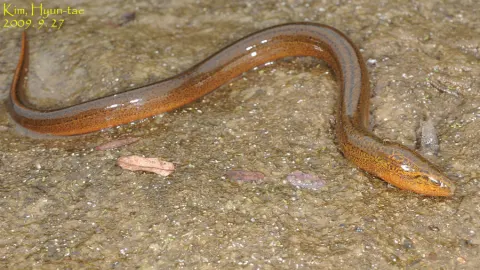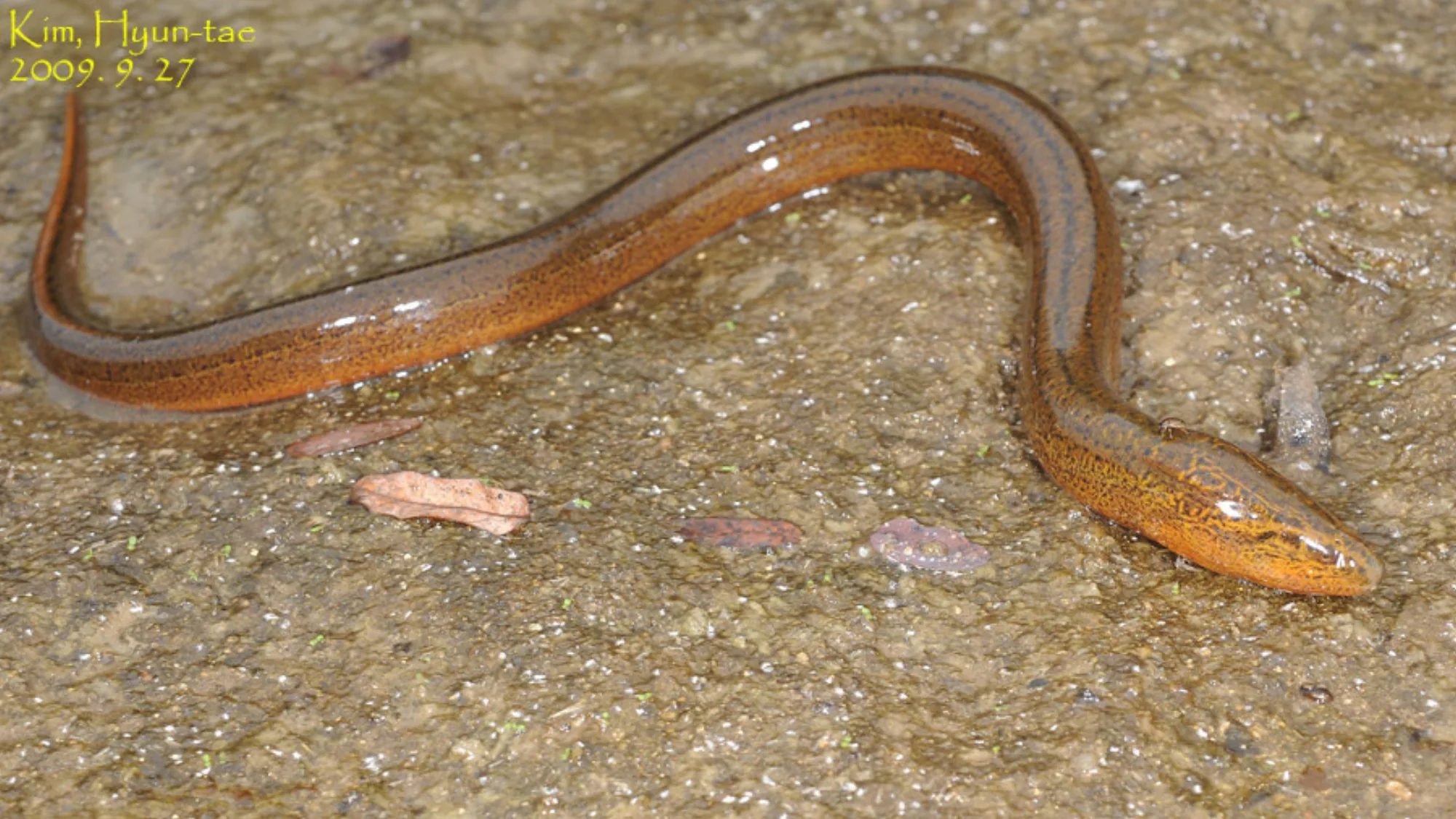
Asian Swamp Eel
Monopterus albus
At night, the Asian Swamp Eel hunts in shallow freshwater, using a large mouth to take fish and other small animals. Despite its eel-like shape, it is a fish with a scaleless body, a blunt snout and a tapering tail. Adults are typically 25 to 40 cm long, with uneven dark markings on an olive or brown body. It can breathe air and live in water with a wide range of oxygen levels.
Its native range extends across much of East and Southeast Asia, reaching India in the west. It has also been introduced to Oahu, areas near Atlanta in Georgia, and Florida, including waters near Everglades National Park. Look for its preferred habitat in muddy, shallow wetlands, including rice paddies, ditches, ponds, marshes, streams, canals and lakes. Water less than 3 m deep is optimal. Its varied diet includes shrimp, crayfish, frogs, turtle eggs, worms and insects, with detritus eaten occasionally.
Spawning can take place throughout the year, and females produce up to 1,000 eggs per spawning event. Breeding behaviour varies between populations: some Japanese and Chinese forms build floating bubble nests in shallow water, where males guard the eggs and young. The most widespread form deposits its eggs among floating plant roots and gives them no parental care. Swamp eels are widely sold as food and farmed in rice fields in several Asian countries. In the United States, efforts to control introduced populations include restricting the opening of water-management structures and discouraging people from catching and transporting the fish.
Written from the English Wikipedia article Asian swamp eel (CC BY-SA 4.0).
- Records
- 241
- Countries
- 11
- Atlas places
- 1
These are open occurrence records, so they show where people looked for and recorded the Asian Swamp Eel as much as where it lives. Cells are up to 25 km across, and every location is generalised to its cell.
Generalised encounter areas, not exact locations. Each shape is a grid cell coloured by how likely the species is there.
- Very likelyUnited States25 km zone · medium confidence · 129 records · updated 80 days ago
- Very likelyIndonesia25 km zone · medium confidence · 38 records · updated 80 days ago
- Very likelyChina25 km zone · medium confidence · 33 records · updated 80 days ago
- Very likelySouth Korea25 km zone · medium confidence · 16 records · updated 80 days ago
- LikelyTaiwan25 km zone · medium confidence · 12 records · updated 80 days ago
- LikelyMyanmar (Burma)25 km zone · medium confidence · 6 records · updated 80 days ago
- PossibleMalaysia25 km zone · medium confidence · 3 records · updated 80 days ago
- PossibleHong Kong SAR China25 km zone · medium confidence · 2 records · updated 80 days ago
- PossibleSingapore25 km zone · medium confidence · 1 record · updated 80 days ago
- PossibleVietnam25 km zone · medium confidence · 1 record · updated 80 days ago
Conservation status not assessed here yet, so every location is generalised to its grid cell.