Narwhal
Monodon monoceros
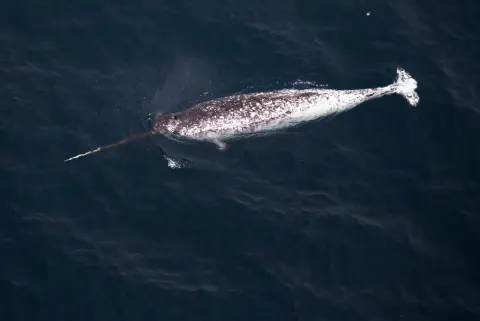
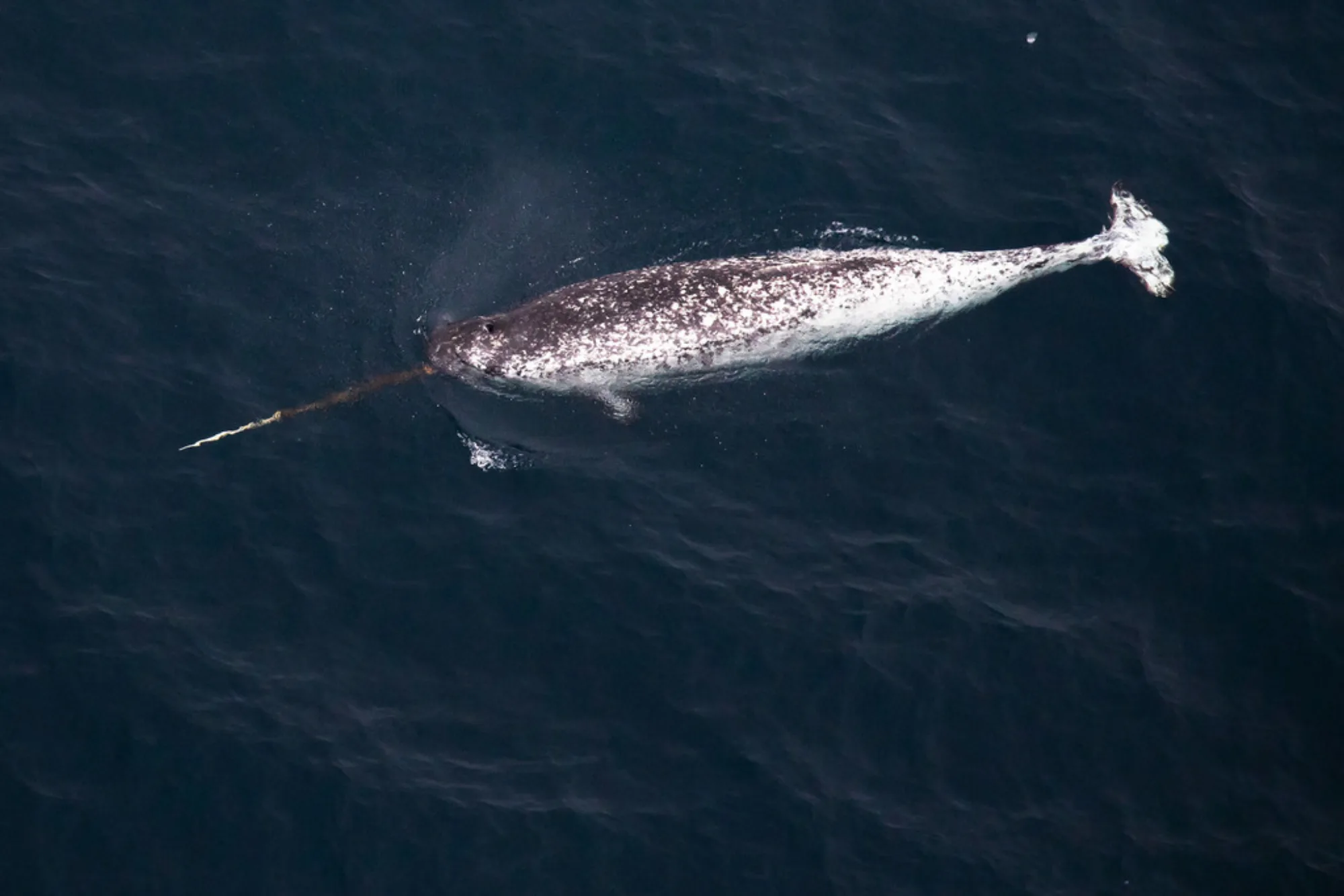
A stocky Arctic whale with mottled skin and a short, blunt snout, the Narwhal has a shallow ridge where many whales have a dorsal fin. Their bodies are 3.0 to 5.5 m long, with blackish-brown markings on a white background. Most conspicuous in males is the long, spiralled tusk, which can reach 3 m; females rarely grow one. Older animals can become almost entirely white.
Narwhals live in Arctic waters around Canada, Greenland and Russia. In summer they move towards the coast, often returning to familiar, ice-free grounds in shallow water. During winter they move offshore beneath thick pack ice, surfacing through cracks and wider openings. They usually travel in groups of three to eight, though much larger gatherings form in summer. Narwhals use clicks, whistles and knocks to communicate, and sound helps them navigate and find food. Their diet includes Arctic and polar cod, Greenland halibut, shrimp, cuttlefish and armhook squid. Deep dives are part of life in their winter waters, with the greatest recorded dive reaching 2,370 m. Young are born in July or August, and calves depend on their mothers' milk for about 20 months.
Life among the ice carries risks: narwhals can drown or starve if they become trapped when open water freezes over. Polar bears and orcas also prey on them. Hunting, pollution and the loss of sea ice associated with climate change threaten the population, while seismic surveys for oil exploration disrupt migration. Reduced ice may also leave narwhals more exposed to predators.
Written from the English Wikipedia article Narwhal (CC BY-SA 4.0).
- Records
- 48
- Countries
- 3
No atlas park has a record of the Narwhal in or around it yet.
These are open occurrence records, so they show where people looked for and recorded the Narwhal as much as where it lives. Cells are up to 25 km across, and every location is generalised to its cell.
Generalised encounter areas, not exact locations. Each shape is a grid cell coloured by how likely the species is there.
- Very likelyCanada25 km zone · medium confidence · 34 records · updated 80 days ago
- Very likelyGreenland25 km zone · medium confidence · 11 records · updated 80 days ago
- LikelySvalbard & Jan Mayen25 km zone · medium confidence · 3 records · updated 80 days ago
Conservation status not assessed here yet, so every location is generalised to its grid cell.