Ling
Molva molva
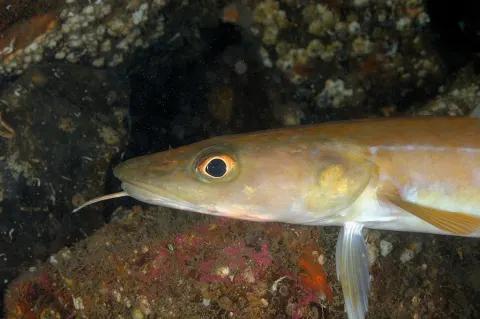
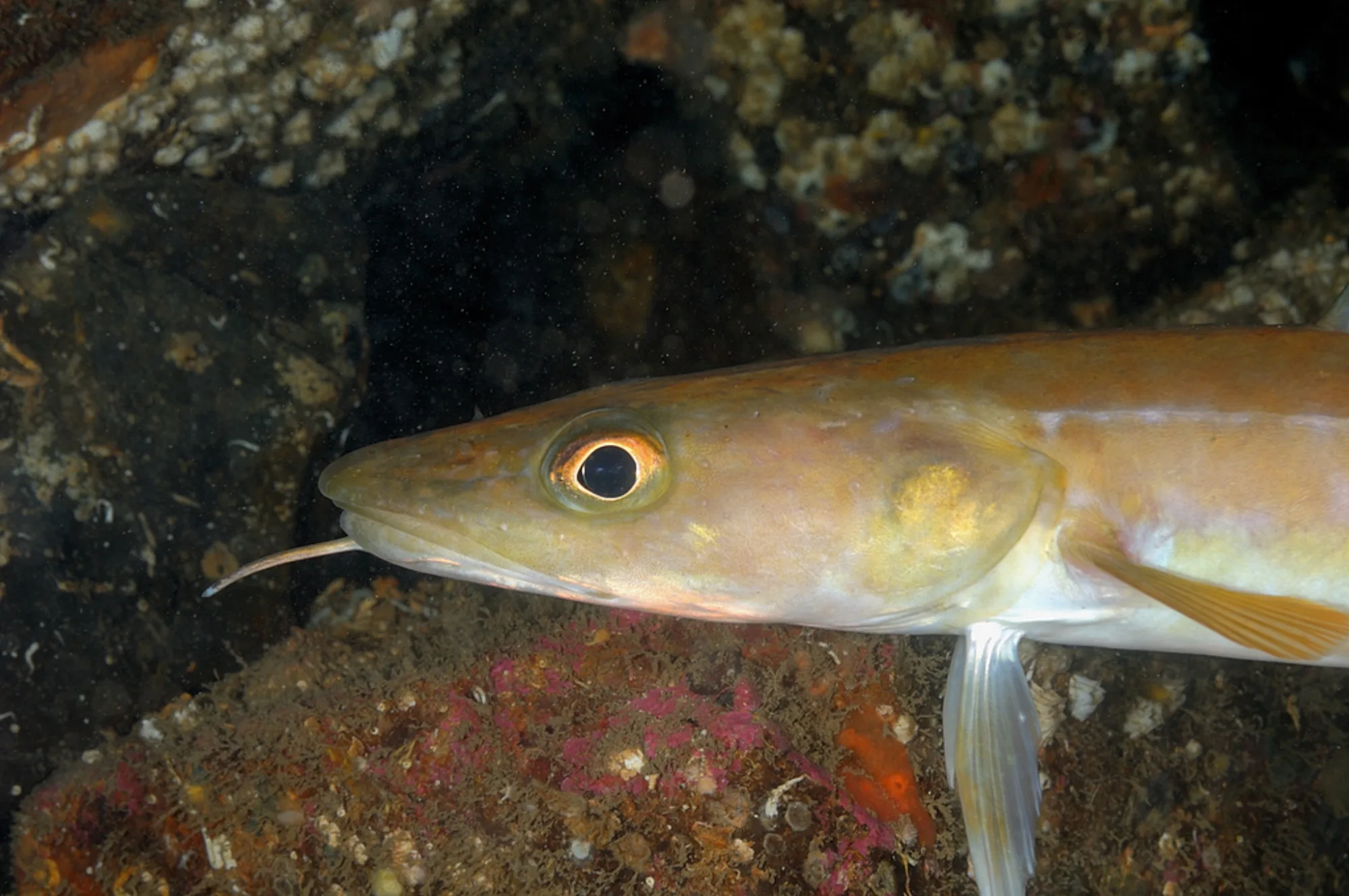
Long and slender, the Ling has a small head, small eyes and a large mouth armed with large teeth. A single sensory barbel hangs from its lower jaw. Its marbled back is greenish-brown, sometimes reddish-brown above, fading to a lighter colour along the sides and underside. White edges and dark spots mark its dorsal and anal fins, with the spot on the shorter front dorsal fin especially noticeable. Juveniles are generally paler than adults and often have pale purplish, iridescent lines. This large cod-like fish can reach 200 cm in length and weigh 30 kg.
Ling live across the North Atlantic, from eastern Canada and southern Greenland to Iceland and the coasts of Europe. Their range extends from the Barents Sea around the UK and south to the Straits of Gibraltar and the north-western Mediterranean, where they are rare. They favour rocky bottoms, most often at depths of 100 to 400 m, and usually live alone. In deep water they shelter among rocks, in crevices and around wrecks, but also swim freely. Young fish spend their early years in coastal waters before moving deeper at 3 years old. Ling feed mainly on fish, including Atlantic cod, herring and flatfish, as well as crustaceans, cephalopods and starfish. Spawning runs from March to July, with major grounds off southern Iceland, in the Mediterranean and across Atlantic waters between the Bay of Biscay and the Norwegian Sea.
Commercial fisheries target Ling with trawls and, in some areas, long lines. Being brought to the surface from deep water badly damages their swim bladder, and there are doubts about whether the fisheries are sustainable.
Written from the English Wikipedia article Common ling (CC BY-SA 4.0).
- Records
- 3,509
- Countries
- 5
No atlas park has a record of the Ling in or around it yet.
These are open occurrence records, so they show where people looked for and recorded the Ling as much as where it lives. Cells are up to 25 km across, and every location is generalised to its cell.
Generalised encounter areas, not exact locations. Each shape is a grid cell coloured by how likely the species is there.
- Very likelyNorway25 km zone · medium confidence · 2446 records · updated 80 days ago
- Very likelyUnited Kingdom25 km zone · medium confidence · 816 records · updated 80 days ago
- Very likelyIreland25 km zone · medium confidence · 188 records · updated 80 days ago
- Very likelyIsle of Man25 km zone · medium confidence · 38 records · updated 80 days ago
- LikelyUnnamed area25 km zone · medium confidence · 11 records · updated 80 days ago
- LikelyDenmark25 km zone · medium confidence · 10 records · updated 80 days ago
Conservation status not assessed here yet, so every location is generalised to its grid cell.