Brown-headed Cowbird
Molothrus ater
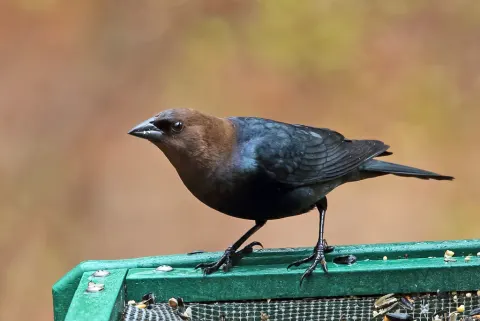
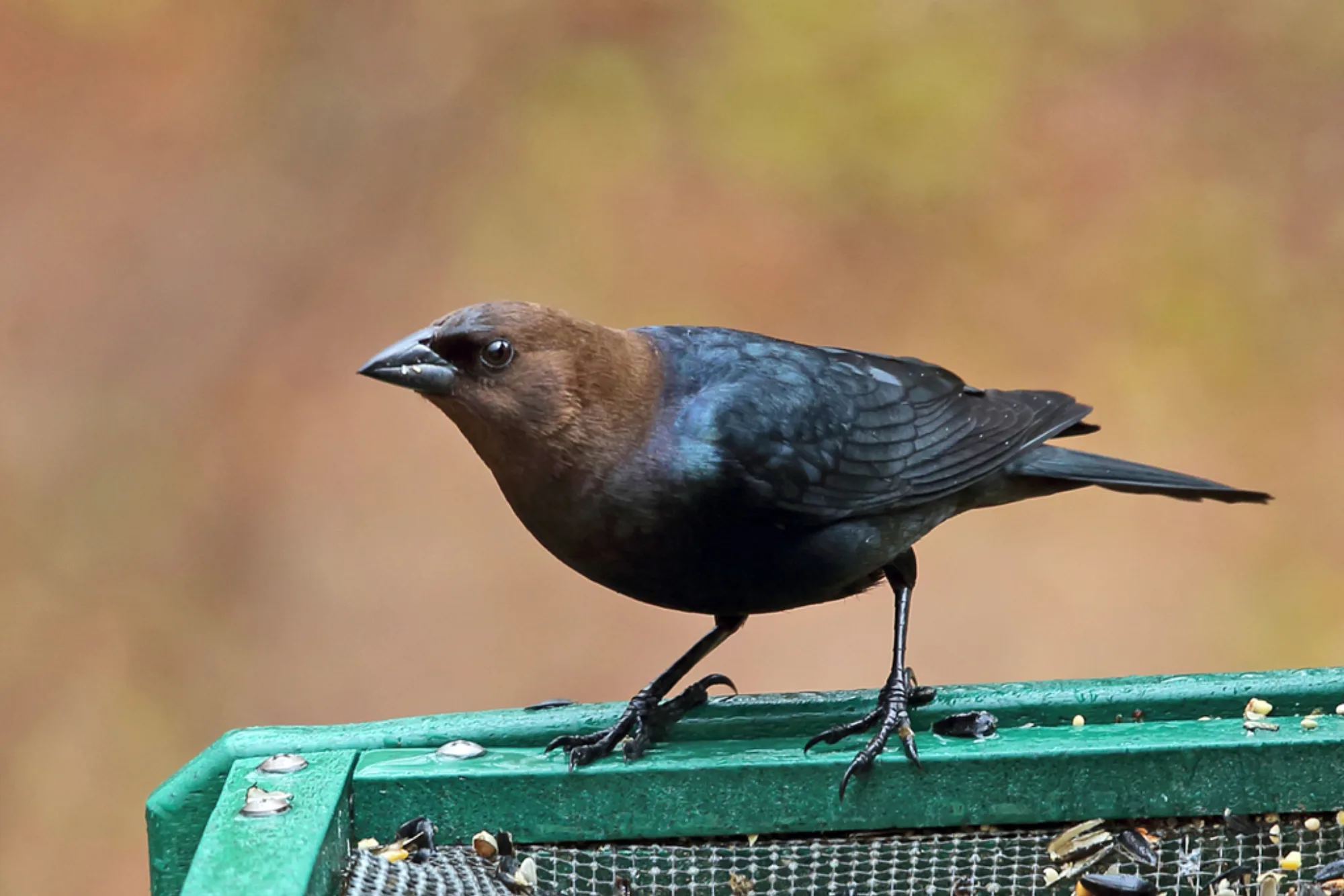
With a finch-like head and beak, the Brown-headed Cowbird is a small bird of temperate and subtropical North America. Adult males have iridescent black plumage and brown heads, while females are slightly smaller, with dull grey colouring, pale throats and finely streaked underparts. The species measures 16 to 22 cm in length and has an average wingspan of 36 cm. It lives in open or semiopen country and is also a regular visitor to suburban birdfeeders. Birds in the south stay year-round, while northern birds spend winter in the southern United States and Mexico and head back to their breeding range around March or April.
Cowbirds often travel in flocks, sometimes alongside red-winged blackbirds, bobolinks, common grackles or European starlings. On the ground they search mainly for seeds and insects, occasionally eating berries. They often follow horses and cattle, catching insects disturbed by the grazing animals. Before European settlement, they followed bison across the prairies, later adapting to grazing animals introduced by settlers. Forest clearing helped the cowbird expand its range and population.
For breeding, females lay their eggs in the nests of other birds, especially small perching birds that make cup-shaped nests. Cowbird eggs have been found in the nests of at least 220 host species, and more than 140 species are known to have raised cowbird young. Host parents feed the chicks at the expense of their own young, but some hosts reject eggs, abandon nests or expel chicks. A plant-based diet offered by hosts such as house finches is unsuitable for young cowbirds, and few survive to leave the nest. People also run cowbird control programmes to protect species affected by this breeding behaviour.
Written from the English Wikipedia article Brown-headed cowbird (CC BY-SA 4.0).
- Records
- 2,453,116
- Countries
- 3
- Atlas places
- 1
These are open occurrence records, so they show where people looked for and recorded the Brown-headed Cowbird as much as where it lives. Cells are up to 25 km across, and every location is generalised to its cell.
Generalised encounter areas, not exact locations. Each shape is a grid cell coloured by how likely the species is there.
- Very likelyUnited States25 km zone · high confidence · 2168947 records · updated 80 days ago
- Very likelyCanada25 km zone · high confidence · 284169 records · updated 80 days ago
Conservation status not assessed here yet, so every location is generalised to its grid cell.