Goblin Shark
Mitsukurina owstoni
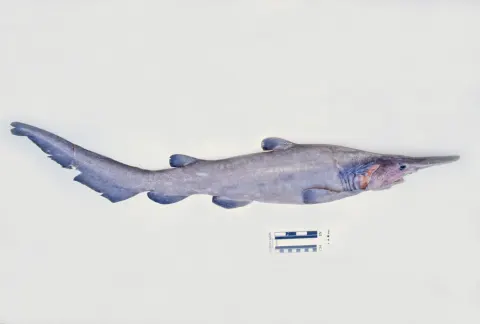
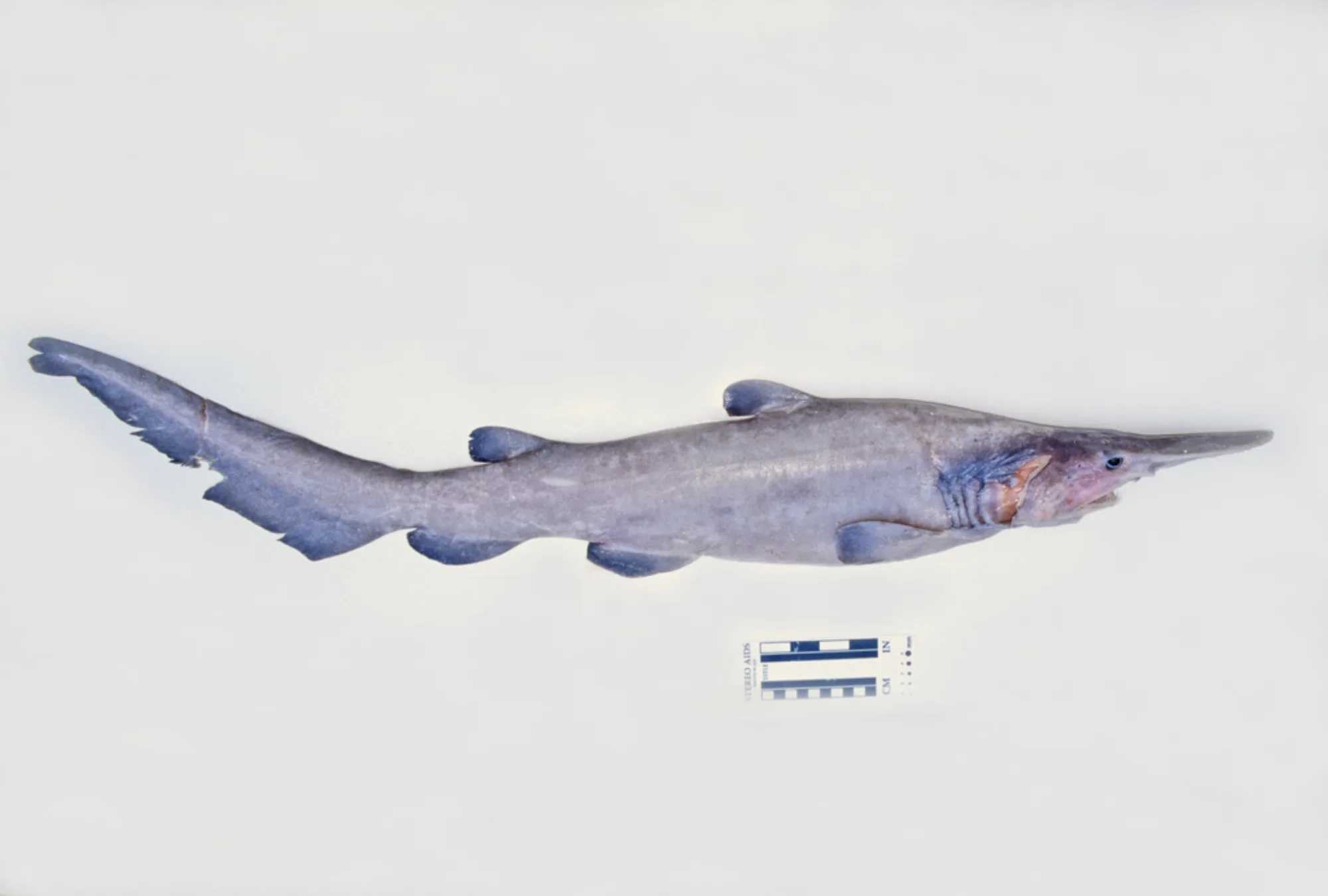
Rarely seen alive, the Goblin Shark (Mitsukurina owstoni) has a long, flat snout and a set of jaws that can thrust forward to reveal prominent, nail-like teeth. Its skin is pink or tan in life, while young sharks can be almost white. Adults usually measure 3 to 4 m long, though a much larger female was captured in 2000. Its small, rounded fins and flabby body suggest a slow-moving animal, although observations of living sharks are scarce.
Goblin sharks have been caught in all three major oceans, with records from places as far apart as Japan, South Africa, Portugal and New Zealand. They live around underwater mountains and canyons, as well as along continental slopes, and are most often found over the upper slope at depths of 270 to 960 m. Adults generally live deeper than juveniles, but immature sharks off southern Japan sometimes enter inshore waters as shallow as 40 m. A sighting at 2,000 m shows that the species can reach much deeper water.
The shark feeds mainly on deep-sea fishes, including rattails and dragonfishes, as well as cephalopods and crustaceans. It searches both near the sea floor and higher in the water, detecting weak electric fields from other animals with its snout and snapping its jaws forward when prey comes close. It may hunt by ambush, drifting towards prey with little movement. Little is known about its breeding, although a pregnant female caught in Taiwan in 2023 carried six pups. Fishing is a threat: goblin sharks are sometimes caught unintentionally in nets, on longlines or in other fishing gear, with juveniles taken regularly off southern Japan.
Written from the English Wikipedia article Goblin shark (CC BY-SA 4.0).
- Records
- 32
- Countries
- 1
No atlas park has a record of the Goblin Shark in or around it yet.
These are open occurrence records, so they show where people looked for and recorded the Goblin Shark as much as where it lives. Cells are up to 25 km across, and every location is generalised to its cell.
Generalised encounter areas, not exact locations. Each shape is a grid cell coloured by how likely the species is there.
- Very likelyAustralia25 km zone · medium confidence · 32 records · updated 80 days ago
Conservation status not assessed here yet, so every location is generalised to its grid cell.