Oriental Weatherfish
Misgurnus anguillicaudatus
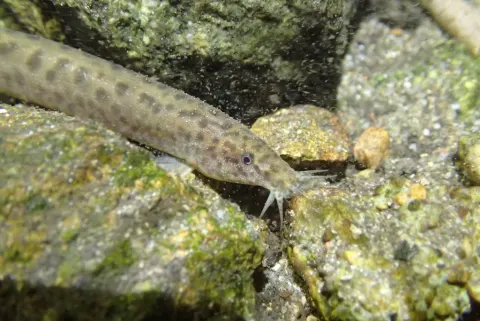
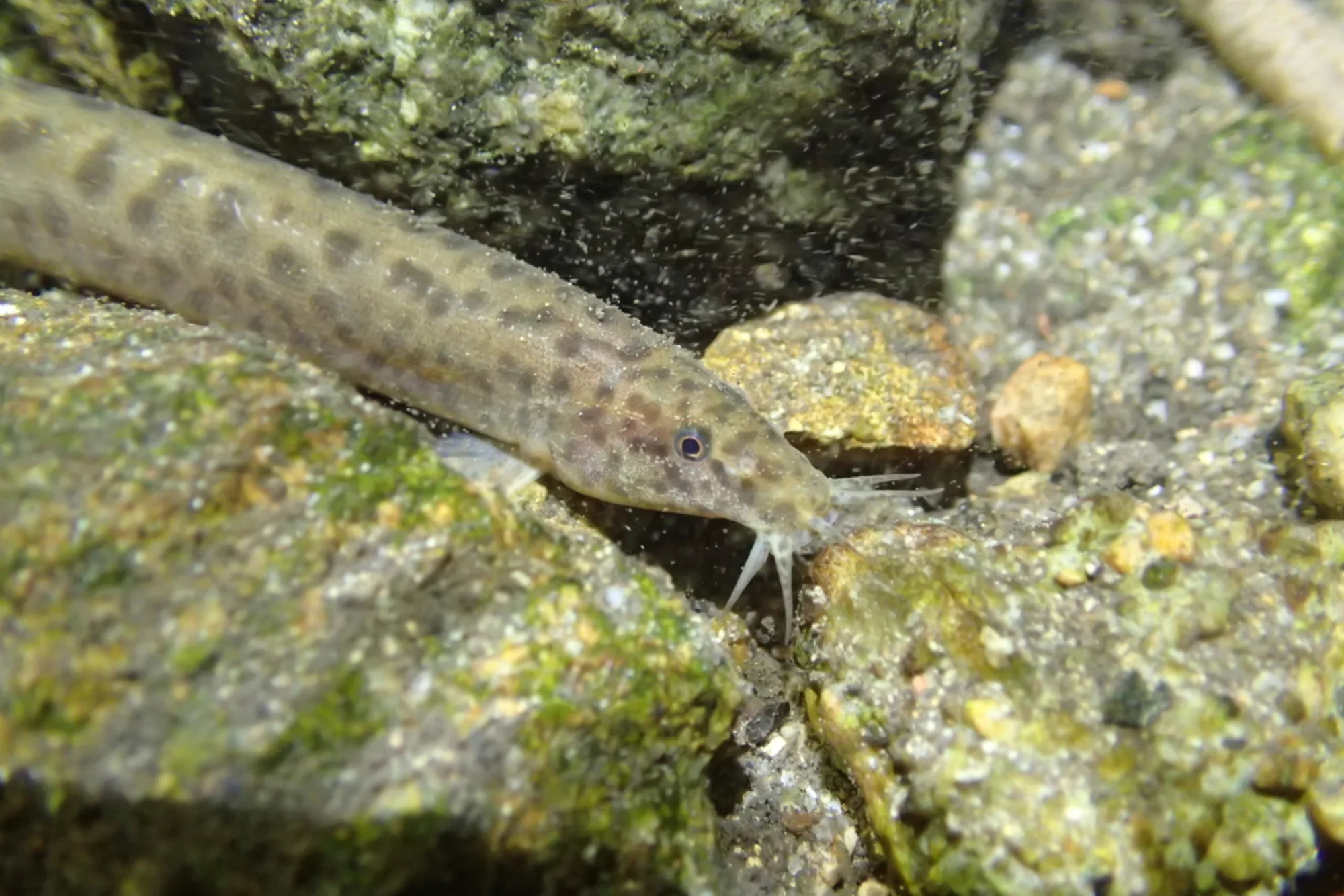
Slender and eel-like, the Oriental Weatherfish is a freshwater loach with a mouth surrounded by three sets of barbels, which it uses to search for food and dig. It usually measures 10 to 20 cm, though some reach 28 cm, and females are generally larger than males. Its colour varies from yellow to olive green, or commonly light brown or grey, with a paler underside; pink, orange and albino fish also occur.
Its natural range stretches from Siberia south to northern Vietnam and includes Japan; people have also introduced it to other parts of Asia, as well as Europe, America and Australia. It lives near the bottom and can burrow into soft material, sometimes burying itself when stressed. Active through the day with intermittent rests, it forages and swims more actively between sunset and sunrise. It may rest on broad leaves, driftwood or smooth rocks, sometimes lying on its side or back before swimming off again. Its food includes small bottom-dwelling invertebrates and detritus, with insect larvae, small crustaceans and molluscs found in stomach studies. The fish can reproduce both sexually and asexually, and asexual clones occur in a few wild populations.
The name weatherfish reflects its response to pressure changes before a storm, when it may swim frantically or stand on end. It can breathe air when necessary and survive short droughts by producing mucus that holds moisture against its body. In the wild, it can move across land between shallow bodies of water, although a fish out of water may be caught by a bird or another animal, or eventually suffocate. Water above 21 to 24 °C can cause breathing problems, fatigue or death.
Written from the English Wikipedia article Pond loach (CC BY-SA 4.0).
- Records
- 3,339
- Countries
- 12
- Atlas places
- 1
These are open occurrence records, so they show where people looked for and recorded the Oriental Weatherfish as much as where it lives. Cells are up to 25 km across, and every location is generalised to its cell.
Generalised encounter areas, not exact locations. Each shape is a grid cell coloured by how likely the species is there.
- Very likelyAustralia25 km zone · medium confidence · 1504 records · updated 80 days ago
- Very likelyChina25 km zone · medium confidence · 753 records · updated 80 days ago
- Very likelySouth Korea25 km zone · medium confidence · 420 records · updated 80 days ago
- Very likelyJapan25 km zone · medium confidence · 234 records · updated 80 days ago
- Very likelyUnited States25 km zone · medium confidence · 234 records · updated 80 days ago
- Very likelyTaiwan25 km zone · medium confidence · 98 records · updated 80 days ago
- Very likelyItaly25 km zone · medium confidence · 81 records · updated 80 days ago
- LikelyBelize25 km zone · medium confidence · 4 records · updated 80 days ago
- LikelyCanada25 km zone · medium confidence · 4 records · updated 80 days ago
- LikelyRussia25 km zone · medium confidence · 3 records · updated 80 days ago
Conservation status not assessed here yet, so every location is generalised to its grid cell.