Northern Elephant Seal
Mirounga angustirostris
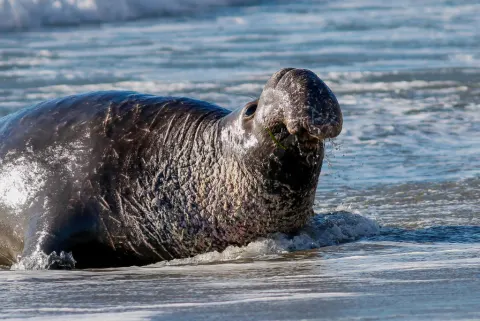
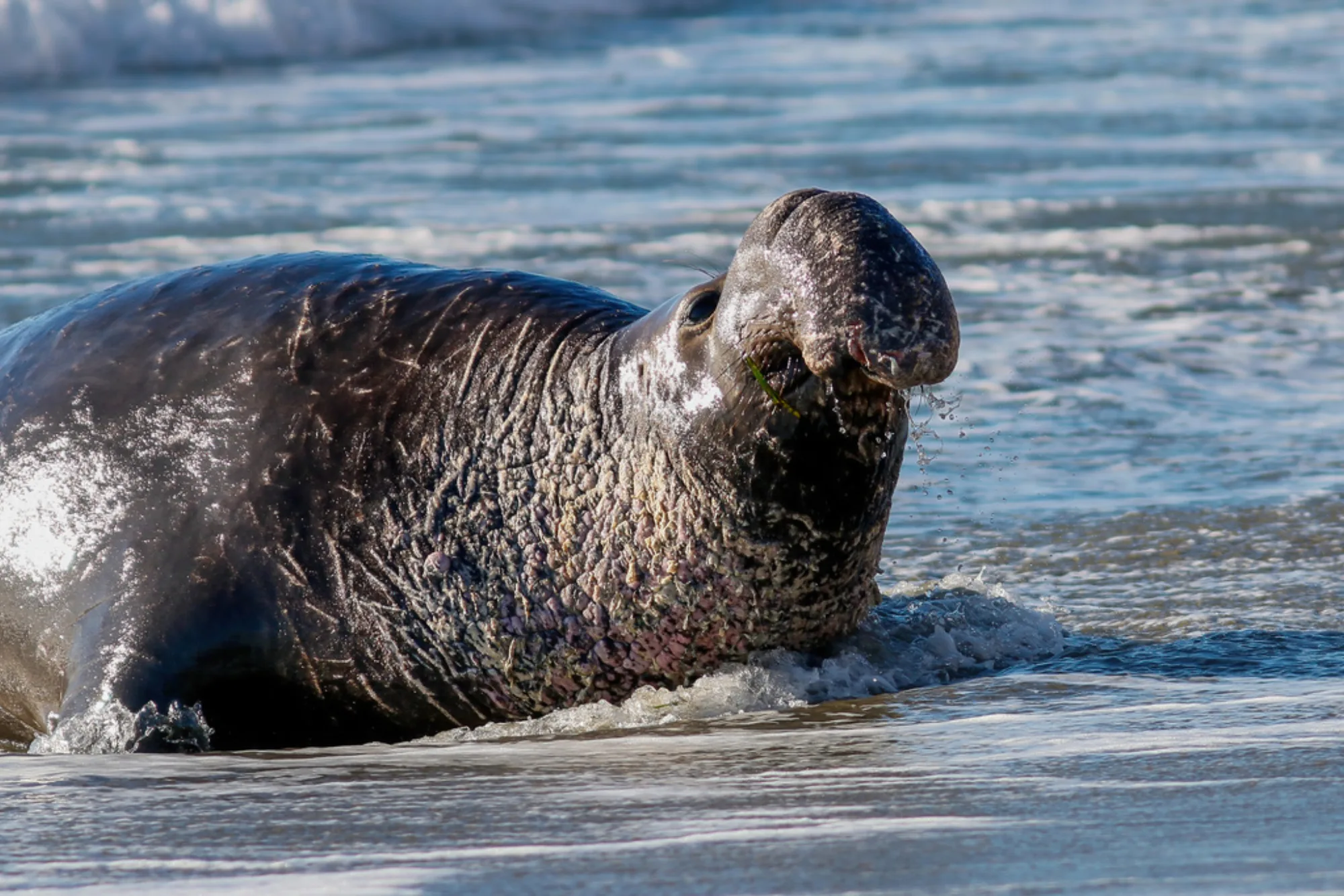
A huge seal with a prominent nose, the male Northern Elephant Seal cuts a distinctive figure on a breeding beach. Males typically measure 4 to 5 m and weigh 1,500 to 2,300 kg, while females are much smaller, measuring 2.5 to 3.6 m. Pups are born with almost black fur, which becomes silvery grey after weaning; later coats range from silver to deep grey before fading to tan. On land, these seals move with an awkward lunge, although they can be quick over short distances.
Northern elephant seals live in the eastern Pacific Ocean and spend most of their time at sea, coming ashore mainly to breed, give birth and moult. Their breeding beaches lie on offshore islands and remote stretches of mainland, with most rookeries in California and northern Baja California. At sea, males head north to feed along the continental shelf, while females travel north or west into the open ocean. Their varied diet includes deep-water squid, fish, crustaceans, small sharks and rays. Females can dive to 1,735 metres, using their whiskers to help locate prey in the darkness. Seals return to breeding grounds in December and January, when males fight for dominance and females give birth. Each female nurses a single pup for four weeks, after which the youngster remains ashore with other weaned pups before learning to forage at sea.
Hunting for oil nearly wiped the species out, and its small surviving population lost genetic diversity, leaving it more susceptible to disease, environmental change and pollution. El Niño weather can reduce numbers, while some southern colonies are declining, likely because of rising sea and air temperatures. Orcas and great white sharks also prey on elephant seals, especially pups.
Written from the English Wikipedia article Northern elephant seal (CC BY-SA 4.0).
- Records
- 1,254
- Countries
- 3
- Atlas places
- 4
These are open occurrence records, so they show where people looked for and recorded the Northern Elephant Seal as much as where it lives. Cells are up to 25 km across, and every location is generalised to its cell.
Generalised encounter areas, not exact locations. Each shape is a grid cell coloured by how likely the species is there.
- Very likelyUnited States25 km zone · medium confidence · 1198 records · updated 80 days ago
- Very likelyMexico25 km zone · medium confidence · 34 records · updated 80 days ago
- Very likelyCanada25 km zone · medium confidence · 22 records · updated 80 days ago
Conservation status not assessed here yet, so every location is generalised to its grid cell.