Northern Mockingbird
Mimus polyglottos
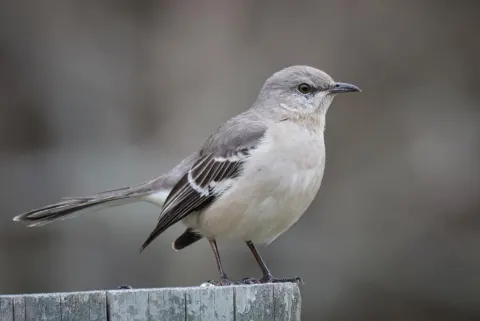
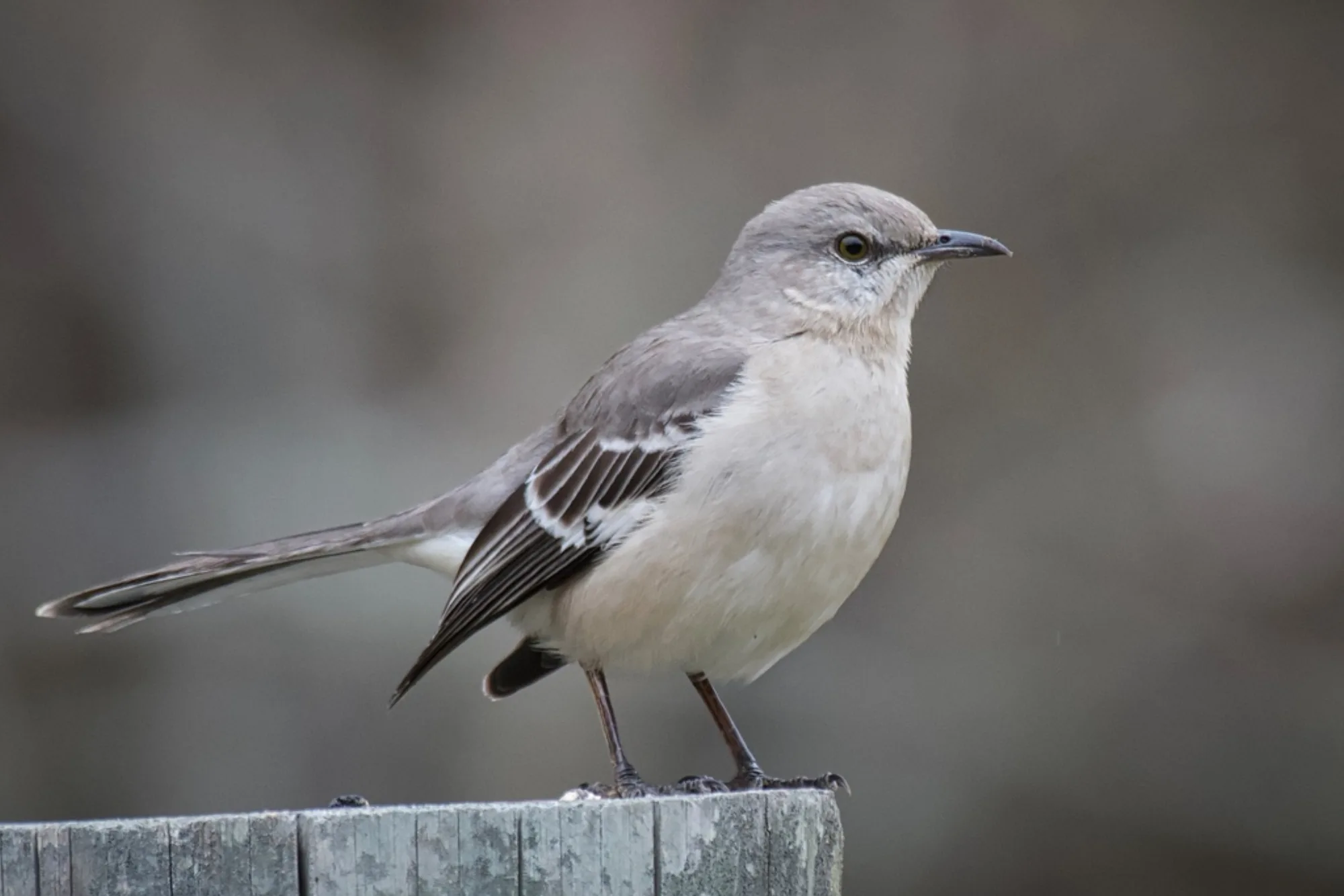
Listen for a bird that borrows its neighbours' voices: the Northern Mockingbird mimics other birds as well as frogs, dogs and sounds such as car alarms. Both sexes sing, although females are generally quieter, and an individual can add to its repertoire throughout its life. This medium-sized bird has grey to brown upper feathers, a pale belly, long legs and a long tail. White patches on the wings and tail stand out in flight, while young birds have streaked backs and marked chests. It measures 20.5 to 28 cm from bill to tail, with the tail nearly matching the body in length.
Northern Mockingbirds are common across North America and also occur in parts of the Caribbean and on the Hawaiian Islands. They favour open places with sparse vegetation, including woodland edges, parks and gardens, as well as desert scrub and chaparral in western regions. Many stay in the same area year round, although birds in northern parts of the range often move south for winter. Foraging on the ground or among plants, they eat insects and other invertebrates, fruit, seeds and occasionally small lizards. Animal prey makes up much of the breeding-season diet, with fruit taking a greater share in autumn and winter. While searching for food, a bird often spreads its wings to show their white patches.
Breeding takes place in spring and early summer, and both parents help build the nest and feed the chicks. A clutch contains three to five eggs; the birds vigorously defend their nest against intruders, sometimes calling neighbours to help. Cats, snakes and other predators take eggs or young, while winter storms and dry seasons can affect populations. In Baltimore and Washington, D.C., urban birds have become more susceptible to lead poisoning.
Written from the English Wikipedia article Northern mockingbird (CC BY-SA 4.0).
- Records
- 4,879,117
- Countries
- 19
- Atlas places
- 3
These are open occurrence records, so they show where people looked for and recorded the Northern Mockingbird as much as where it lives. Cells are up to 25 km across, and every location is generalised to its cell.
Generalised encounter areas, not exact locations. Each shape is a grid cell coloured by how likely the species is there.
- Very likelyUnited States25 km zone · high confidence · 4634006 records · updated 86 days ago
- Very likelyMexico25 km zone · high confidence · 117859 records · updated 86 days ago
- Very likelyPuerto Rico25 km zone · high confidence · 33481 records · updated 86 days ago
- Very likelyCanada25 km zone · high confidence · 25665 records · updated 86 days ago
- Very likelyBahamas25 km zone · high confidence · 20210 records · updated today
- Very likelyCayman Islands25 km zone · high confidence · 14574 records · updated today
- Very likelyCuba25 km zone · high confidence · 12925 records · updated today
- Very likelyDominican Republic25 km zone · high confidence · 8205 records · updated today
- Very likelyJamaica25 km zone · high confidence · 7031 records · updated today
- LikelyHaiti25 km zone · high confidence · 1792 records · updated today
Conservation status not assessed here yet, so every location is generalised to its grid cell.