Red Kite
Milvus milvus
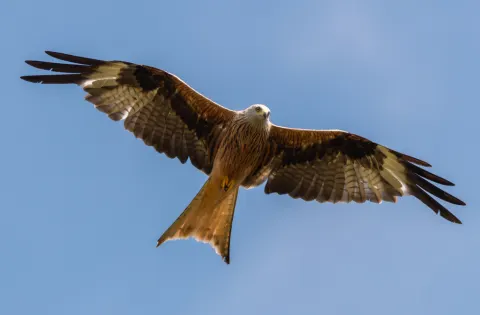
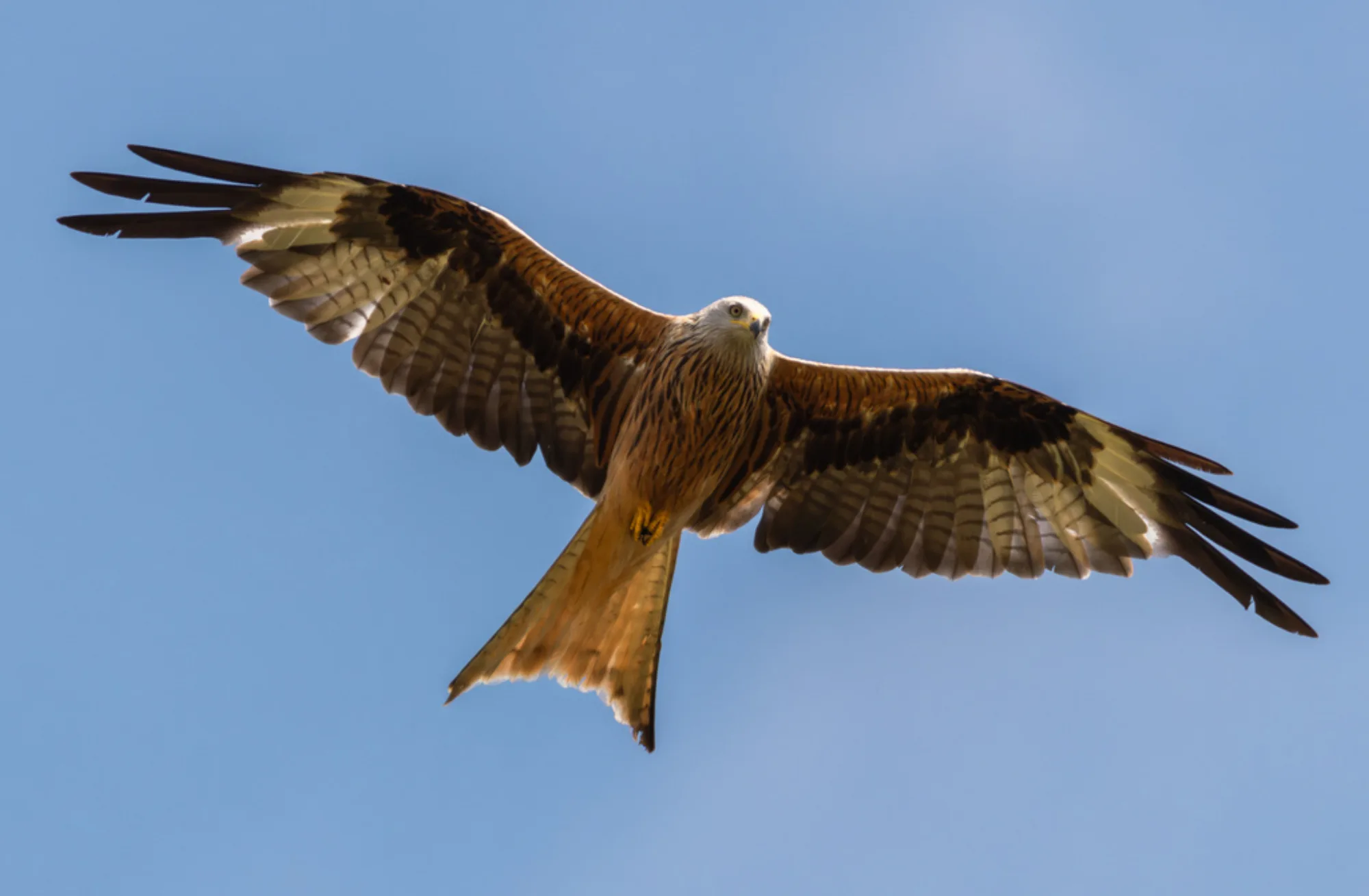
Look for the Red Kite soaring on long wings, its forked tail twisting as it changes direction. This bird of prey has a rufous body and upper tail, with white flight feathers contrasting against black wingtips. Young birds have a buff breast and belly, and a less deeply forked tail than adults. Listen for a slender, piping call, less mewling than a common buzzard's.
Red Kites now breed only in Europe, from Portugal and Spain east to European Russia, and north to southern Scandinavia and the United Kingdom. They use broadleaf woodland, pastures, mixed farmland, valleys and wetland edges, reaching at least 1,600 metres in elevation. In southern Sweden, Kullaberg Nature Preserve is one place to look for them; in England, many occur in the Oxfordshire Chilterns. Many northern mainland European birds once moved south or west for winter, though increasing numbers now stay in the region year-round.
Kites scavenge and hunt, feeding mainly on carrion, roadkill and stranded fish, but also taking small mammals and live birds. Earthworms are an important food, especially in spring, and some kites are fed in gardens in the United Kingdom. Pairs usually nest in a fork of a large hardwood tree, sometimes reusing a nest, and both parents care for the chicks. Poisoning is a major threat, including illegal poison baits and pesticides, while changes in farming can reduce food supplies. Electrocution, hunting, trapping and deforestation also threaten the birds.
Written from the English Wikipedia article Red kite (CC BY-SA 4.0).
- Records
- 473,233
- Countries
- 41
No atlas park has a record of the Red Kite in or around it yet.
These are open occurrence records, so they show where people looked for and recorded the Red Kite as much as where it lives. Cells are up to 25 km across, and every location is generalised to its cell.
Generalised encounter areas, not exact locations. Each shape is a grid cell coloured by how likely the species is there.
- Very likelySpain25 km zone · high confidence · 158449 records · updated 86 days ago
- Very likelyUnited Kingdom25 km zone · high confidence · 157992 records · updated 86 days ago
- Very likelyFrance25 km zone · high confidence · 88014 records · updated 86 days ago
- Very likelySwitzerland25 km zone · high confidence · 16191 records · updated 86 days ago
- Very likelyGermany25 km zone · high confidence · 13400 records · updated 86 days ago
- Very likelySweden25 km zone · high confidence · 9341 records · updated 86 days ago
- Very likelyPortugal25 km zone · high confidence · 6913 records · updated 86 days ago
- Very likelyBelgium25 km zone · high confidence · 5384 records · updated today
- Very likelyAustria25 km zone · high confidence · 4684 records · updated 86 days ago
- Very likelyCzechia25 km zone · high confidence · 4138 records · updated 86 days ago
Conservation status not assessed here yet, so every location is generalised to its grid cell.