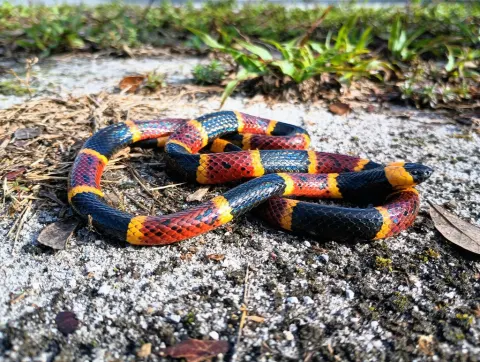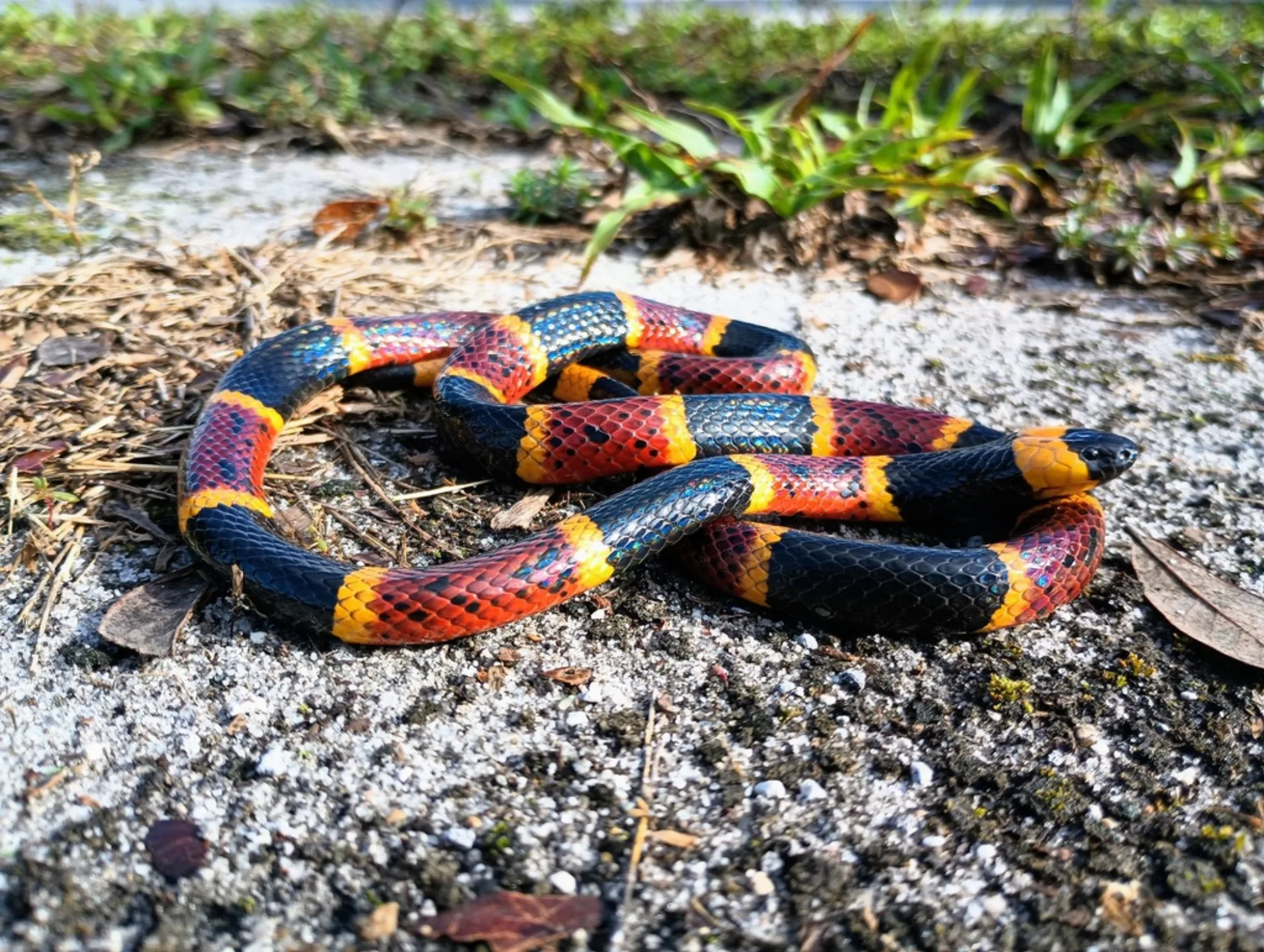
Eastern Coral Snake
Micrurus fulvius
Bands of red, black and yellow wrap around the Eastern Coral Snake, a highly venomous snake native to the southeastern United States. Its red and black bands are wide, while the yellow bands between them are narrow; the red is usually speckled with black. The head is black past the eyes, with a yellow band across its back half. It is usually less than 80 cm long, including the tail, and can be confused with the nonvenomous scarlet snake and scarlet kingsnake.
Its range includes all of Florida and reaches north to the southern coast of North Carolina. It occurs from near sea level to about 400 m, in habitats ranging from pine flatwoods and oak scrub to hammocks. In southern Georgia and Florida, it favours dry, bushy places with open ground and relatively sparse vegetation. In Mississippi, it occurs around sandy ridges, while in Louisiana it is found along sandy creek bottoms. Within scrubby habitats, it prefers sandy soils.
Coral snakes spend most of their time underground or sheltering beneath objects, but may emerge by day during early spring or when rain has soaked the ground. Night sightings are rare. If discovered, a snake will try to escape; if prevented, it may hide its head in its coils or feign death. It feeds mainly on other snakes and slender lizards, though its diet also includes mammals, birds, frogs, fish and insects. Females lay 3 to 12 eggs in June, and these hatch in September. No parental care of hatchlings has been recorded. The species is a local conservation concern throughout most of its range, although no specific threats are identified here.
Written from the English Wikipedia article Micrurus fulvius (CC BY-SA 4.0).
- Records
- 67
- Countries
- 1
- Atlas places
- 1
These are open occurrence records, so they show where people looked for and recorded the Eastern Coral Snake as much as where it lives. Cells are up to 25 km across, and every location is generalised to its cell.
Generalised encounter areas, not exact locations. Each shape is a grid cell coloured by how likely the species is there.
- Very likelyUnited States25 km zone · medium confidence · 67 records · updated 80 days ago
Conservation status not assessed here yet, so every location is generalised to its grid cell.