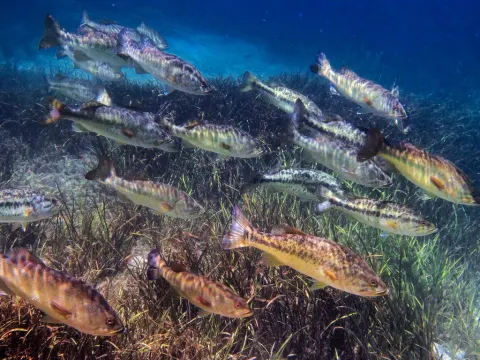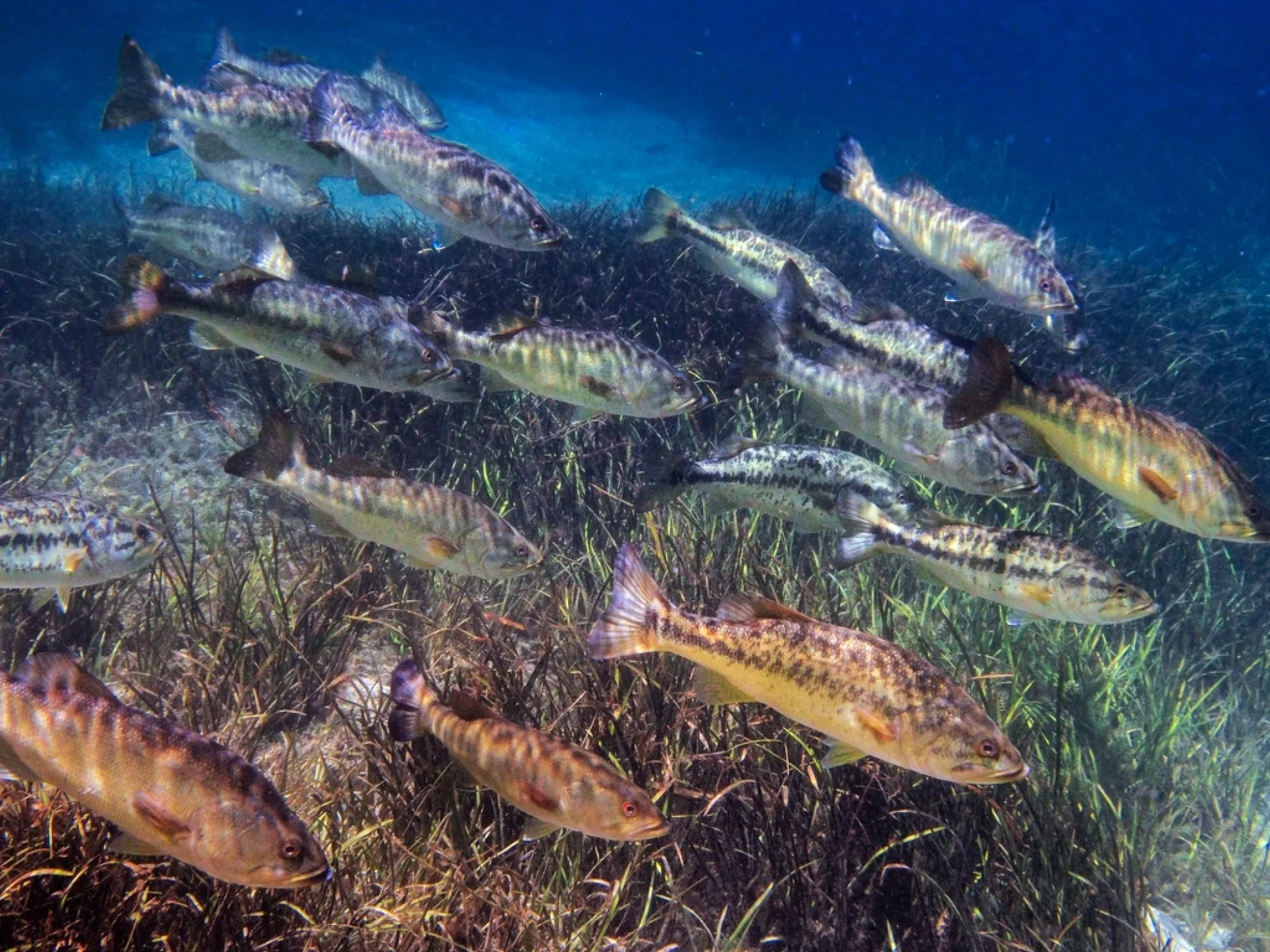
Largemouth Bass
Micropterus salmoides
Olive green to greenish grey, the Largemouth Bass has a broken, dark stripe running along each side. Its upper jaw extends behind the eye, and females grow larger than males. A freshwater fish and the largest of the black basses, it has reached a recorded length of 75 cm and an unofficial weight of 11.4 kg. Native to northern Mexico, parts of Canada and the eastern and central United States, it has also been introduced to many other regions. Look for it around large weed patches and other cover in shallow water, particularly where vegetation is plentiful. In lakes, individuals generally stay within relatively small home ranges.
Young bass eat small fish, tiny aquatic animals and insects, while adults also take prey such as frogs, snakes, snails and crayfish. In larger lakes and reservoirs, adults live a little deeper than young bass, feeding almost entirely on smaller fish. They use sight, hearing, vibration and smell to seize prey around cover such as overhanging banks, brush and submerged weedbeds. Spring brings spawning, with males making nests on the bottom and guarding the eggs until they hatch. The male then remains with the young until they are ready to swim away on their own. Young bass face predators including herons, larger bass, northern pike and water snakes, while bald eagles take both young and adults. Anglers also seek the fish, which may leap from the water when hooked. Research has linked heavy angling pressure with changes in bass physiology and suggests that repeated stress may affect populations.
Written from the English Wikipedia article Largemouth bass (CC BY-SA 4.0).
- Records
- 56,353
- Countries
- 3
No atlas park has a record of the Largemouth Bass in or around it yet.
These are open occurrence records, so they show where people looked for and recorded the Largemouth Bass as much as where it lives. Cells are up to 25 km across, and every location is generalised to its cell.
Generalised encounter areas, not exact locations. Each shape is a grid cell coloured by how likely the species is there.
- Very likelyUnited States25 km zone · high confidence · 55054 records · updated 80 days ago
- Very likelyFrance25 km zone · high confidence · 1172 records · updated 80 days ago
- Very likelySouth Korea25 km zone · high confidence · 127 records · updated 80 days ago
Conservation status not assessed here yet, so every location is generalised to its grid cell.