Spade-toothed Whale
Mesoplodon traversii
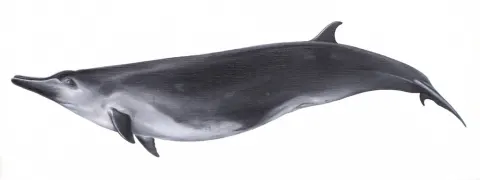
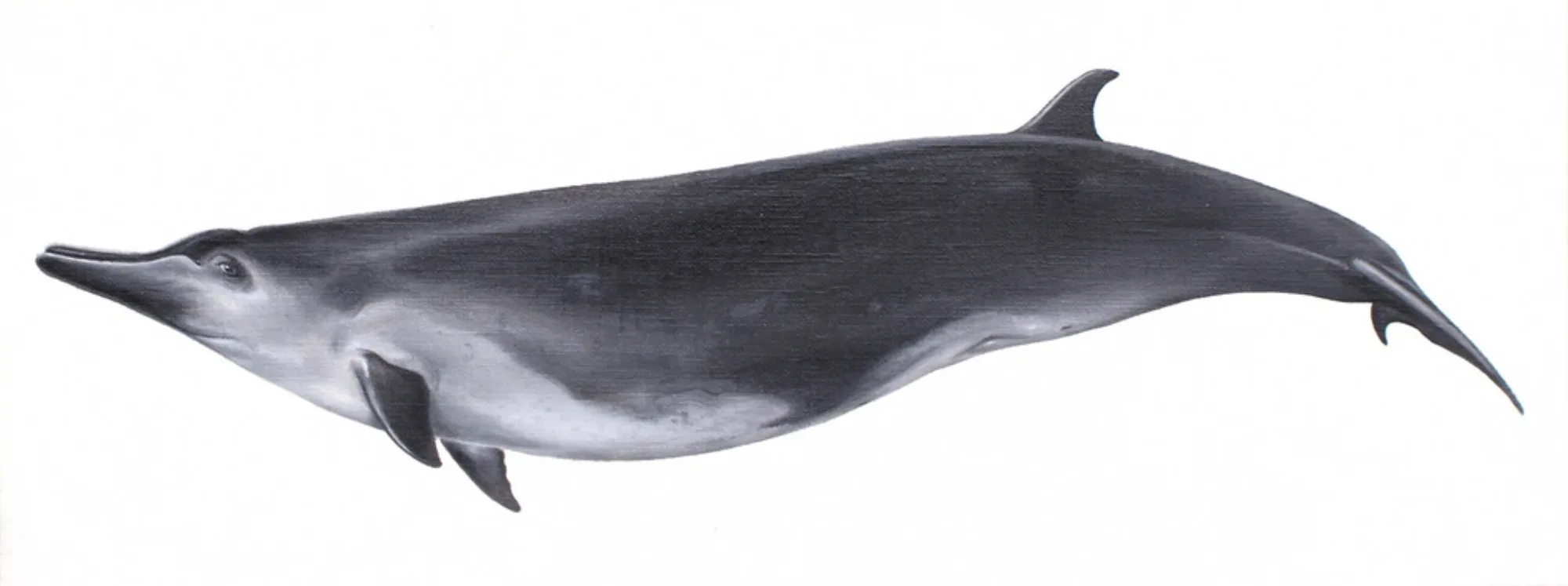
The Spade-toothed Whale is the rarest beaked whale on earth. It is a spindle-shaped mammal with a dark gray or black back and a white underside. You can identify it by its prominent eye patch, dark flippers, and a triangular dorsal fin located about two-thirds down its body. Its most distinctive features are huge teeth that can reach 23 cm, shaped like the tip of a flensing spade. While adult females have been measured at 5.3 metres, males may grow slightly larger.
Finding this whale in the wild is a significant challenge as it has never been seen alive. All seven confirmed specimens were found in the South Pacific, specifically in New Zealand and Chile. It is likely a deep-water species that lives alone or in small groups. Though its behavior remains a mystery, its diet includes squid, and it presumably feeds on small fish. In terms of breeding, it is thought that young whales stay with their mothers for about one year after a year-long gestation.
Because so few individuals have ever been found, the total population of this species is completely unknown. It is protected by a memorandum of understanding for conserving cetaceans in the Pacific Islands. Potential threats include parasitic worms, which have been found in the stomachs of specimens. Additionally, males appear to engage in aggressive behavior with one another, which can cause their teeth to smooth over time.
Written from the English Wikipedia article Spade-toothed whale (CC BY-SA 4.0).
- Atlas places
- 0
These are open occurrence records, so they show where people looked for and recorded the Spade-toothed Whale as much as where it lives. Cells are up to 25 km across, and every location is generalised to its cell.
No encounter zones yet
Where and when you can expect to see Spade-toothed Whale is calculated from observation density. No zones have been computed for this species yet.
Conservation status not assessed here yet, so every location is generalised to its grid cell.