Strap-toothed Whale
Mesoplodon layardii
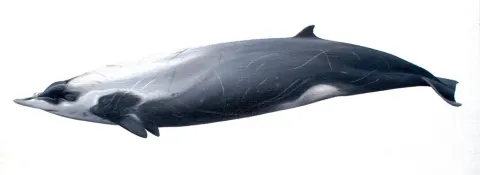
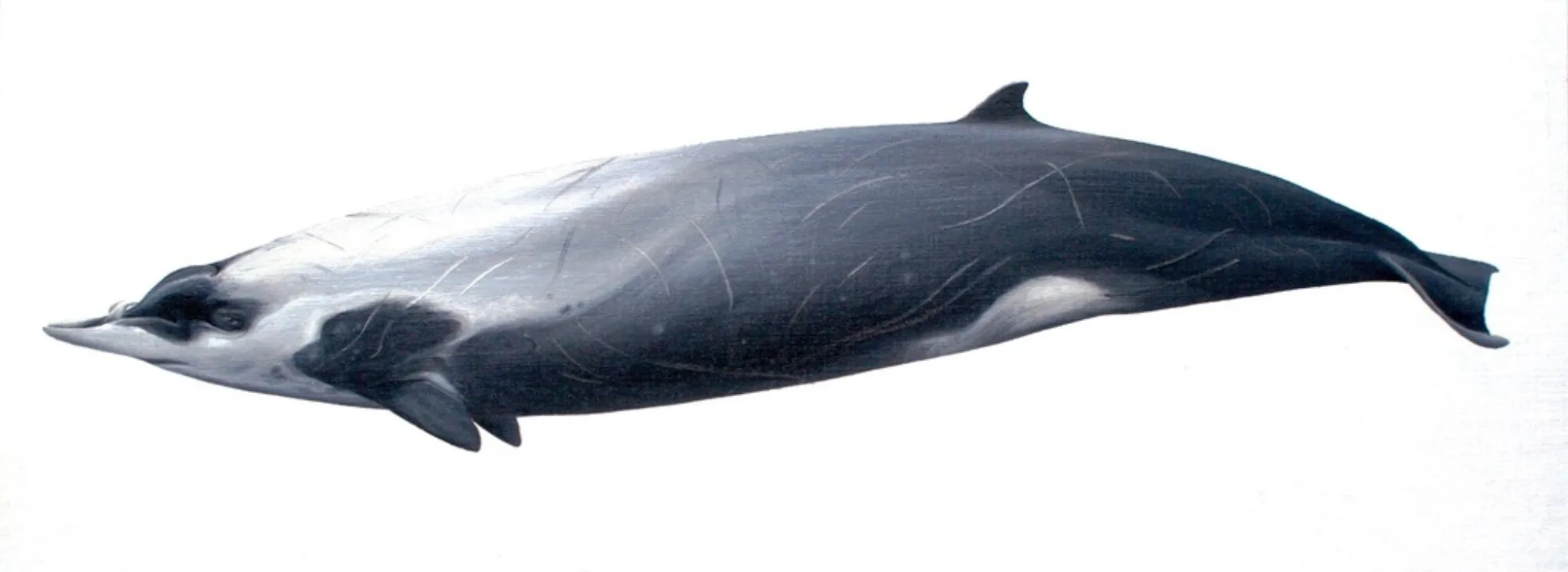
In the deep waters of the Southern Ocean, the Strap-toothed Whale can be recognised by the contrasting colours of adults. A white beak and dark face mask lead back to a pale cape, while a pale neckband separates the darker head from the rest of the body. The fin sits far back and has a white tip, as do the tail flukes. Juveniles are more difficult to distinguish from other beaked whales because they are uniformly grey. Females reach 6.2 metres, while males grow to around 5.9 metres. Adult males have long, curved teeth that arch over the upper jaw and limit how widely they can open their mouths.
Sightings and strandings suggest a wide range across subantarctic and temperate waters, possibly around the Southern Ocean. Records come from Argentina, the Falkland Islands, Australia and New Zealand. The whales favour deep offshore habitat, though they may come into coastal waters in summer to give birth. Much of their behaviour remains poorly known, but groups of two to ten have been observed. On calm days they may rest at the surface, yet they can sink out of sight when a vessel approaches. They surface steeply, beak first, and usually dive without showing their flukes. They use echolocation to navigate and hunt in deep, dark water, feeding mainly on squid. Females have been seen with calves.
Orcas prey on these whales, and human pressures include entanglement, noise, plastic debris and climate change. Intense sonar noise has caused panic, rapid ascent and death from decompression sickness in several beaked whale species.
Written from the English Wikipedia article Strap-toothed whale (CC BY-SA 4.0).
- Records
- 149
- Countries
- 4
No atlas park has a record of the Strap-toothed Whale in or around it yet.
These are open occurrence records, so they show where people looked for and recorded the Strap-toothed Whale as much as where it lives. Cells are up to 25 km across, and every location is generalised to its cell.
Generalised encounter areas, not exact locations. Each shape is a grid cell coloured by how likely the species is there.
- Very likelyAustralia25 km zone · medium confidence · 135 records · updated 80 days ago
- Very likelySouth Africa25 km zone · medium confidence · 7 records · updated 80 days ago
- PossibleArgentina25 km zone · medium confidence · 3 records · updated 80 days ago
- PossibleHeard & McDonald Islands25 km zone · medium confidence · 3 records · updated 80 days ago
- RareUnnamed area25 km zone · medium confidence · 1 record · updated 80 days ago
Conservation status not assessed here yet, so every location is generalised to its grid cell.