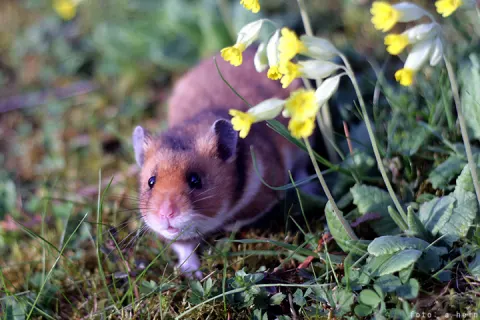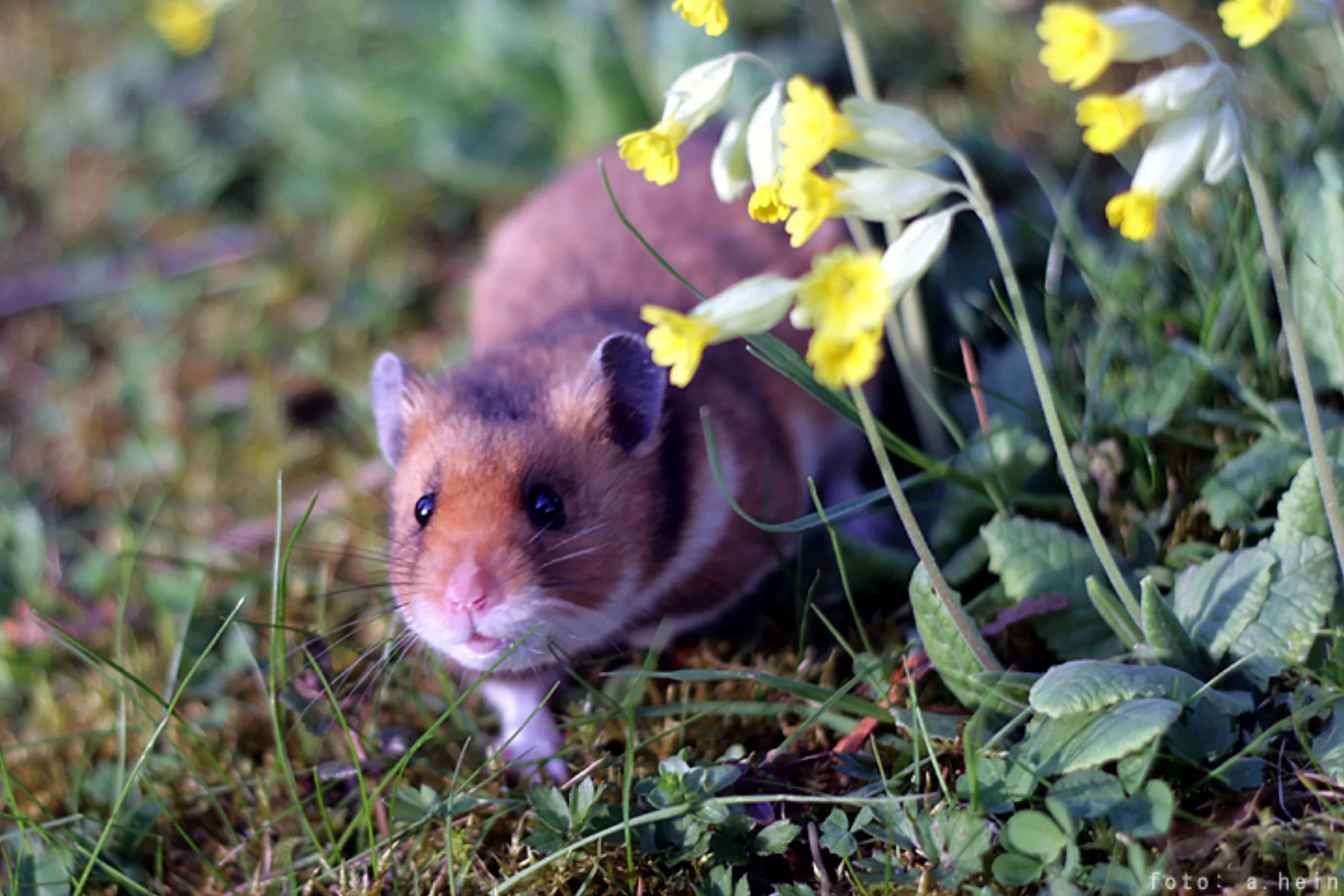
Golden Hamster
Mesocricetus auratus
Known also as the Syrian hamster, the Golden Hamster (Mesocricetus auratus) is a rodent native to dry areas spanning northern Syria and southern Turkey. Adults can reach around 18 cm in length, and females are usually larger than males. Its natural wild coat is agouti, while captive breeding has produced a range of colours, patterns and coat types. Expandable cheek pouches help it carry food back to its burrow, where it stores provisions. Wild sightings and captures have been infrequent, though researchers found and mapped 30 burrows during expeditions in northern Syria and southern Turkey.
Golden hamsters live alone and defend their territories, with encounters between individuals often leading to attacks. They mark their burrows with scent, and males also drag their sides against objects to mark territory. None of the occupied burrows found on the expeditions contained more than one adult. Observations of females in one wild population found them active around dawn and dusk, possibly to avoid night-hunting predators such as owls. Another study found wild Syrian hamsters active almost exclusively during the day, while laboratory animals are generally active at night. The species hoards food, although the available account does not specify what wild hamsters eat.
Females can give birth to 20 or more young, though a typical litter contains between eight and 10 pups. Pregnancy lasts around 16 days. An inexperienced or threatened mother may abandon or eat her young. In the wild, habitat loss caused by agriculture and deliberate killing by people have contributed to declining numbers.
Written from the English Wikipedia article Golden hamster (CC BY-SA 4.0).
- Records
- 6
- Countries
- 2
No atlas park has a record of the Golden Hamster in or around it yet.
These are open occurrence records, so they show where people looked for and recorded the Golden Hamster as much as where it lives. Cells are up to 25 km across, and every location is generalised to its cell.
Generalised encounter areas, not exact locations. Each shape is a grid cell coloured by how likely the species is there.
- Very likelyKenya25 km zone · medium confidence · 6 records · updated 81 days ago
- PossibleUnited States25 km zone · low confidence · 0 records · updated 81 days ago
Conservation status not assessed here yet, so every location is generalised to its grid cell.