Mongolian Jird
Meriones unguiculatus
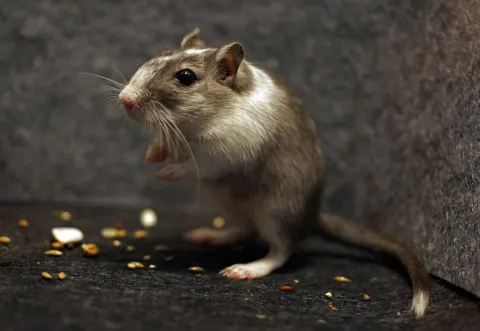
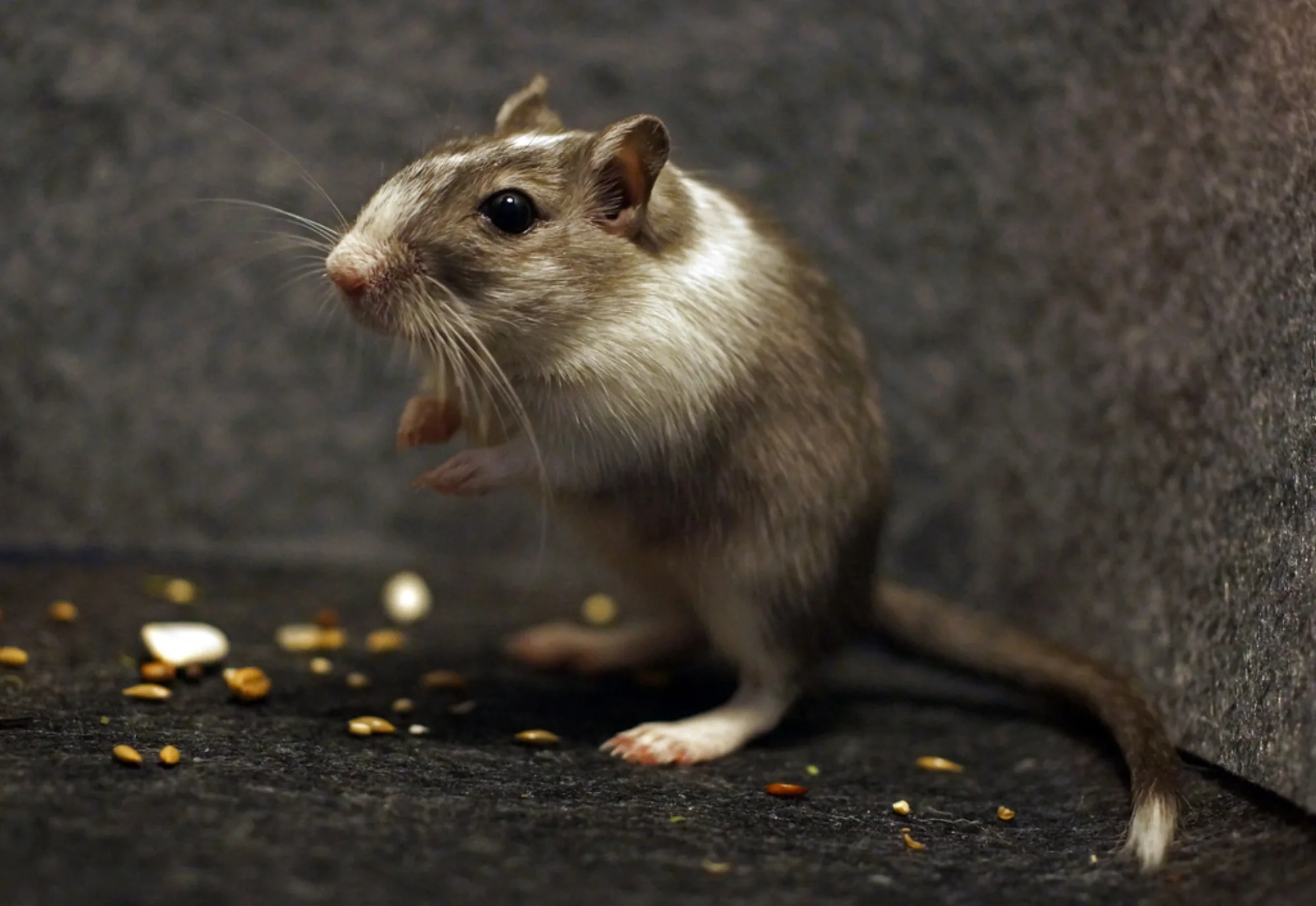
Across the grasslands and deserts of China, Mongolia and Russia, the Mongolian Jird (Meriones unguiculatus) lives in family groups centred on a shared burrow. This small rodent typically has a body 110 to 135 mm long and a tail measuring 95 to 120 mm; adults weigh 60 to 130 g, with males larger than females. Its range includes shrubland, semidesert and steppe, where sandy soil supports grasses, herbs and shrubs. Winters on the steppe are cool and dry, while summers are hot.
A wild group generally includes a breeding pair, their latest litter and a few older pups, sometimes joined by sisters of the dominant female. The central burrow has 10 to 20 exits, and the group may also have deeper burrows elsewhere in its territory. These offer an escape from predators when the animals are too far from their main burrow. Groups usually range over 325 to 1,550 square metres. Jirds use scent to recognise members of their own clan and may attack and kill an animal with an unfamiliar smell. Their natural food includes grass seeds, leaves, bulbs and herbs.
In the wild, breeding takes place in February and October, and only dominant females produce pups within the group. An average litter contains around 4 to 8 pups. Predators are a danger, and very small litters can also be at risk: mothers may neglect litters of 1 to 2 young, which then die from starvation. The account does not identify wider threats to wild populations.
Written from the English Wikipedia article Mongolian gerbil (CC BY-SA 4.0).
- Records
- 9
- Countries
- 5
- Atlas places
- 1
These are open occurrence records, so they show where people looked for and recorded the Mongolian Jird as much as where it lives. Cells are up to 25 km across, and every location is generalised to its cell.
Generalised encounter areas, not exact locations. Each shape is a grid cell coloured by how likely the species is there.
- Very likelyMongolia25 km zone · medium confidence · 9 records · updated 80 days ago
- LikelyCanada25 km zone · low confidence · 0 records · updated 80 days ago
- PossibleBelgium25 km zone · low confidence · 0 records · updated 80 days ago
- PossibleUnited States25 km zone · low confidence · 0 records · updated 80 days ago
- UncommonPoland25 km zone · low confidence · 0 records · updated 80 days ago
Conservation status not assessed here yet, so every location is generalised to its grid cell.