Red-breasted Merganser
Mergus serrator
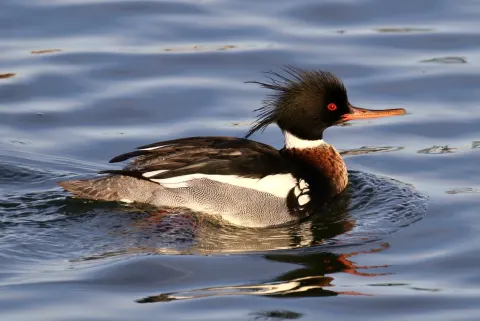
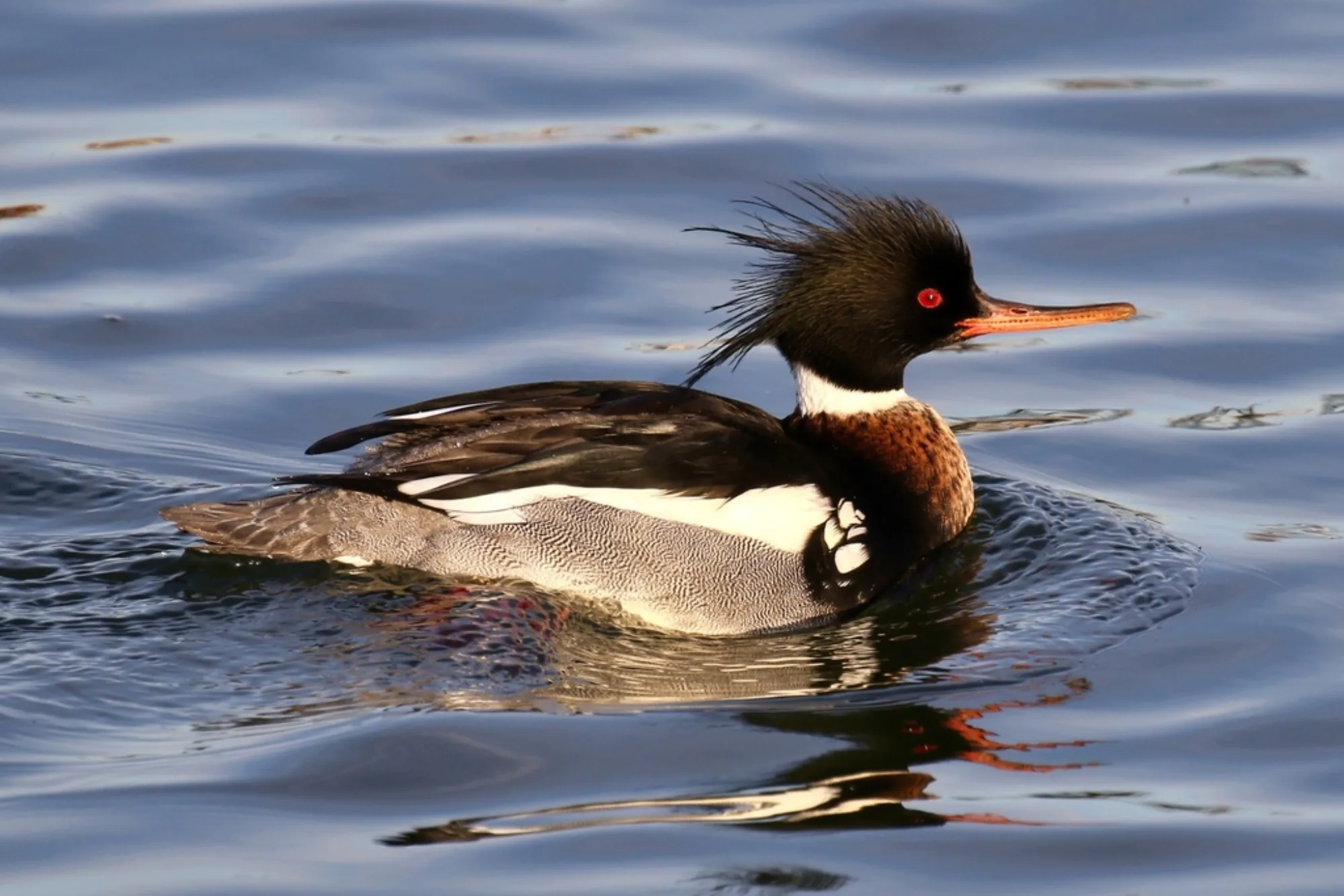
A spiky crest and a long, thin red bill give the Red-breasted Merganser a distinctive profile on the water. This duck measures 51 to 64 cm in length, with a wingspan of 66 to 74 cm. In breeding plumage, the male has a dark, green-sheened head, a white neck and a rusty breast, with a black back and white underparts. Females have rusty heads and greyish-brown bodies, while young birds look similar but have shorter crests. Females, immature birds and males outside breeding plumage can be difficult to tell from the similar common merganser.
The species is native to northern regions ranging from temperate latitudes to the subarctic. It breeds beside freshwater lakes and rivers across the Palearctic and Europe, as well as Greenland and northern North America. Most migrate, with northern breeders moving south to coastal waters for winter, although some populations in northwestern Europe remain close to home. Outside the breeding season, these ducks gather in flocks, generally smaller on spring migration than in autumn or winter. They fly rapidly and dive from the surface, swimming underwater in pursuit of prey. Small fish make up most of their diet, supplemented by aquatic insects, worms, crustaceans and amphibians. Nests are sheltered spots on the ground near water, sometimes close to estuaries or the coast. Once hatched, the young leave the nest within 24 hours.
Wetland destruction and exposure to pesticides and lead threaten the species in some areas. Birds can also become bycatch in commercial fishing operations. Some anglers and fish farmers persecute them as competitors, with illegal persecution by fisheries interests a significant problem in Britain, particularly Scotland.
Written from the English Wikipedia article Red-breasted merganser (CC BY-SA 4.0).
- Records
- 1,544,706
- Countries
- 7
- Atlas places
- 2
These are open occurrence records, so they show where people looked for and recorded the Red-breasted Merganser as much as where it lives. Cells are up to 25 km across, and every location is generalised to its cell.
Generalised encounter areas, not exact locations. Each shape is a grid cell coloured by how likely the species is there.
- Very likelyUnited States25 km zone · high confidence · 1036785 records · updated 80 days ago
- Very likelyCanada25 km zone · high confidence · 252193 records · updated 80 days ago
- Very likelyNorway25 km zone · high confidence · 229359 records · updated 80 days ago
- Very likelyIceland25 km zone · high confidence · 15012 records · updated 80 days ago
- Very likelyFinland25 km zone · high confidence · 8076 records · updated 80 days ago
- Very likelyUnited Kingdom25 km zone · high confidence · 3281 records · updated 80 days ago
Conservation status not assessed here yet, so every location is generalised to its grid cell.