Common Merganser
Mergus merganser
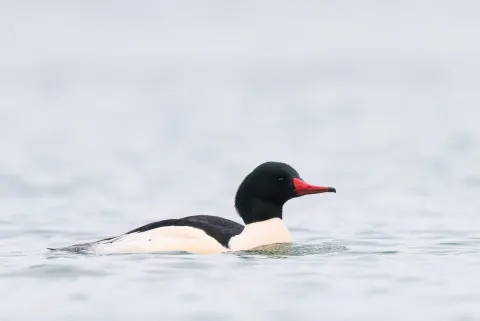
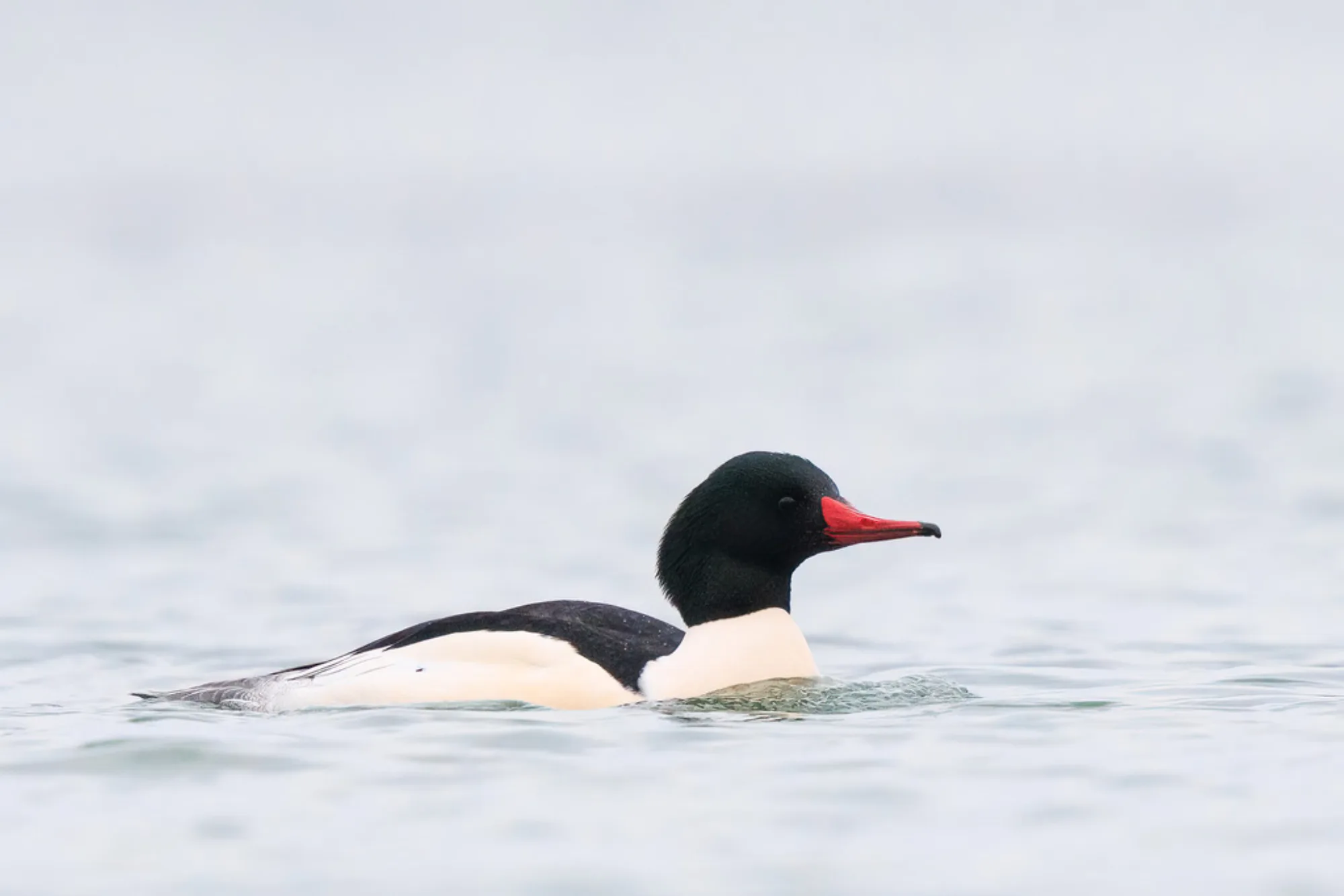
Look for the Common Merganser on rivers and lakes in forested parts of Europe, Asia and North America. Also known as the goosander in Eurasia, this large duck measures 58 to 72 cm long, with a wingspan of 78 to 97 cm. In breeding plumage, the male has a dark head with a green sheen, a mostly white body that can have a salmon-pink tint, and black and white wings. Females are mostly grey with a reddish-brown head and white chin; young birds look similar but have a short white stripe near the bill. The bill and legs range from red to brownish-red.
Fish make up most of its diet, but it also takes aquatic animals including molluscs, crustaceans, worms, insect larvae and amphibians. Groups often fish together, forming a semicircle to drive their prey into shallow water. Between dives, birds may swim on the surface or rest on midstream rocks, among riverbank plants or beside floating ice in winter. They use both fresh and salt water, and may drift downstream before fishing their way back. Some populations migrate when rivers and large lakes freeze, while birds remain year-round where the water stays open.
The species usually nests in tree cavities and needs mature forest for breeding, although it also uses large nest boxes. In treeless mountain country, it may nest in holes in cliffs or high banks. A female lays 6 to 17 eggs and carries her newly hatched ducklings on her back to rivers or lakes, where the young eat small fish fry and freshwater invertebrates. Illegal persecution associated with game fishing is a problem in some regions.
Written from the English Wikipedia article Common merganser (CC BY-SA 4.0).
- Records
- 1,446,432
- Countries
- 8
- Atlas places
- 1
These are open occurrence records, so they show where people looked for and recorded the Common Merganser as much as where it lives. Cells are up to 25 km across, and every location is generalised to its cell.
Generalised encounter areas, not exact locations. Each shape is a grid cell coloured by how likely the species is there.
- Very likelyUnited States25 km zone · high confidence · 817356 records · updated 80 days ago
- Very likelyCanada25 km zone · high confidence · 516244 records · updated 80 days ago
- Very likelyNorway25 km zone · high confidence · 76720 records · updated 80 days ago
- Very likelyFinland25 km zone · high confidence · 19394 records · updated 80 days ago
- Very likelyFrance25 km zone · high confidence · 6800 records · updated 80 days ago
- Very likelyUnited Kingdom25 km zone · high confidence · 5241 records · updated 80 days ago
- Very likelyBelgium25 km zone · high confidence · 4677 records · updated 80 days ago
Conservation status not assessed here yet, so every location is generalised to its grid cell.