Smew
Mergellus albellus
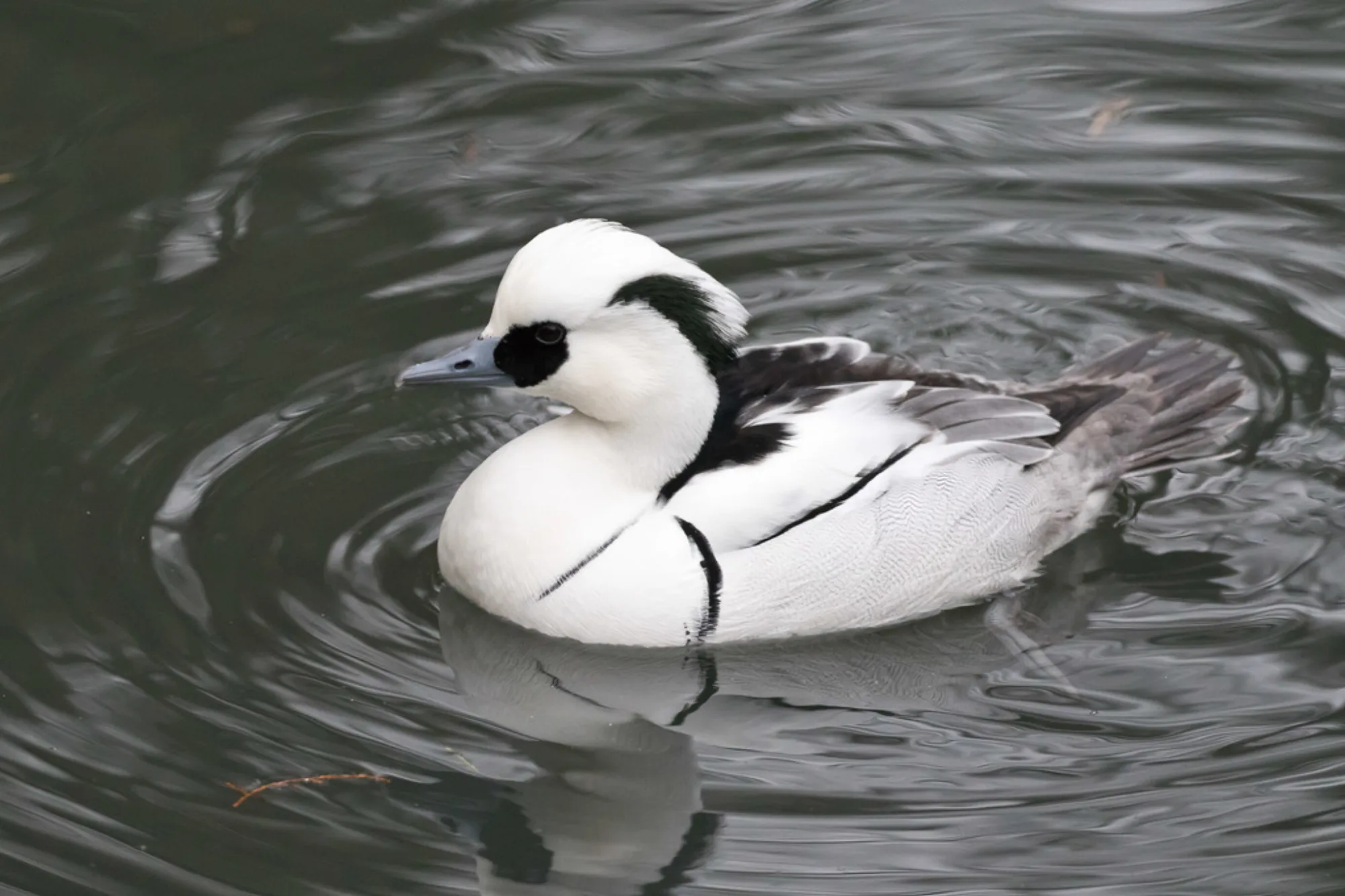
In flight, an adult male Smew stands out in black and white, while the grey females and young males have chestnut crowns and foreheads, with white cheeks and chins. These birds are often called redhead smew. White oval patches show on the wings in flight. The duck measures 38 to 44 cm in length, spans 56 to 69 cm across the wings and weighs 450 to 650 g. Young males acquire adult plumage late in their first winter, while adult males look more like females in late summer and autumn, though they retain more white in the wing.
Smew need trees for nesting and breed across northern taiga, ranging eastwards from Scandinavia as far as Chukotka. They live on fish-rich lakes and slow rivers, favouring lake edges, often beneath small trees. A shy bird, the Smew takes flight readily when disturbed. It dives for fish, using its hooked bill to help catch them. Migrants leave the breeding grounds for sheltered coasts and inland lakes, wintering in places including the Baltic and Black seas, Great Britain, eastern China, Korea and Japan. In Great Britain, most winter in southeast England, though some reach Scotland.
Breeding takes place in May, with nests in tree holes, including old woodpecker nests. The female incubates 7 to 11 cream-coloured eggs for 26 to 28 days. Soon after hatching, the ducklings leave the nest, and they learn to fly within about 10 weeks. The population is decreasing, though the available account does not identify a particular threat.
Written from the English Wikipedia article Smew (CC BY-SA 4.0).
- Records
- 85,588
- Countries
- 26
No atlas park has a record of the Smew in or around it yet.
These are open occurrence records, so they show where people looked for and recorded the Smew as much as where it lives. Cells are up to 25 km across, and every location is generalised to its cell.
Generalised encounter areas, not exact locations. Each shape is a grid cell coloured by how likely the species is there.
- Very likelyNorway25 km zone · high confidence · 21711 records · updated 80 days ago
- Very likelyBelgium25 km zone · high confidence · 18522 records · updated 80 days ago
- Very likelyFinland25 km zone · high confidence · 15026 records · updated 80 days ago
- Very likelyUnited Kingdom25 km zone · high confidence · 8690 records · updated 80 days ago
- Very likelyNetherlands25 km zone · high confidence · 2801 records · updated 80 days ago
- Very likelyJapan25 km zone · high confidence · 2764 records · updated 80 days ago
- Very likelySweden25 km zone · high confidence · 2484 records · updated 80 days ago
- Very likelyFrance25 km zone · high confidence · 1904 records · updated 80 days ago
- Very likelyChina25 km zone · high confidence · 1688 records · updated 80 days ago
- Very likelyRussia25 km zone · high confidence · 1635 records · updated 80 days ago
Conservation status not assessed here yet, so every location is generalised to its grid cell.