Striped Skunk
Mephitis mephitis
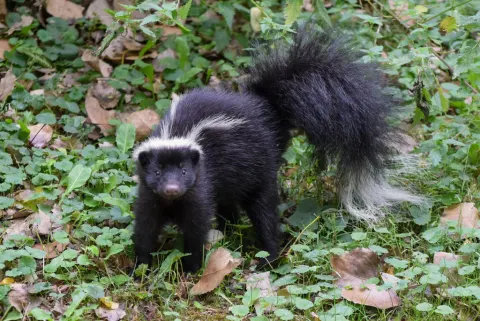
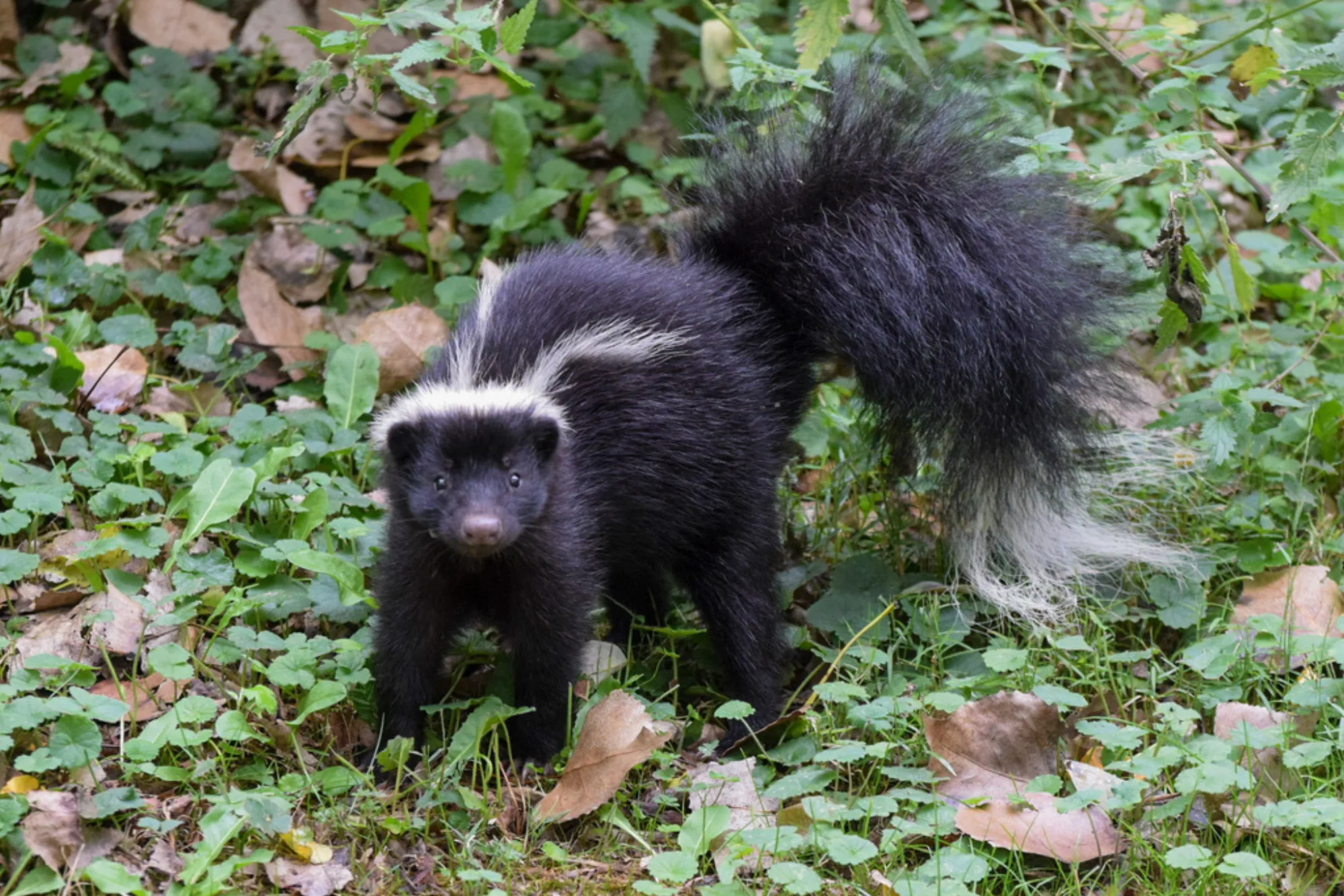
A stout body, short legs and a long, bushy tail give the Striped Skunk a distinctive shape. Its fur is usually black, with a white stripe from the head that divides at the shoulders and runs along the sides towards the rump and tail. Patterns vary, and some animals also have white on the chest or front legs. Adults measure 52 to 77 centimetres in total length and usually weigh 1.8 to 4.5 kg. The species occurs across much of North America, from southern Canada through the United States to northern Mexico. It uses many habitats, including mixed woodland, brushy corners and open fields broken up by wooded ravines and rocky outcrops. Some populations favour cultivated land.
Mostly active at night, the skunk eats insects including grasshoppers, beetles and crickets, as well as other animals and seasonal plant food. It tears open rotting logs for grubs and digs for insects, leaving small pits that can reveal its presence. It may dig a den or take over one abandoned by another animal; in winter, several females and a male may share a den. In cold weather it relies mainly on stored fat, although it still forages briefly. Breeding usually takes place from mid-February to mid-April, with young born around mid-May to early June. Litters generally contain 2 to 12 kits, which are born blind and sparsely furred and become independent after 2+1⁄2 months.
The skunk can spray a strong-smelling musk to defend itself, and few natural predators tackle it. Birds of prey, including eagles and great horned owls, have greater success than mammalian hunters. Disease also affects skunks, including rabies and leptospirosis. People have trapped them for fur, and intensive trapping largely eliminated the more valuable, mostly black animals.
Written from the English Wikipedia article Striped skunk (CC BY-SA 4.0).
- Records
- 3,386
- Countries
- 3
- Atlas places
- 3
These are open occurrence records, so they show where people looked for and recorded the Striped Skunk as much as where it lives. Cells are up to 25 km across, and every location is generalised to its cell.
Generalised encounter areas, not exact locations. Each shape is a grid cell coloured by how likely the species is there.
- Very likelyUnited States25 km zone · medium confidence · 2442 records · updated 80 days ago
- Very likelyCanada25 km zone · high confidence · 851 records · updated 80 days ago
- Very likelyMexico25 km zone · high confidence · 93 records · updated 80 days ago
Conservation status not assessed here yet, so every location is generalised to its grid cell.