Sloth Bear
Melursus ursinus
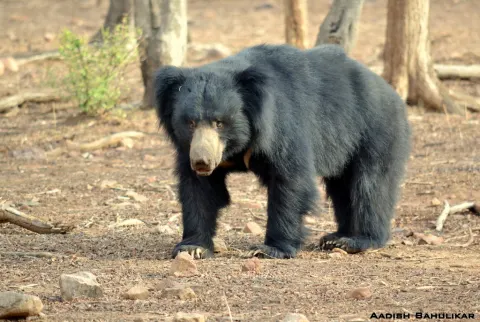
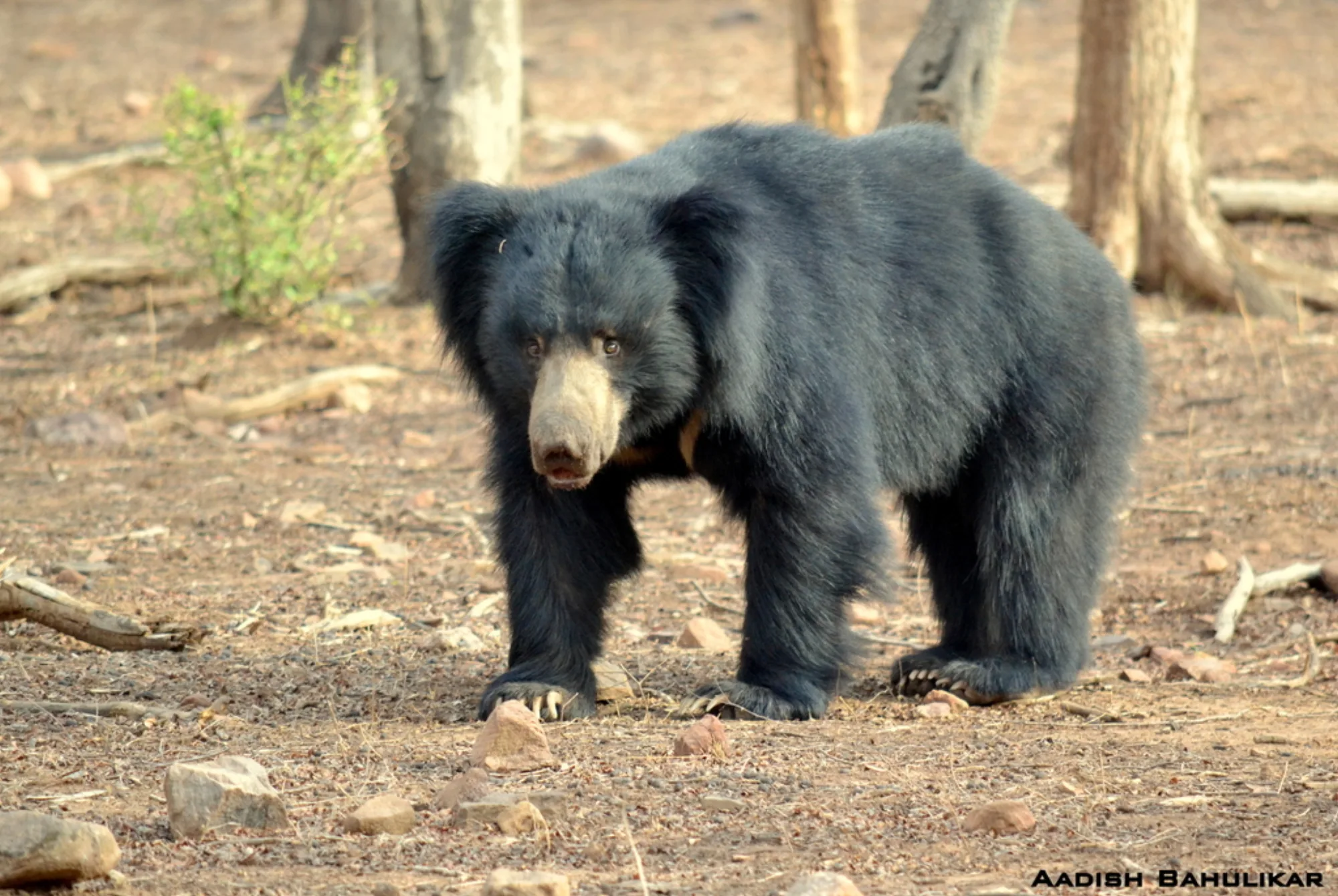
Shaggy black fur, a pale muzzle and long, curved claws give the Sloth Bear a distinctive appearance. This medium-sized bear has a heavy mane around its neck and shoulders, large floppy ears and often a whitish V- or Y-shaped chest mark, although the mark can be absent. Its build is rangier than that of the Asian black bear, and its slow walk has a noisy, flapping quality.
The species ranges across India, Nepal's Terai, temperate parts of Bhutan and Sri Lanka. It lives in habitats from moist and dry tropical forests to savannahs, scrublands and grasslands, and is regionally extinct in Bangladesh. Despite their shambling walk, sloth bears can gallop faster than a running human and climb trees to feed or rest. They use their claws to break into termite mounds, then suck up the insects with a sound that can carry 180 m. Ants, fruit and honey are also on the menu; in Rajasthan's Aravalli hills, fruit and other plant foods dominate winter diets, while insects dominate in summer. In India, breeding takes place from April to June, with births in December and early January; in Sri Lanka, breeding occurs throughout the year. Mothers usually give birth to one or two cubs in caves or shelters beneath boulders, and carry young cubs on their backs when walking, running or climbing.
Habitat loss and degradation have reduced the bears' range and brought them into conflict with people. Poachers also kill them for the illegal trade in body parts, while tigers and leopards can threaten cubs.
Written from the English Wikipedia article Sloth bear (CC BY-SA 4.0).
- Records
- 7
- Countries
- 1
- Atlas places
- 2
These are open occurrence records, so they show where people looked for and recorded the Sloth Bear as much as where it lives. Cells are up to 25 km across, and every location is generalised to its cell.
Generalised encounter areas, not exact locations. Each shape is a grid cell coloured by how likely the species is there.
- Very likelyIndia25 km zone · medium confidence · 7 records · updated 80 days ago
Conservation status not assessed here yet, so every location is generalised to its grid cell.