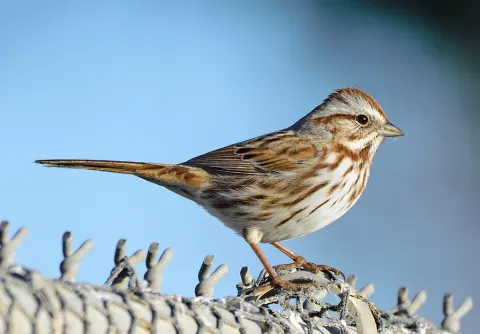
Song Sparrow
Melospiza melodia
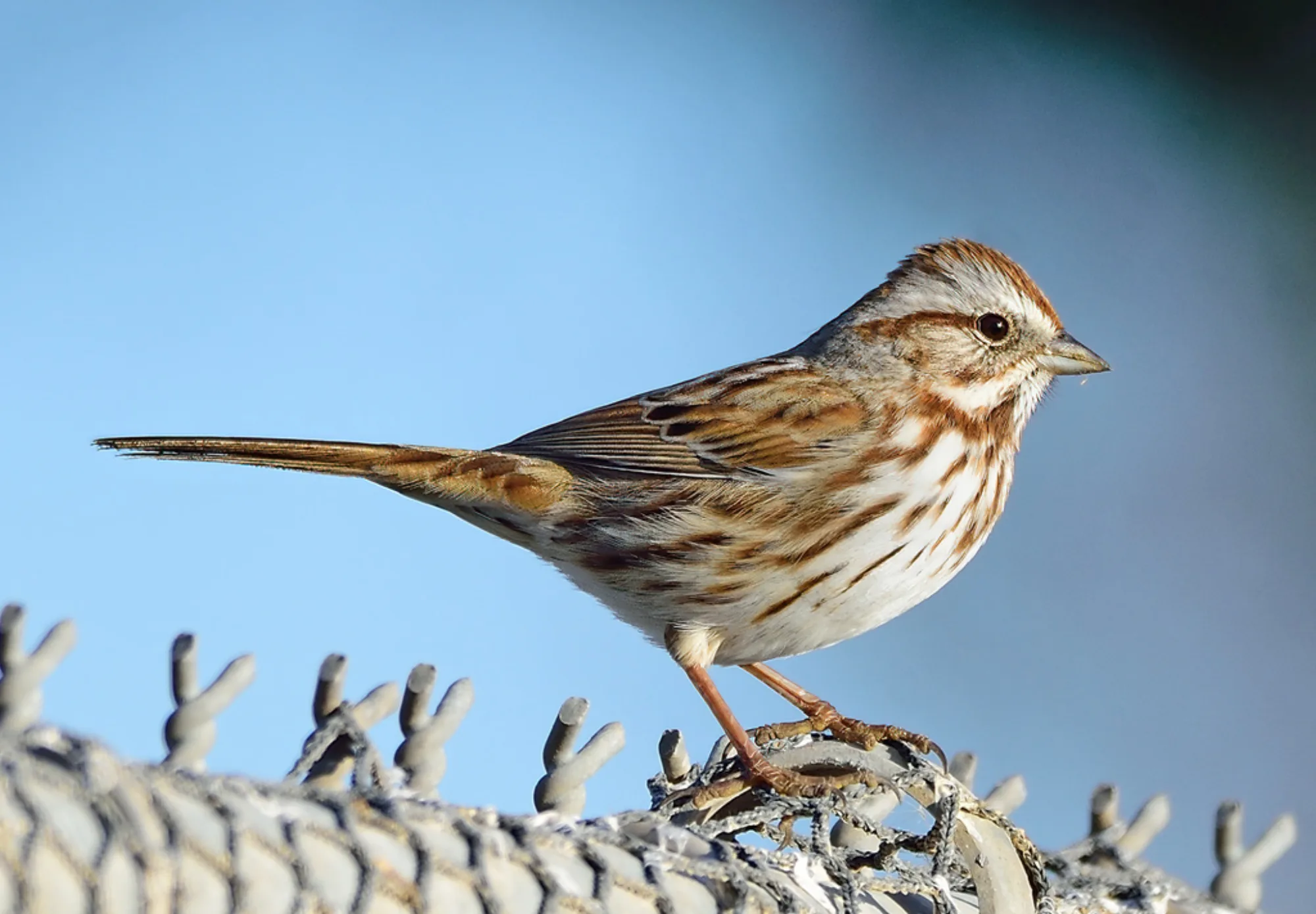
Look for the Song Sparrow in brushland and marshes across much of Canada and the United States, including salt marshes. This medium-sized New World sparrow also lives in suburbs, agricultural fields and along roadsides. Its appearance varies widely, but adults have brown upperparts, dark streaks on the back and a white underside marked with dark streaks and a central brown spot. A brown cap, rounded brown tail and grey face with a brown stripe through each eye add to the pattern. It can be confused with Lincoln's sparrow, which has a shorter, greyer tail, or the Savannah sparrow, whose tail is forked and whose face has yellowish flecks. Northern populations travel south to the United States or Mexico for winter, while birds in the southern half of the range stay year-round.
A male sings to claim territory and attract females, combining repeated notes with quick isolated notes and trills. Listen for the same song repeated several times before he changes to another. Song Sparrows search for food on the ground, among shrubs or in very shallow water, eating mainly insects and seeds. In salt marshes, they may also take small crustaceans. They place their nests in sheltered ground locations, trees or shrubs, and each clutch contains three to five eggs. Cats, hawks and owls prey on Song Sparrows, while brown-headed cowbirds lay eggs in their nests. Habitat destruction eliminated the Amak Island population, and feral cats eliminated birds from Santa Barbara Island.
Written from the English Wikipedia article Song sparrow (CC BY-SA 4.0).
- Records
- 8,032,706
- Countries
- 10
- Atlas places
- 2
These are open occurrence records, so they show where people looked for and recorded the Song Sparrow as much as where it lives. Cells are up to 25 km across, and every location is generalised to its cell.
Generalised encounter areas, not exact locations. Each shape is a grid cell coloured by how likely the species is there.
- Very likelyUnited States25 km zone · high confidence · 6655965 records · updated 86 days ago
- Very likelyCanada25 km zone · high confidence · 1339216 records · updated 86 days ago
- Very likelyMexico25 km zone · high confidence · 36267 records · updated today
- LikelySt. Pierre & Miquelon25 km zone · high confidence · 949 records · updated today
- PossibleNorway25 km zone · high confidence · 108 records · updated today
- PossibleBelgium25 km zone · high confidence · 80 records · updated today
- PossibleBermuda25 km zone · medium confidence · 70 records · updated today
- PossibleUnited Kingdom25 km zone · medium confidence · 47 records · updated today
- RareSweden25 km zone · medium confidence · 4 records · updated today
Conservation status not assessed here yet, so every location is generalised to its grid cell.