Bornean Ferret-badger
Melogale everetti
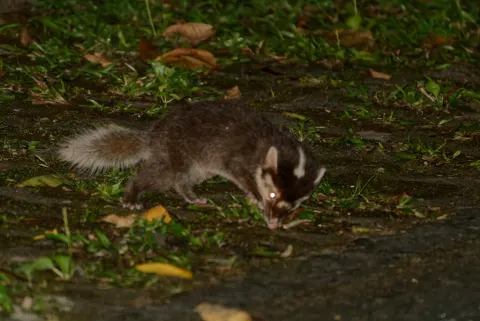
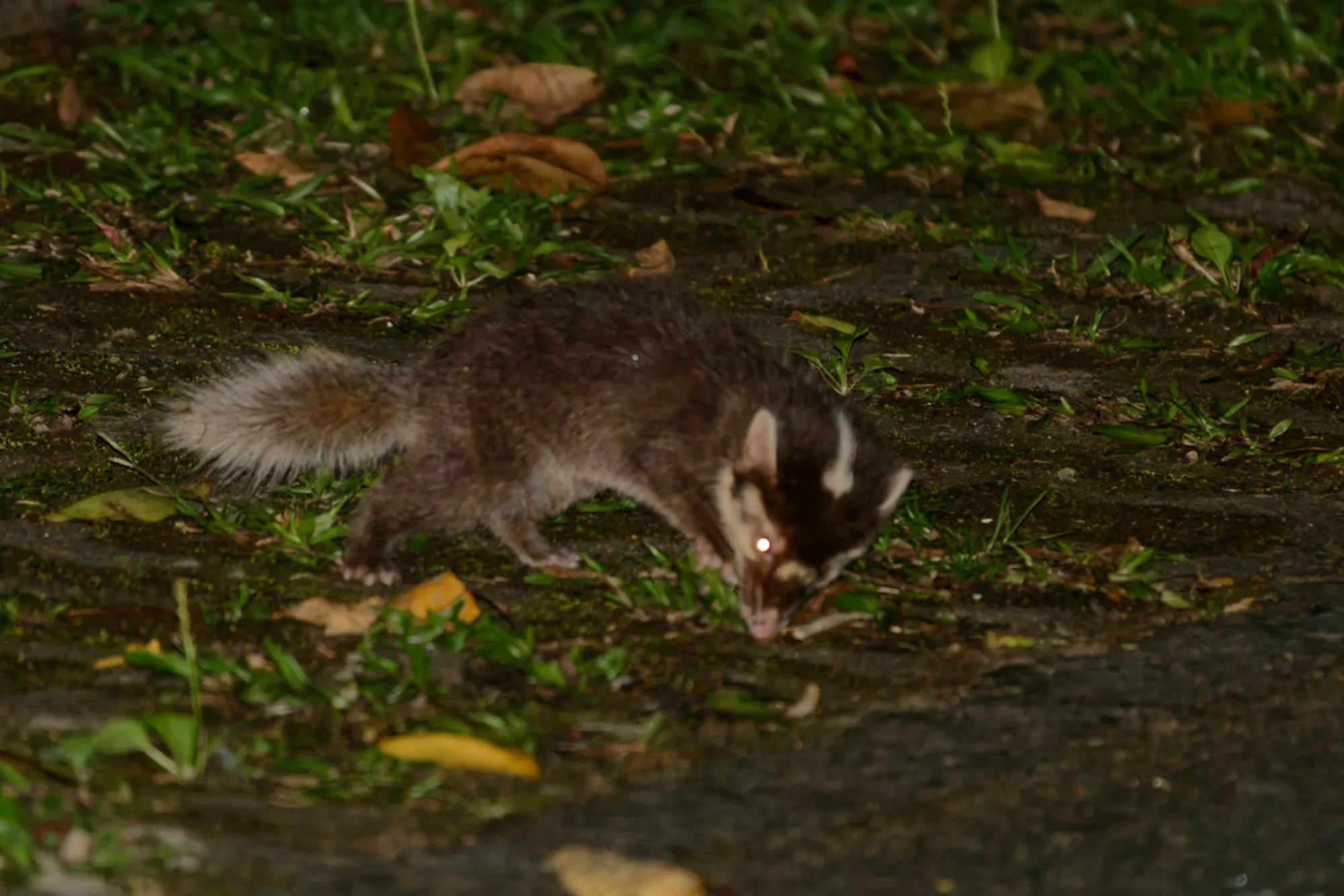
Restricted to the northern tip of Borneo, the Bornean ferret-badger is a small, nocturnal mammal with a long, bushy tail. It is easily identified by the yellow or white mask-like pattern on its face and a dorsal stripe, varying from white to red, that stretches from its head to its shoulders. This species typically weighs between 1 kg and 3 kg, with a body length reaching up to 44 cm. To support its lifestyle, it possesses broad feet with strong claws for digging and partial webbing that aids in climbing.
The animal mainly inhabits evergreen and montane forests, though it is sometimes seen in scrubland or agricultural fields. Most reliable sightings occur at elevations between 500 m and 3,000 m, particularly within Kinabalu and Crocker Range National Parks. While it is a formidable climber that forages in trees, it spends much of its time on the ground. As an omnivore, its diet consists of earthworms, insects, amphibians, fruit, and carrion. Though capable of digging, it prefers to sleep in burrows created by other animals.
Survival is threatened by a very limited distribution range of approximately 4,200 km2, which makes the population vulnerable to localized disasters like typhoons or epidemics. Rising temperatures from climate change may also push this high-altitude specialist toward extinction as it cannot move further upslope. Additionally, human encroachment and the conversion of surrounding forests into agricultural land continue to degrade its habitat. Roadways fragmenting the parks further restrict its movement, leaving the species in a state of population decrease.
Written from the English Wikipedia article Bornean ferret badger (CC BY-SA 4.0).
- Records
- 0
- Countries
- 1
- Atlas places
- 0
These are open occurrence records, so they show where people looked for and recorded the Bornean Ferret-badger as much as where it lives. Cells are up to 25 km across, and every location is generalised to its cell.
Generalised encounter areas, not exact locations. Each shape is a grid cell coloured by how likely the species is there.
- Very likelyMalaysia50 km zone · low confidence · 0 records · updated 4 days ago