Bee Hummingbird
Mellisuga helenae
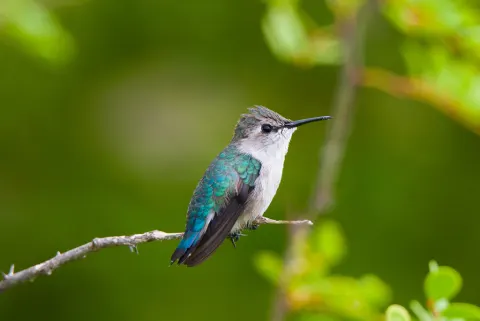
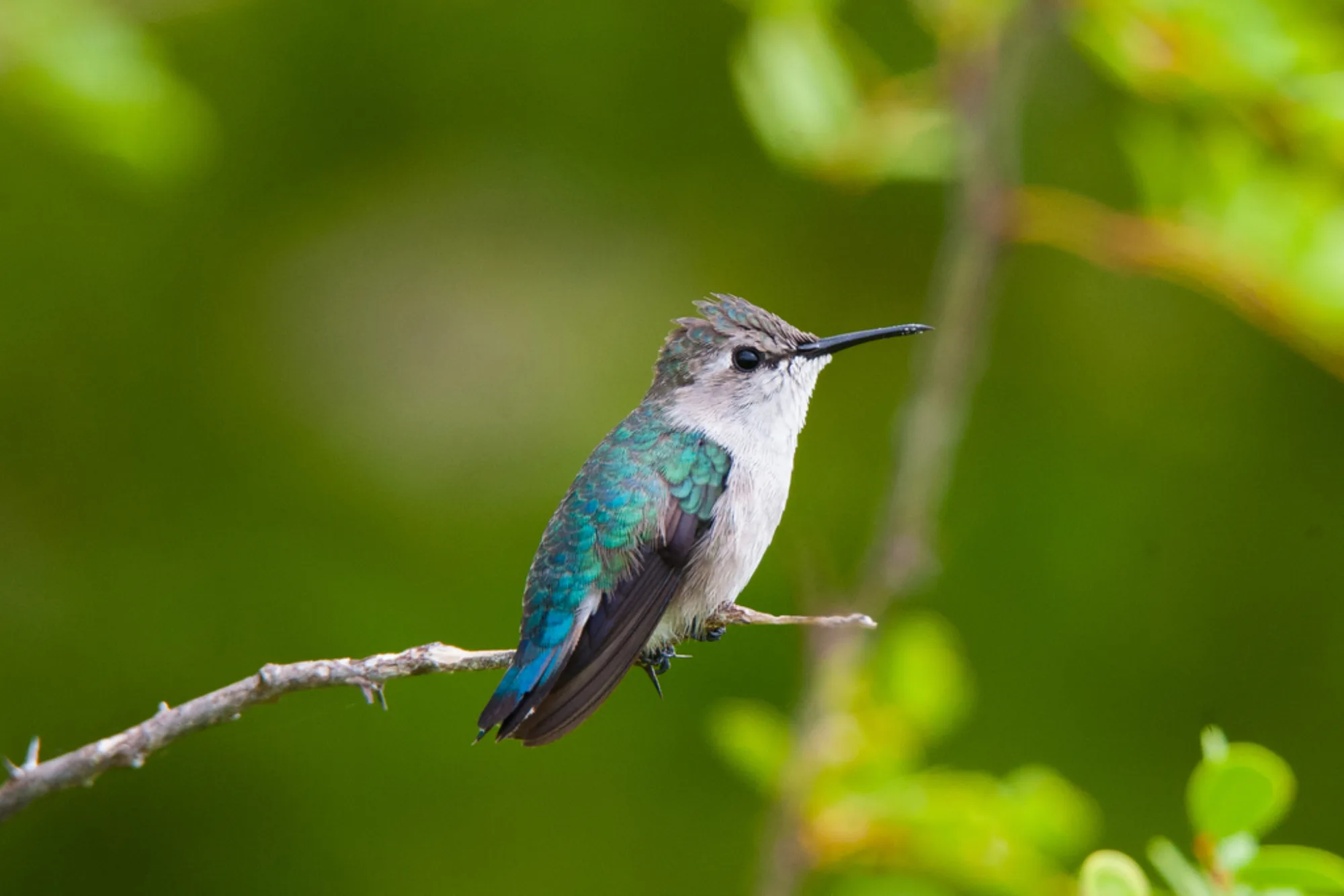
Cuba's Bee Hummingbird, also known as the zunzuncito, is the smallest known bird. It has a rounded, plump outline and a slender, pointed bill for reaching into flowers. Females are slightly larger than males, measuring 6.1 cm and weighing 2.6 g; males average 5.5 cm and 1.95 g. A female is bluish green with a pale grey underside and white spots at the tips of her tail feathers. Males have bluish upperparts and a bright red throat; in the mating season, their heads and throats take on reddish or pink tones. Their iridescent feathers change in appearance with the viewing angle.
The species occurs across the Cuban archipelago, including Cuba and Isla de la Juventud, although its population is fragmented. It generally lives among thick growth containing lianas and epiphytes. It is found more commonly in Zapata Swamp and eastern Cuba, with records from Baitiquirí Ecological Reserve as well as Alexander Humboldt National Park. Active by day, it is a swift, strong flier that can hover at flowers while feeding. It eats mainly nectar, occasionally taking insects and spiders, and may visit 1,500 flowers in a day. As it moves between flowers, it carries pollen on its bill and head. A male often sings from the top of the highest tree in his territory, and its call is a high-pitched, jumbled twitter.
Breeding takes place from March to June. The female builds a small cup-shaped nest from cobweb strands, bark and lichen, lining it with soft plant wool. She lays one or two eggs and incubates them for 21 days; after hatching, she cares for the young for 18 days. Each nest is used only once.
Written from the English Wikipedia article Bee hummingbird (CC BY-SA 4.0).
- Records
- 4,003
- Countries
- 1
No atlas park has a record of the Bee Hummingbird in or around it yet.
These are open occurrence records, so they show where people looked for and recorded the Bee Hummingbird as much as where it lives. Cells are up to 25 km across, and every location is generalised to its cell.
Generalised encounter areas, not exact locations. Each shape is a grid cell coloured by how likely the species is there.
- Very likelyCuba25 km zone · high confidence · 4003 records · updated 80 days ago
Conservation status not assessed here yet, so every location is generalised to its grid cell.