Eurasian Badger
Meles meles
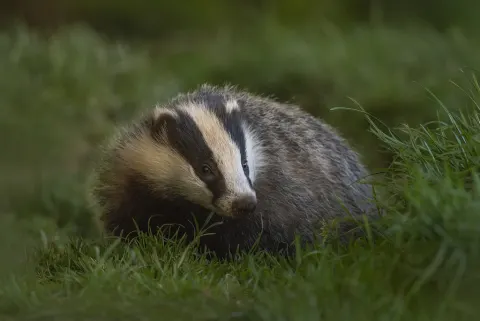
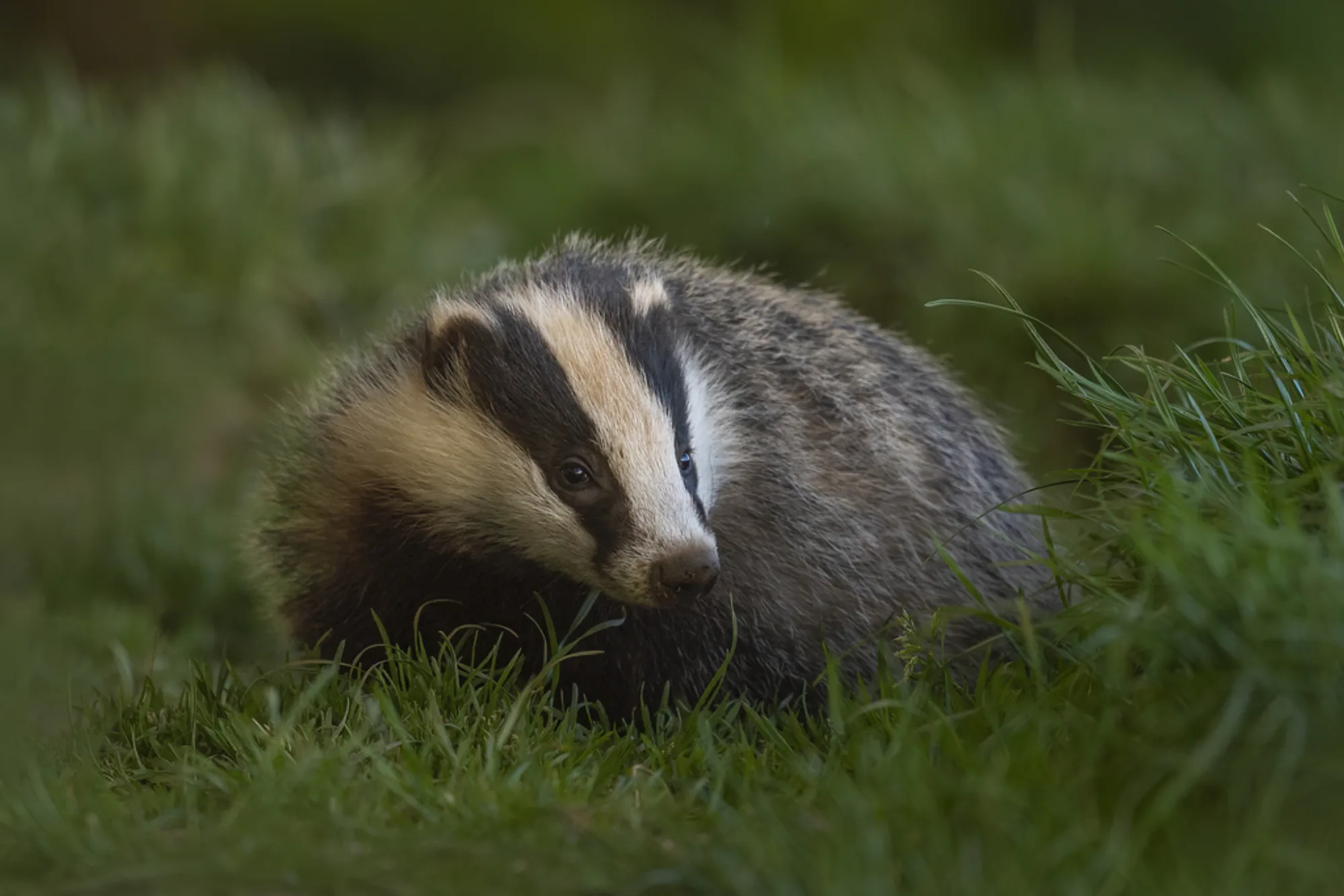
With its stocky body, short tail and boldly marked face, the Eurasian Badger is distinctive even in dim light. Two black bands run up its head towards the ears, framing a broad white stripe that extends from the nose over the forehead. Its back and sides are silvery grey, while its legs and chest are black before winter. Native to most of Europe and parts of western and central Asia, it lives in deciduous and mixed woodland, pasture, scrub and clearings. It also makes a home in suburban areas and urban parks, and occurs in mountains up to 2,000 m.
Badgers are social and active at dusk and night, spending the day asleep underground in a sett. A sett can hold several families, with separate passages and nesting chambers, and may remain in use for decades. The occupants bring in fresh bedding and clear out old material, while well-worn paths and communal latrines can mark their territory. Earthworms are their most important food, but they also eat insects, fruit, cereals, carrion and small mammals. In spring, a litter can contain up to five cubs, which emerge from the sett at eight weeks and usually remain with the family group after weaning. In colder parts of their range, badgers spend the winter asleep underground; in milder areas they may emerge during mild spells or forgo winter sleep.
Habitat loss in areas of intensive agriculture has caused declines, and badgers are hunted as pests in some places. Bovine tuberculosis is a significant cause of death, and badgers are also culled in England in an attempt to reduce the disease in cattle. Foxes and golden eagles can kill cubs, while wolves, lynxes, bears and large domestic dogs can threaten adults.
Written from the English Wikipedia article European badger (CC BY-SA 4.0).
- Records
- 219,470
- Countries
- 39
No atlas park has a record of the Eurasian Badger in or around it yet.
These are open occurrence records, so they show where people looked for and recorded the Eurasian Badger as much as where it lives. Cells are up to 25 km across, and every location is generalised to its cell.
Generalised encounter areas, not exact locations. Each shape is a grid cell coloured by how likely the species is there.
- Very likelySwitzerland25 km zone · high confidence · 110995 records · updated 86 days ago
- Very likelyFrance25 km zone · high confidence · 58326 records · updated 86 days ago
- Very likelyGermany25 km zone · high confidence · 21722 records · updated 86 days ago
- Very likelyUnited Kingdom25 km zone · high confidence · 12339 records · updated 86 days ago
- Very likelyLuxembourg25 km zone · high confidence · 7709 records · updated 86 days ago
- Very likelyBelgium25 km zone · high confidence · 2818 records · updated 86 days ago
- Very likelyNorway25 km zone · high confidence · 1687 records · updated 86 days ago
- Very likelyJapan25 km zone · high confidence · 1115 records · updated 86 days ago
- Very likelyIreland25 km zone · high confidence · 654 records · updated 86 days ago
- Very likelyDenmark25 km zone · high confidence · 476 records · updated 86 days ago
Conservation status not assessed here yet, so every location is generalised to its grid cell.