Japanese Badger
Meles anakuma
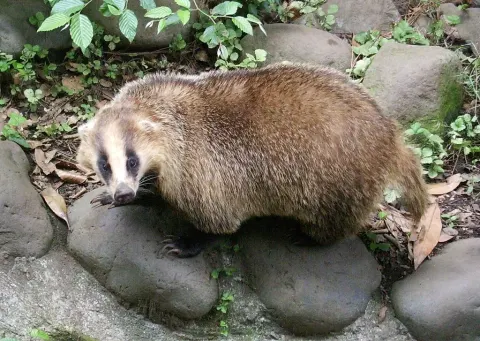
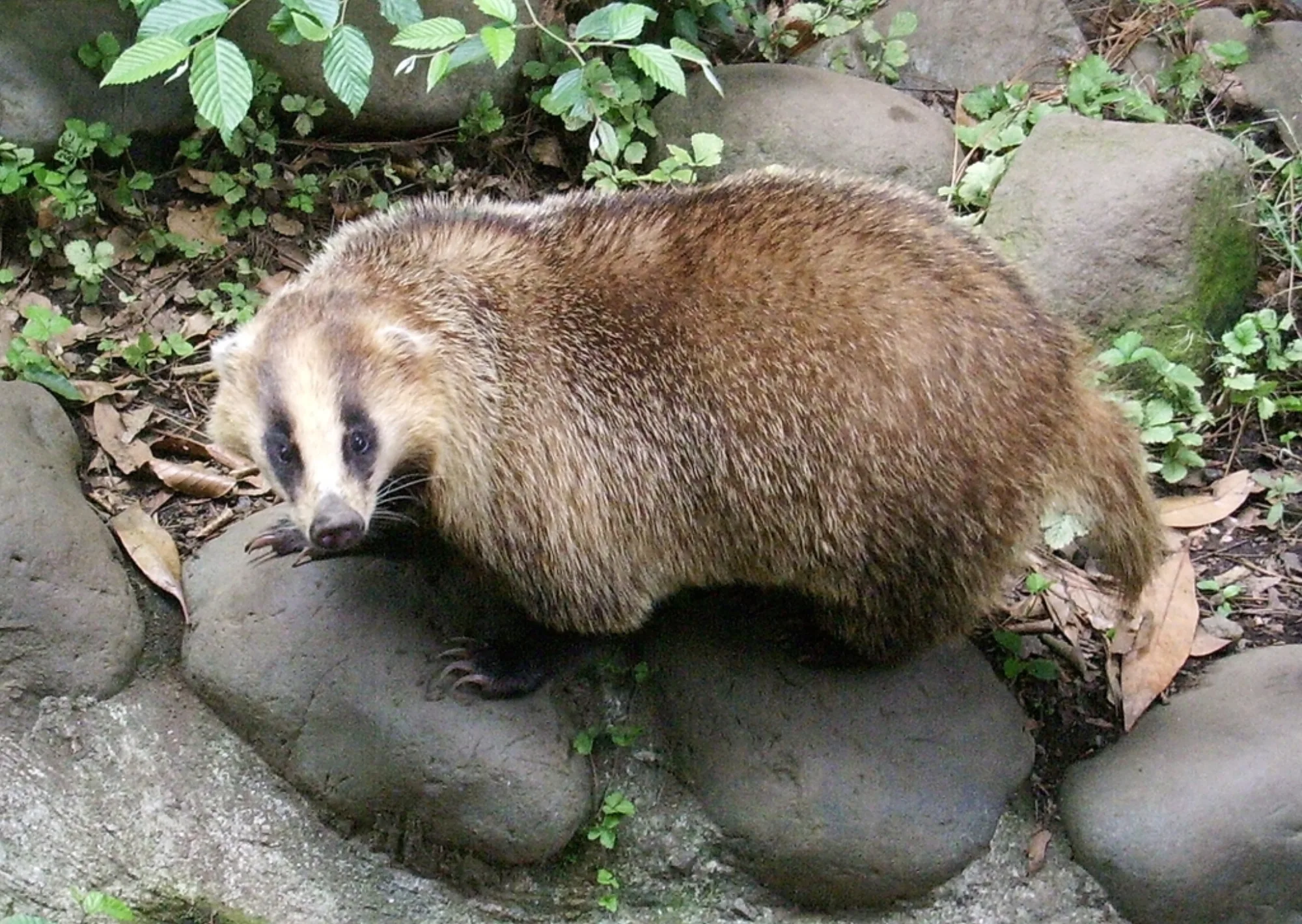
A stocky member of the weasel family, the Japanese Badger has a blunt body, short legs and powerful claws on its front feet for digging. Its long outer coat is grey-brown, while the short hair underneath is black. Black and white stripes mark its face, with the darker colour concentrated around the eyes. Males average 79 cm in length and females 72 cm, with a tail measuring 14 to 20 cm. Adults usually weigh between 3.8 and 11 kg.
Found only in Japan, this badger lives on Honshu, Kyushu, Shikoku and Shōdoshima, across a range of wooded habitats. Active at night, it spends the coldest part of the year hibernating. Japanese Badgers are relatively solitary and do not gather in social clans. Animals whose ranges overlap may communicate through scent marking. Females begin breeding at 2 years of age and give birth to two or three cubs in spring. Their varied diet includes earthworms, beetles, berries and persimmons, with the balance changing as foods become available. It eats the most earthworms in warmer seasons, turning more often to wild berries when worms are scarcer in cooler months. Persimmon consumption peaks in autumn, when the fruit is most available.
Although the badger remains common, its range has shrunk in recent years. Land development, agriculture and competition from introduced raccoons threaten it. Hunting is legal, though it has fallen sharply since the 1970s. A rise in culling in Kyushu raised concern in 2017, with fears that it could have reached an unsustainable level.
Written from the English Wikipedia article Japanese badger (CC BY-SA 4.0).
- Records
- 321
- Countries
- 1
No atlas park has a record of the Japanese Badger in or around it yet.
These are open occurrence records, so they show where people looked for and recorded the Japanese Badger as much as where it lives. Cells are up to 25 km across, and every location is generalised to its cell.
Generalised encounter areas, not exact locations. Each shape is a grid cell coloured by how likely the species is there.
- Very likelyJapan25 km zone · high confidence · 321 records · updated 80 days ago
Conservation status not assessed here yet, so every location is generalised to its grid cell.