Ocellated Turkey
Meleagris ocellata
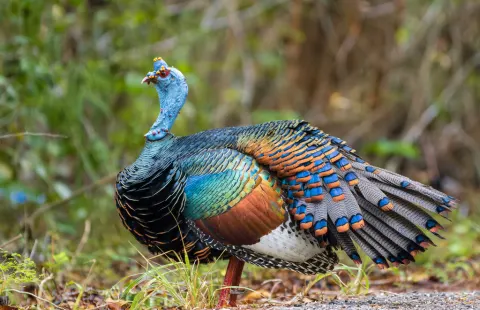
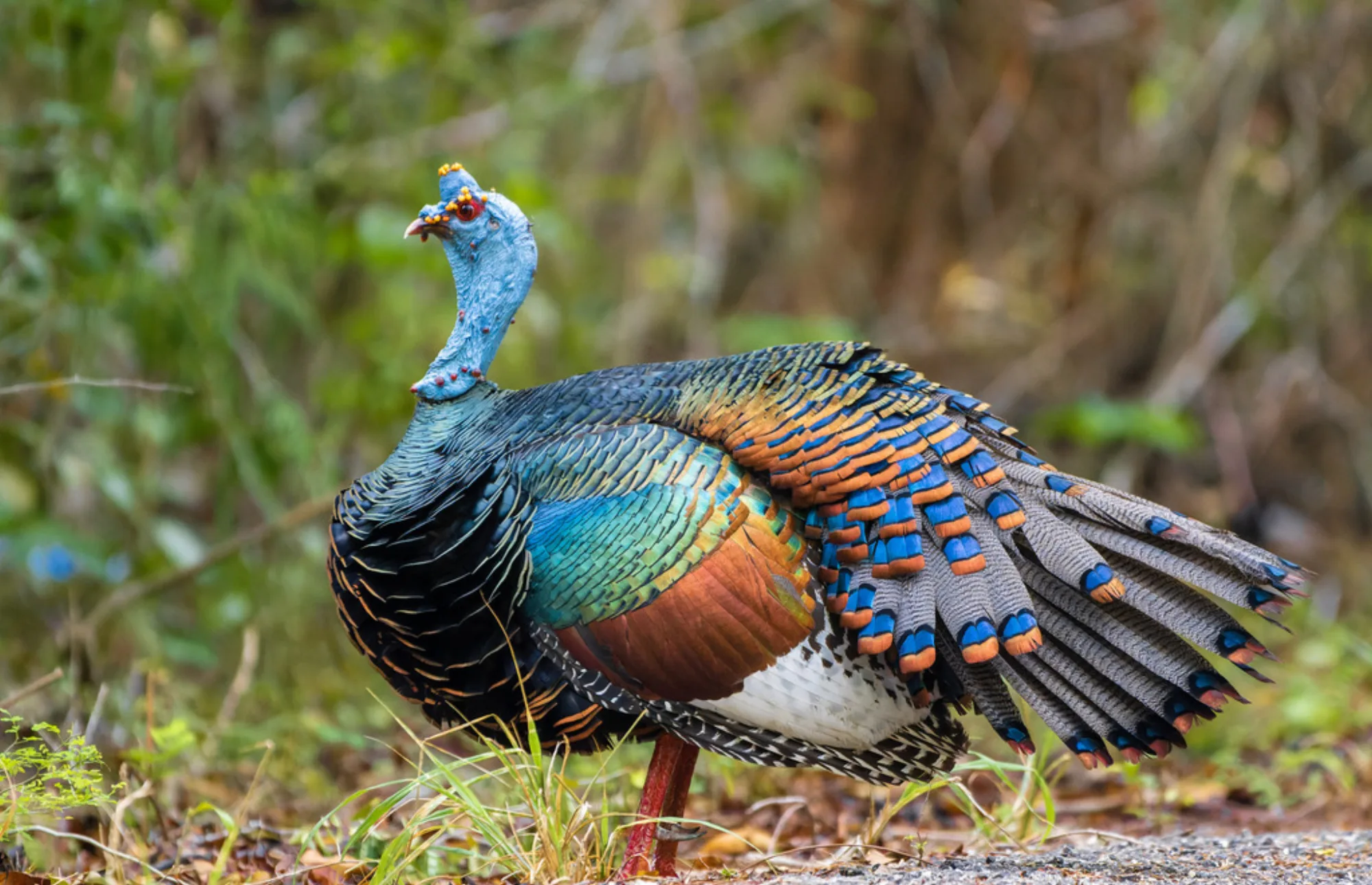
Bronze and green shimmer across the feathers of the Ocellated Turkey, a large bird native to the Yucatán Peninsula and parts of Belize and Guatemala. Its bluish-grey tail feathers carry eye-shaped blue-bronze spots and bright gold tips, while its blue head has orange or red nodules. Both sexes have deep red legs, and males show a brighter yellow-orange crown during the breeding season. The bird measures around 70 to 122 cm long, with females averaging 3 kg and males 5 kg.
Ocellated Turkeys spend most of their time on the ground, often choosing to run from danger by day, though they can fly swiftly over short distances. At night they usually roost high in trees, often with family, away from predators such as jaguars. Their varied diet includes beetles, moths, leafcutter ants, grass seeds, nuts and leaves. Before breeding, adult males have been seen in small flocks, usually of no more than three mature birds, while larger flocks include hens and younger birds. A male's song begins with low, bongo-like tones that grow faster and louder, followed by higher-pitched notes; he typically starts singing 20 to 25 minutes before sunrise.
Breeding begins in early February, peaks in March and ends by late April, with males displaying to attract females. Females lay 8 to 15 eggs in a concealed ground nest, and the young hatch from May to July after 28 days. They leave the nest after one night and follow their mother, later beginning to range but often regrouping to roost. Land use changes and hunting above sustainable levels are believed to have contributed to the species' decline.
Written from the English Wikipedia article Ocellated turkey (CC BY-SA 4.0).
- Records
- 21,451
- Countries
- 3
No atlas park has a record of the Ocellated Turkey in or around it yet.
These are open occurrence records, so they show where people looked for and recorded the Ocellated Turkey as much as where it lives. Cells are up to 25 km across, and every location is generalised to its cell.
Generalised encounter areas, not exact locations. Each shape is a grid cell coloured by how likely the species is there.
- Very likelyGuatemala25 km zone · high confidence · 10130 records · updated 80 days ago
- Very likelyBelize25 km zone · high confidence · 7958 records · updated 80 days ago
- Very likelyMexico25 km zone · high confidence · 3363 records · updated 80 days ago
Conservation status not assessed here yet, so every location is generalised to its grid cell.