Wild Turkey
Meleagris gallopavo
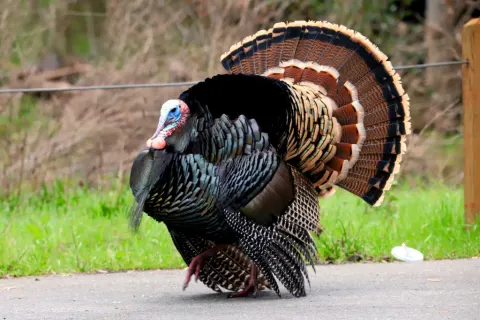
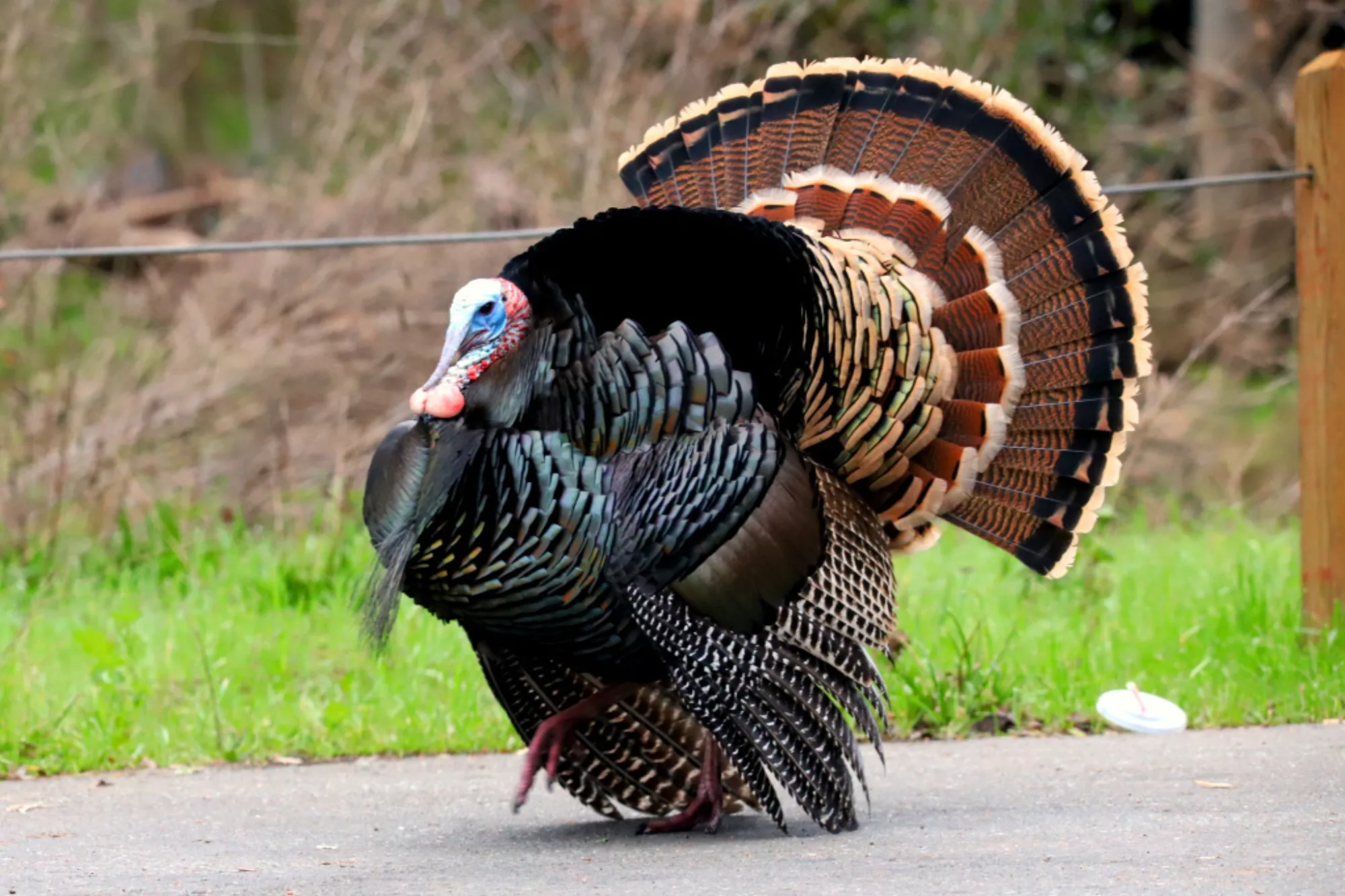
Native to North America, the Wild Turkey is a large game bird with dark body feathers and a coppery sheen. Males are substantially larger than females, with reddish, featherless heads, glossy bronze wings and long, dark tails that spread into fans. Females are more subdued, with brown and grey feathers, while both sexes have white bars on their primary wing feathers.
Look for these birds in hardwood or mixed forests broken by fields, pastures, orchards or seasonal marshes. Their range includes the eastern United States and parts of Canada and Mexico; introduced populations also live in places including California, Hawaii and New Zealand. Despite their weight, they are agile fliers, usually staying close to the ground and flying no more than 400 m at a time. At twilight they generally seek the safety of tree roosts, and in snowy regions they shelter in conifers during blizzards. Early spring brings the sound of males gobbling to announce themselves to females and rivals.
Turkeys feed on the ground and sometimes climb shrubs or small trees for food, favouring acorns, nuts, seeds, berries and other plant material as well as insects. They may also take salamanders, lizards and small snakes, and often feed in cow pastures or search harvested fields for seeds. In March and April, males display to females by puffing up their feathers and spreading their tails. Females nest in shallow ground depressions surrounded by woody vegetation, laying 10 to 14 eggs; the young leave the nest after about 12 to 24 hours. Ground nests are exposed to predators, including raccoons and foxes, while humans are the leading predator of adults. Overhunting and habitat loss caused a steep historical decline, although populations recovered with protection and reintroduction.
Written from the English Wikipedia article Wild turkey (CC BY-SA 4.0).
- Records
- 910,103
- Countries
- 3
- Atlas places
- 5
These are open occurrence records, so they show where people looked for and recorded the Wild Turkey as much as where it lives. Cells are up to 25 km across, and every location is generalised to its cell.
Generalised encounter areas, not exact locations. Each shape is a grid cell coloured by how likely the species is there.
- Very likelyUnited States25 km zone · high confidence · 804842 records · updated 80 days ago
- Very likelyCanada25 km zone · high confidence · 97669 records · updated 80 days ago
- Very likelyMexico25 km zone · high confidence · 7592 records · updated 80 days ago
Conservation status not assessed here yet, so every location is generalised to its grid cell.