Black Caiman
Melanosuchus niger
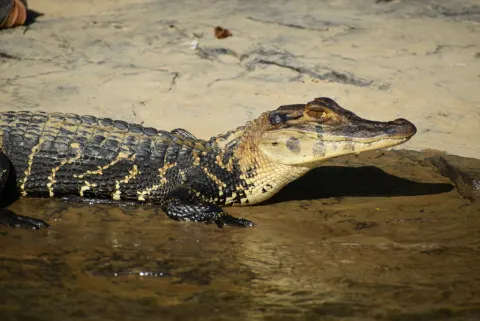
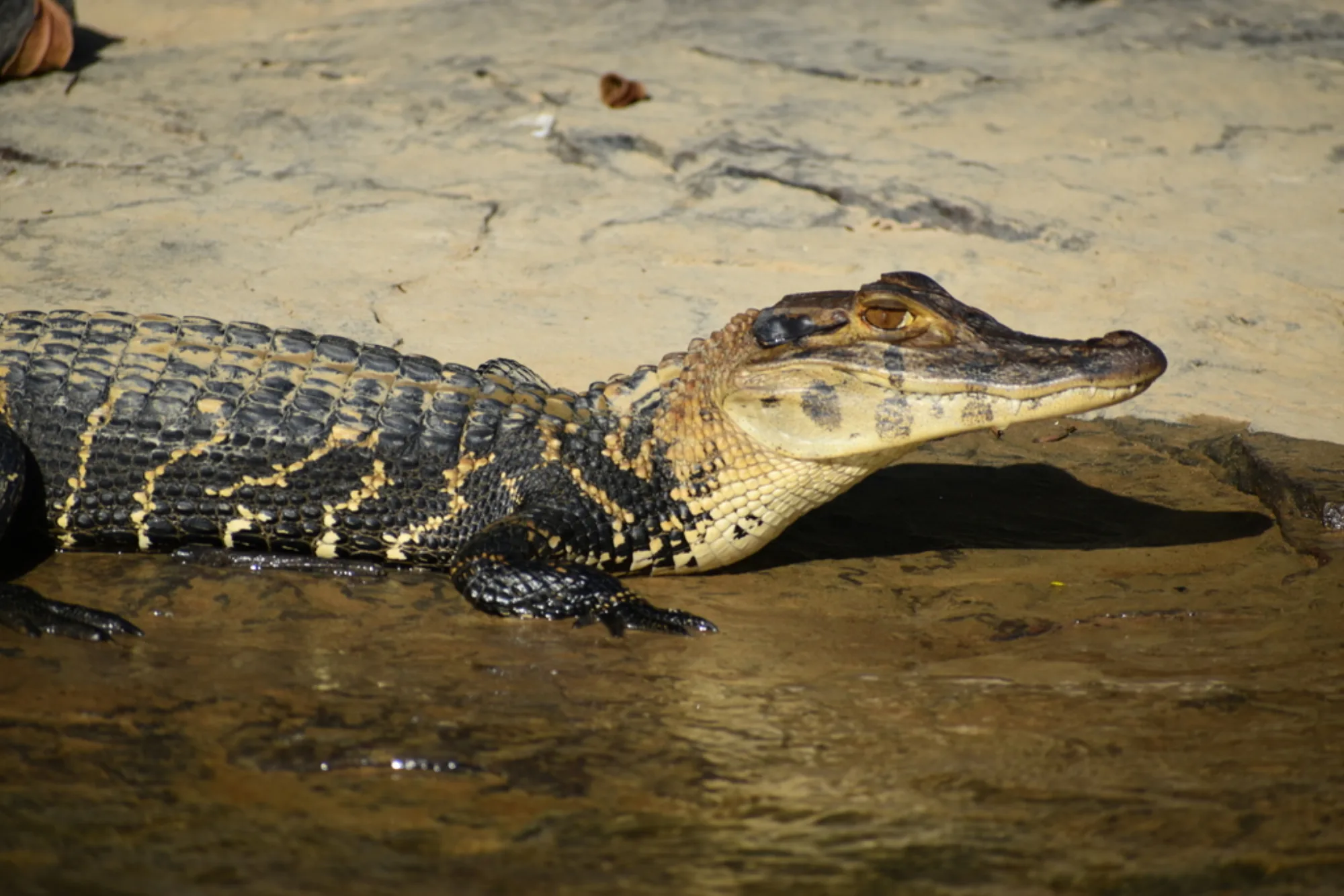
Dark, heavily built and often active after nightfall, the Black Caiman is a South American crocodilian with a large head, short legs and a long tail. Adults have greenish-black skin, sometimes almost jet-black, with grey to brown bands on the lower jaw. Pale bands along the flanks are especially conspicuous in young animals and fade gradually with age. Most adults measure 2.2 to 2.9 m, although a few old males exceed 5 m. With eyes and nostrils high on its head, it can watch and breathe even when most of its body is submerged.
The species lives mostly in Amazonia, in rivers, swamps, wetlands and lakes, including slow-moving rivers and seasonally flooded savannas. It occurs in Brazil and parts of Peru, Ecuador, Bolivia, French Guiana and Guyana. Black caimans hunt at night and also hunt on land, taking prey from fish and molluscs to birds and mammals. Young animals often eat snails and small fish, while larger caimans can take capybaras and other substantial prey. As the dry season draws to a close, females make nests from soil and vegetation, laying up to 65 eggs. Mothers guard the nests, carry hatchlings to safe pools and may tend them for several months, although most young do not survive to maturity.
Hunting for valuable hides once brought the species close to extinction. Its numbers have recovered overall, but people still trade its skins and meat on a small scale, while habitat destruction is another possible ongoing threat. Eggs and young also face many predators, including snakes, birds and mammals.
Written from the English Wikipedia article Black caiman (CC BY-SA 4.0).
- Records
- 179
- Countries
- 7
- Atlas places
- 6
These are open occurrence records, so they show where people looked for and recorded the Black Caiman as much as where it lives. Cells are up to 25 km across, and every location is generalised to its cell.
Generalised encounter areas, not exact locations. Each shape is a grid cell coloured by how likely the species is there.
- Very likelyPeru25 km zone · medium confidence · 52 records · updated 80 days ago
- Very likelyEcuador25 km zone · medium confidence · 43 records · updated 80 days ago
- Very likelyBrazil25 km zone · medium confidence · 38 records · updated 80 days ago
- Very likelyBolivia25 km zone · medium confidence · 30 records · updated 80 days ago
- Very likelyGuyana25 km zone · medium confidence · 12 records · updated 80 days ago
- PossibleFrench Guiana25 km zone · medium confidence · 3 records · updated 80 days ago
- PossibleColombia25 km zone · medium confidence · 1 record · updated 80 days ago
Conservation status not assessed here yet, so every location is generalised to its grid cell.