Haddock
Melanogrammus aeglefinus
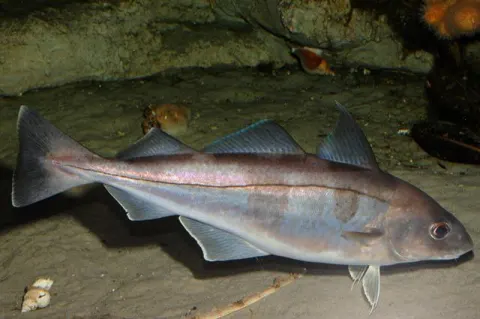
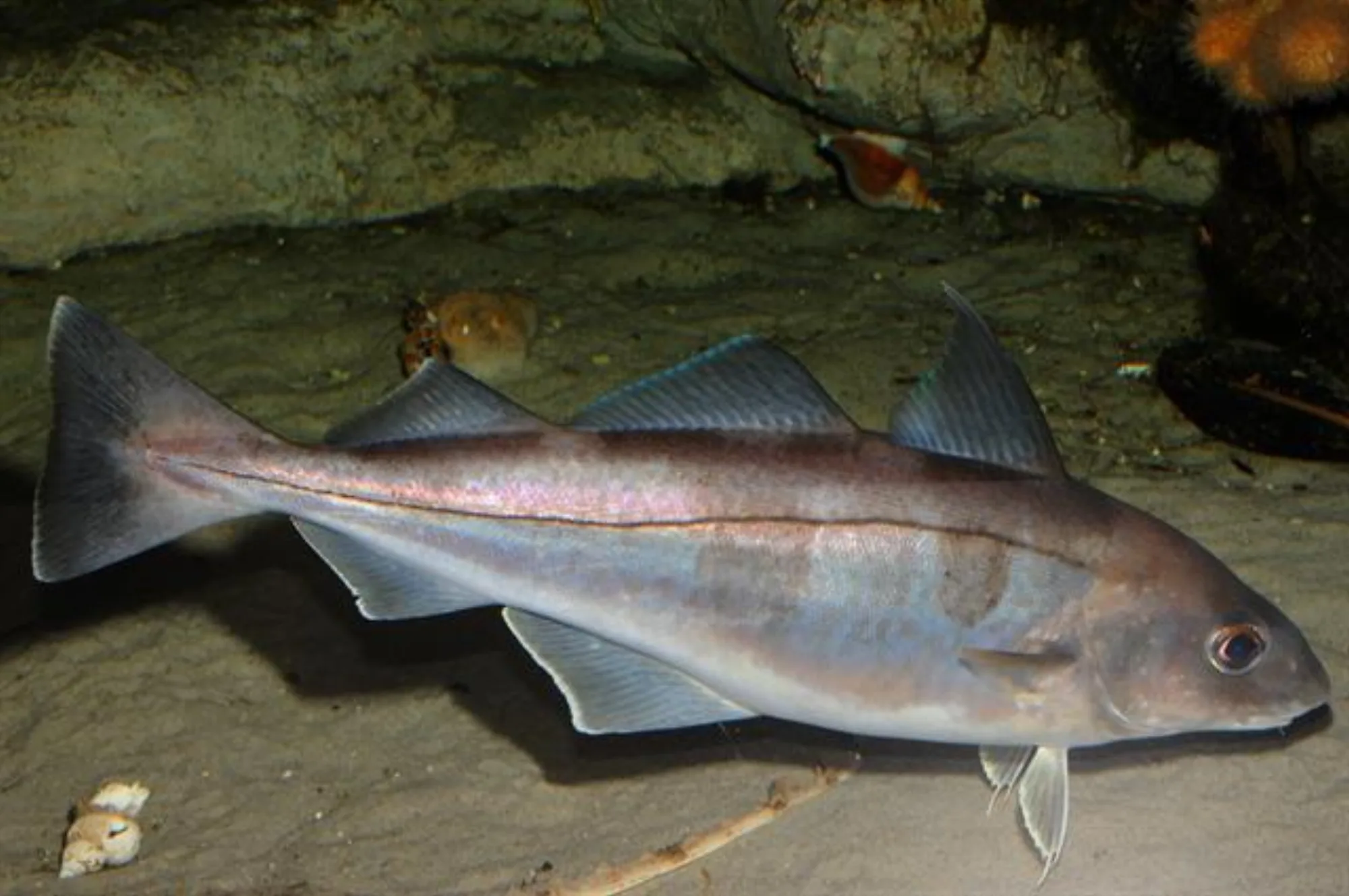
A dark line and a black thumbprint help distinguish the Haddock, a saltwater fish in the cod family. Its body is long and tapered, with a small mouth and a wedge-shaped snout. Its back can be almost black or dark grey-brown, fading to a dull silvery white underneath. The oval blotch sits above the pectoral fin, though some unusually coloured fish lack it. Haddock seldom exceed 80 cm in length, and the vast majority landed in the United Kingdom are 30 to 70 cm long.
Haddock live on both sides of the North Atlantic, with larger populations in the eastern Atlantic. In the northeast Atlantic, their range reaches north from the Bay of Biscay as far as Spitzbergen and includes the Barents Sea; across the ocean, they occur between western Greenland and Cape Hatteras. They live near the seabed over rock, sand, gravel or shells, most often at depths of 80 to 200 m. Off Iceland and in the Barents Sea they make extensive migrations, whereas movements in the northwestern Atlantic are more restricted.
Adults eat seabed animals including sea urchins, brittlestars, bivalves and worms, and also take smaller fish when the opportunity arises. Young haddock are eaten by larger bottom-dwelling fish, while seals prey on larger haddock. Spawning takes place at depths of around 50 to 150 m, with important grounds off central Norway, southwest Iceland and over Georges Bank. The eggs hatch after one to three weeks, and young fish remain in open water until they are around 7 cm long, when they settle near the seabed. Fishing takes place year-round, and high fishing mortality can prevent periods of increased productivity from having a lasting effect on the population.
Written from the English Wikipedia article Haddock (CC BY-SA 4.0).
- Records
- 743,894
- Countries
- 3
No atlas park has a record of the Haddock in or around it yet.
These are open occurrence records, so they show where people looked for and recorded the Haddock as much as where it lives. Cells are up to 25 km across, and every location is generalised to its cell.
Generalised encounter areas, not exact locations. Each shape is a grid cell coloured by how likely the species is there.
- Very likelyUnited Kingdom25 km zone · high confidence · 378584 records · updated 80 days ago
- Very likelyCanada25 km zone · high confidence · 328957 records · updated 80 days ago
- Very likelyUnited States25 km zone · high confidence · 36353 records · updated 80 days ago
Conservation status not assessed here yet, so every location is generalised to its grid cell.