Humpback Anglerfish
Melanocetus johnsonii
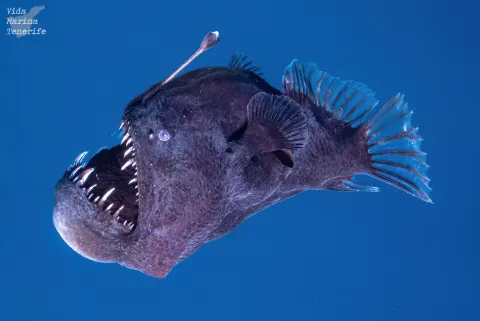
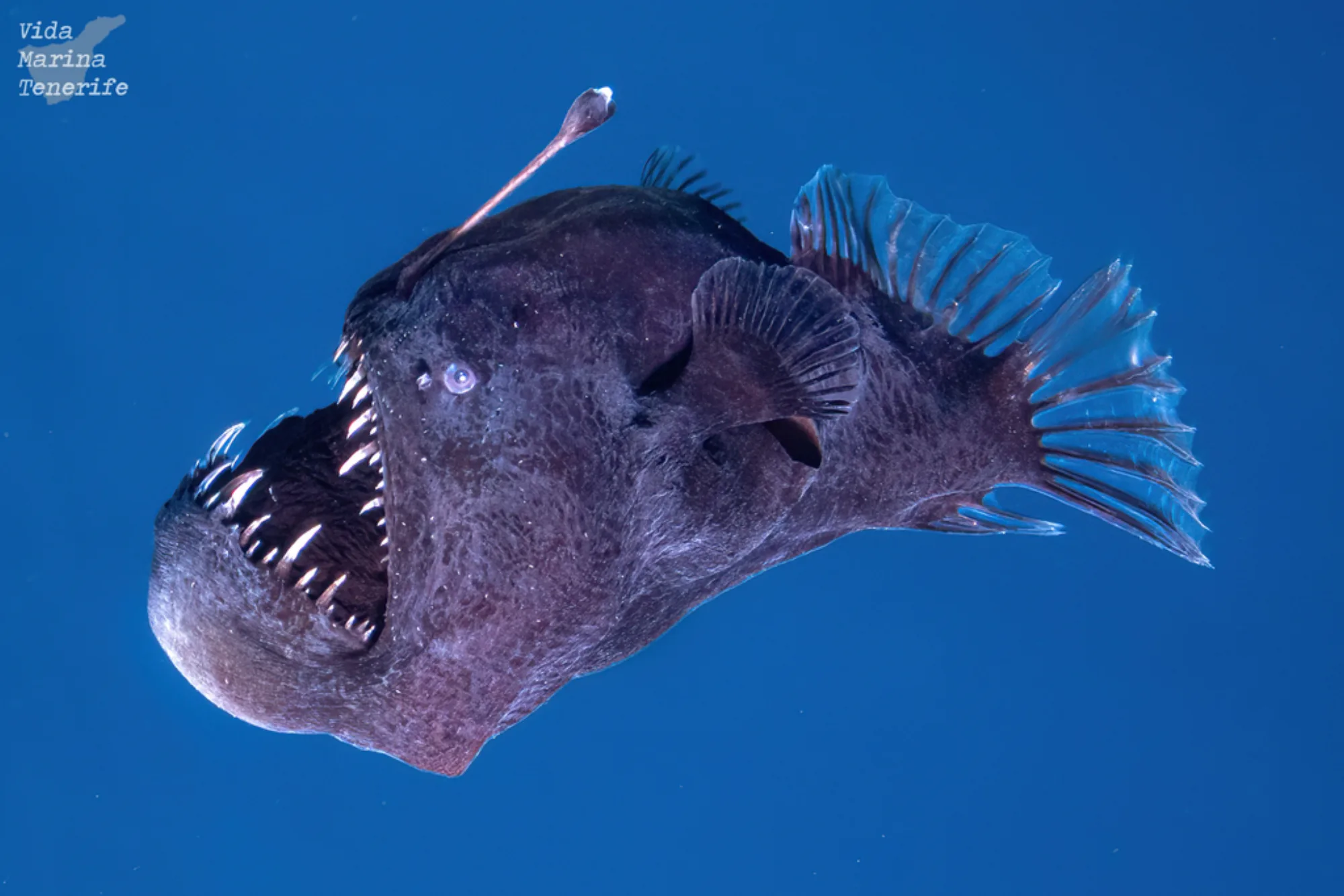
In the deep ocean, the Humpback Anglerfish waits for food beneath a glow of its own. This black seadevil has a soft body, dark brown or black colouring, and a striking difference in size between the sexes. Females have rounded bodies, large heads, almost vertical mouths and long, pointed teeth. They can reach 153 mm, while males grow to between 15.5 and 28 mm. A female carries a glowing lure on her snout, whereas a male has no lure but has large eyes and nostrils.
The species ranges through temperate and tropical waters in all oceans, including the South China Sea and East China Sea. Specimens have also been found in the Ross Sea and near Father Charles Canyon in British Columbia. It lives most often between 200 and 1,500 metres deep, where little or no sunlight reaches it. These fish live alone and far apart, making mates difficult to find. Males can follow a female's scent through the still deep water, and both sexes can reach maturity independently.
Food is scarce in the deep sea, so the anglerfish sits and waits to ambush prey. A female's lure attracts animals with light produced by bacteria living on it. Her large, expandable stomach lets her swallow meals heavier than herself: one specimen weighing 8.8 grams contained three snipe eels weighing 12.3 grams in total. Humpback anglerfish are not hunted for food, but they can be caught accidentally in trawls. As commercial fishing moves further into deep water, such catches may affect them more.
Written from the English Wikipedia article Humpback anglerfish (CC BY-SA 4.0).
- Records
- 113
- Countries
- 10
No atlas park has a record of the Humpback Anglerfish in or around it yet.
These are open occurrence records, so they show where people looked for and recorded the Humpback Anglerfish as much as where it lives. Cells are up to 25 km across, and every location is generalised to its cell.
Generalised encounter areas, not exact locations. Each shape is a grid cell coloured by how likely the species is there.
- Very likelyWestern Sahara25 km zone · medium confidence · 25 records · updated 80 days ago
- Very likelyUnited States25 km zone · medium confidence · 20 records · updated 80 days ago
- Very likelyGuatemala25 km zone · medium confidence · 9 records · updated 80 days ago
- LikelyNicaragua25 km zone · medium confidence · 14 records · updated 80 days ago
- LikelyCanada25 km zone · medium confidence · 8 records · updated 80 days ago
- LikelyMexico25 km zone · medium confidence · 6 records · updated 80 days ago
- PossibleAustralia25 km zone · medium confidence · 22 records · updated 80 days ago
- UncommonCape Verde25 km zone · medium confidence · 3 records · updated 80 days ago
- UncommonCosta Rica25 km zone · medium confidence · 3 records · updated 80 days ago
- UncommonUnnamed area25 km zone · medium confidence · 3 records · updated 80 days ago
Conservation status not assessed here yet, so every location is generalised to its grid cell.