Red-headed Woodpecker
Melanerpes erythrocephalus
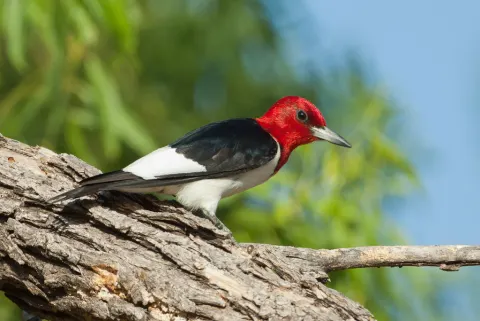
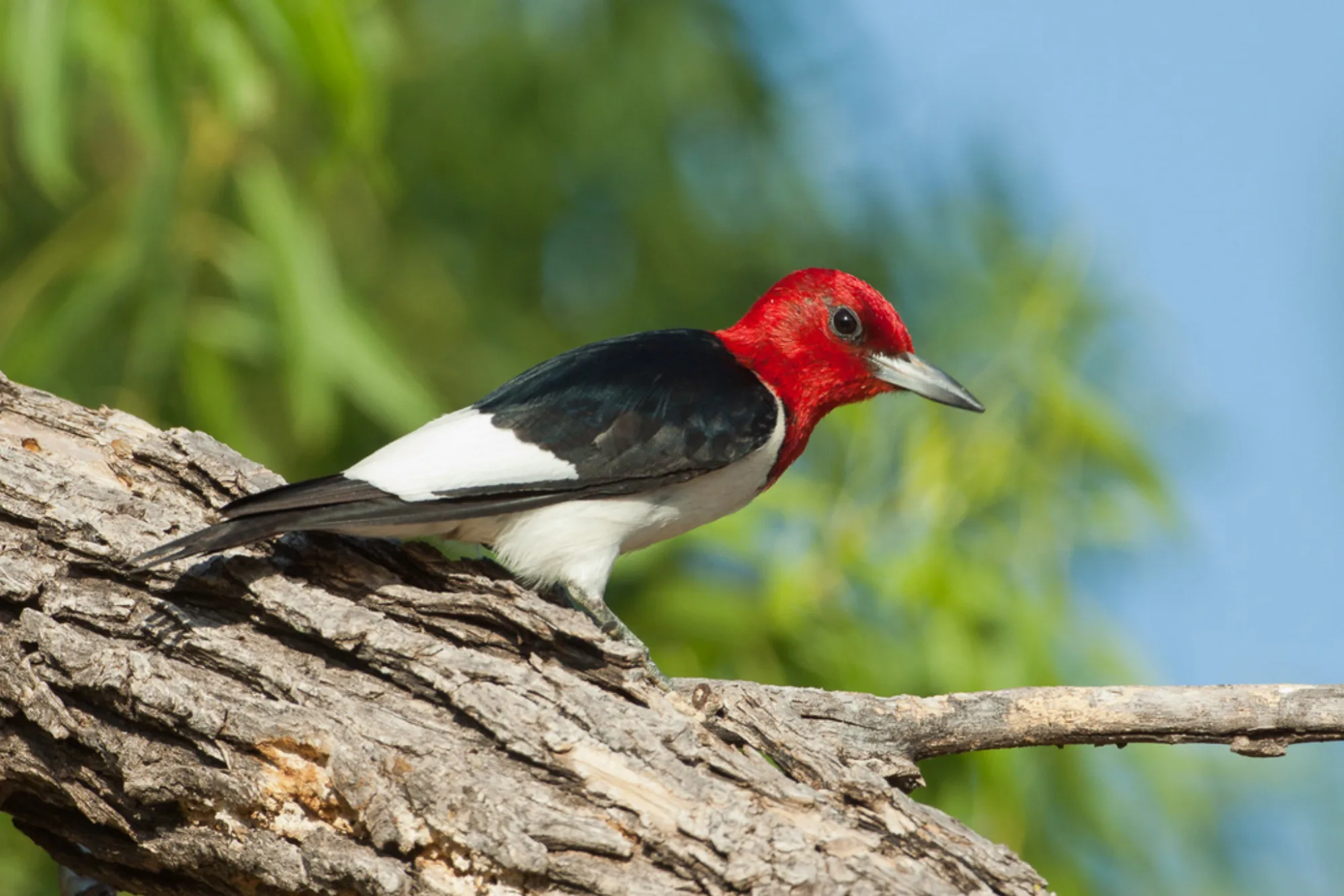
A crimson head and neck make the adult Red-headed Woodpecker easy to pick out: its back and tail are black, while its belly and rump are white. Its black wings have white patches, and a perched bird shows a triangular white patch on its lower back. Males and females look alike, but young birds have grey heads. This mid-sized woodpecker lives in temperate North America, where it breeds in open landscapes from southern Canada through the east-central United States. Across much of its range, it uses land heavily altered by people. Northern birds typically begin moving south for winter by late October, and migrants return by late April; birds in the south are less likely to migrate.
Listen for its tchur-tchur call or the sound of drumming within its territory. Its varied diet includes insects, seeds, fruit, berries and nuts, as well as occasional small rodents and other birds' eggs. It stores food in tree cavities, crevices and beneath bark, keeping supplies available throughout the year. Nesting sites are usually in dead trees or utility poles, and both parents excavate a cavity if one is needed. The female lays a clutch of four to seven white eggs in early May, and both parents care for the young after they hatch. The young usually leave the nest after 27 to 31 days, and a pair can raise two broods in a season. Habitat loss threatens the species, including the loss of standing dead wood needed for nest sites. Limited food and competition for nesting cavities, including from European starlings, are also linked to its decline.
Written from the English Wikipedia article Red-headed woodpecker (CC BY-SA 4.0).
- Records
- 591,332
- Countries
- 2
- Atlas places
- 1
These are open occurrence records, so they show where people looked for and recorded the Red-headed Woodpecker as much as where it lives. Cells are up to 25 km across, and every location is generalised to its cell.
Generalised encounter areas, not exact locations. Each shape is a grid cell coloured by how likely the species is there.
- Very likelyUnited States25 km zone · high confidence · 572992 records · updated 80 days ago
- Very likelyCanada25 km zone · high confidence · 18340 records · updated 80 days ago
Conservation status not assessed here yet, so every location is generalised to its grid cell.