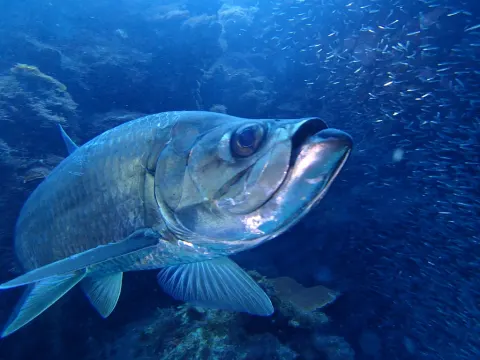
Tarpon
Megalops atlanticus
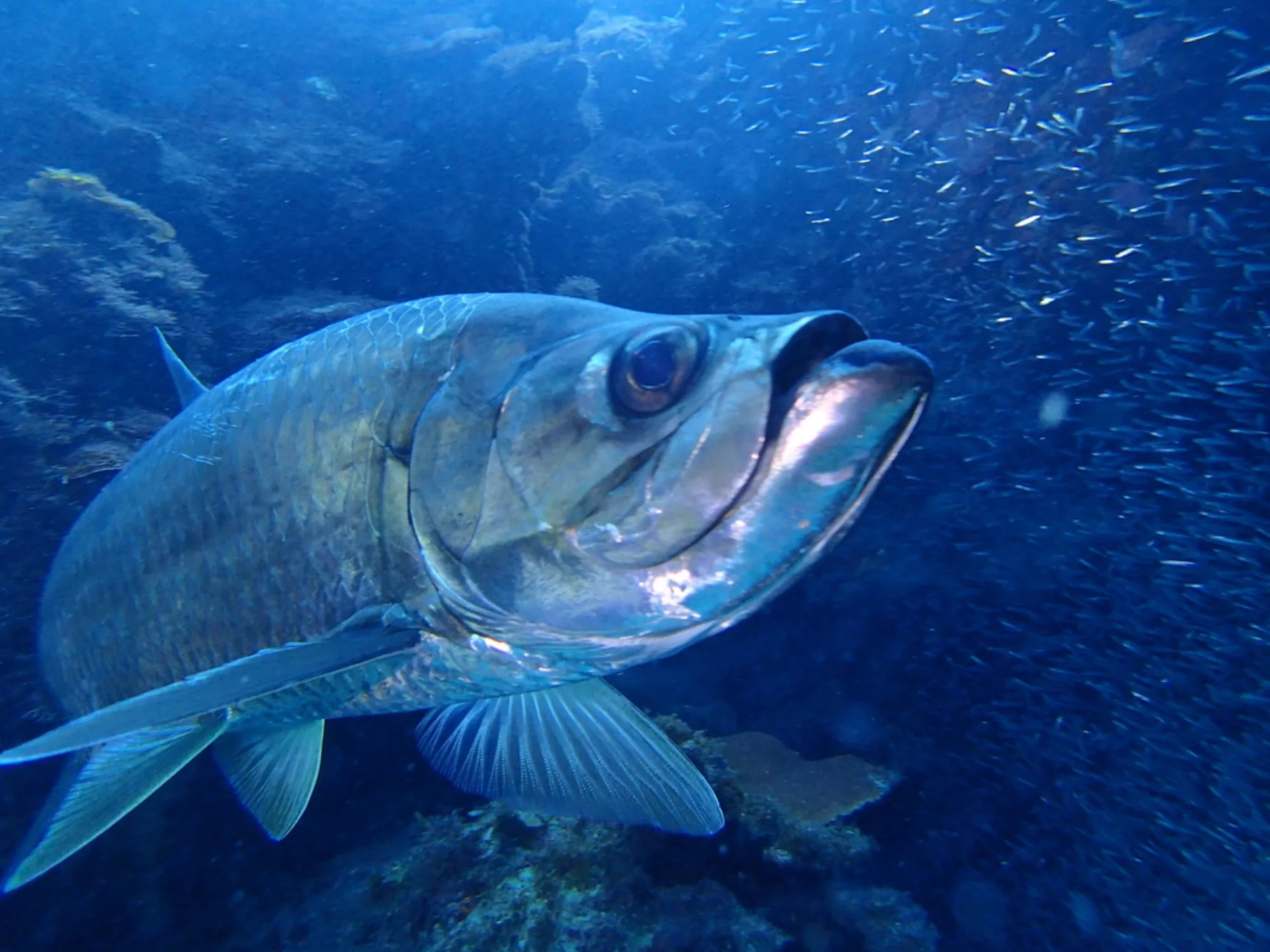
Known to anglers as the silver king, the Tarpon is a large, ray-finned fish with impressive scales and a reputation for acrobatics. It has a greenish or bluish back, silver sides and a large, upward-facing mouth. One long ray on its dorsal fin reaches almost to the tail. The largest recorded measurements are 2.5 m in length and 161 kg in weight. When hooked, they can make spectacular leaps from the water, one reason they are prized by recreational anglers.
Tarpon live on both sides of the Atlantic, mostly in tropical and subtropical waters, with reports ranging north to Nova Scotia and southern France and south to Argentina. They use coastal waters, estuaries, lagoons and rivers, and tolerate a wide range of salinity. They can also cope with boat traffic and poor water quality, and around people they are mainly active at night. Highly migratory, they cross international boundaries, and schools have travelled through the Panama Canal between the Atlantic and Pacific. Costa Rica also has an established population on its Pacific side. Adults feed mainly on fish, crabs and shrimp, while juveniles take zooplankton and other small prey. Tarpon can fill their swim bladder with air, giving them an advantage as predators when oxygen in the water is scarce.
Breeding fish gather to spawn in the open ocean. Young fish move inshore, often into stagnant, oxygen-poor water that many of their predators cannot tolerate, before moving to nearshore habitats at about three years old. Sharks and humans are their most significant predators, and fishing poses a threat: tarpon are targeted by recreational anglers and caught in subsistence and commercial fisheries.
Written from the English Wikipedia article Atlantic tarpon (CC BY-SA 4.0).
- Records
- 56,828
- Countries
- 25
- Atlas places
- 1
These are open occurrence records, so they show where people looked for and recorded the Tarpon as much as where it lives. Cells are up to 25 km across, and every location is generalised to its cell.
Generalised encounter areas, not exact locations. Each shape is a grid cell coloured by how likely the species is there.
- Very likelyColombia25 km zone · high confidence · 56055 records · updated 80 days ago
- Very likelyUnited States25 km zone · medium confidence · 517 records · updated 80 days ago
- Very likelyMexico25 km zone · medium confidence · 57 records · updated 80 days ago
- Very likelyCaribbean Netherlands25 km zone · medium confidence · 43 records · updated 80 days ago
- Very likelyPuerto Rico25 km zone · medium confidence · 43 records · updated 80 days ago
- Very likelyU.S. Virgin Islands25 km zone · medium confidence · 30 records · updated 80 days ago
- Very likelyCayman Islands25 km zone · medium confidence · 25 records · updated 80 days ago
- LikelyGuadeloupe25 km zone · medium confidence · 19 records · updated 80 days ago
- LikelyBelize25 km zone · medium confidence · 15 records · updated 80 days ago
- LikelyFrench Guiana25 km zone · medium confidence · 10 records · updated 80 days ago
Conservation status not assessed here yet, so every location is generalised to its grid cell.